
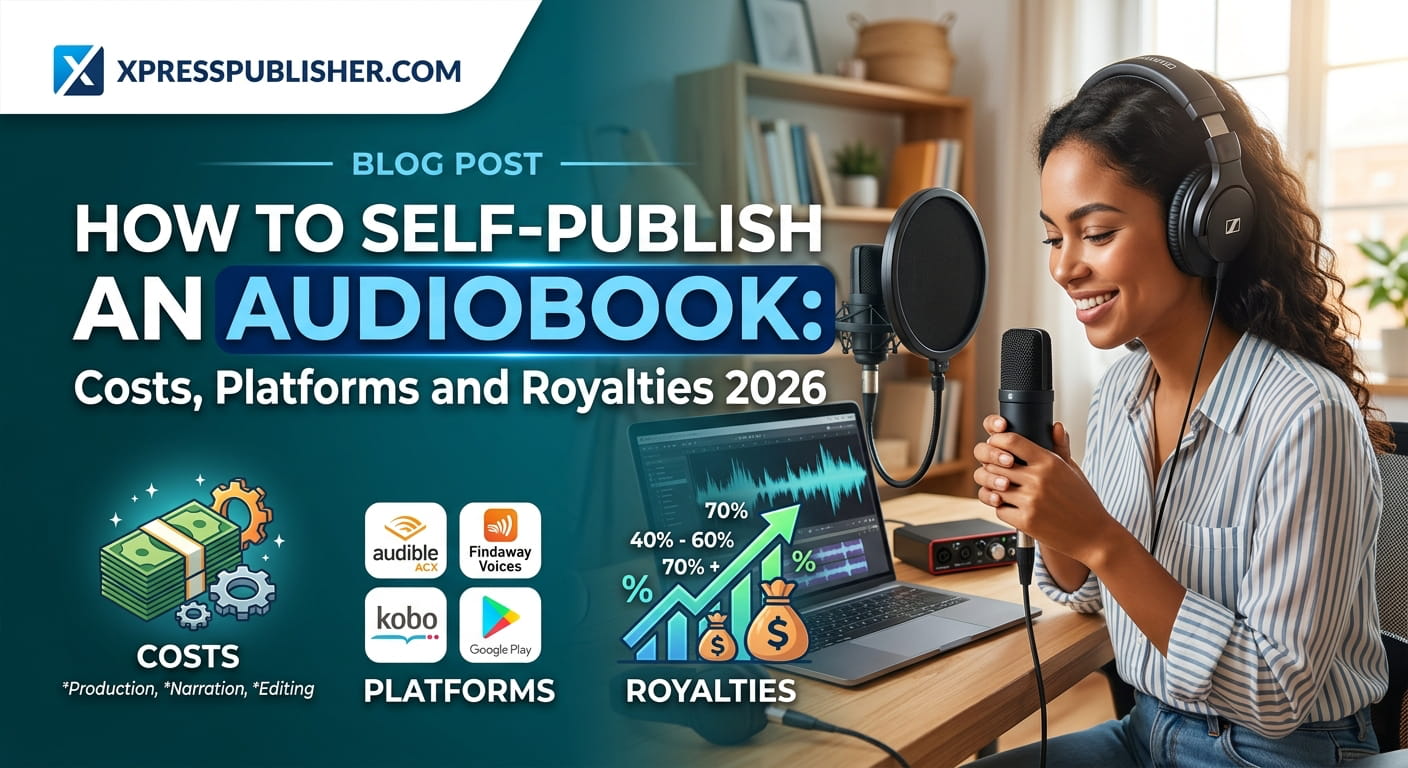
An audiobook is not a lesser version of your print book. It’s a separate product reaching a distinct audience through a different medium, generating independent royalty income from the same manuscript you’ve already written. The production cost is paid once. The royalties from Audible, Spotify, Apple Books, and 40+ other platforms then run for the lifetime of the book.
Self publish audiobook revenue has grown faster than any other format in publishing. Audiobook sales reached $2.22 billion in 2024 and grew 13% in that year alone — returning to double-digit growth after a brief slowdown. This guide covers the full process: how to produce your audiobook, what it costs across three different production approaches, which platforms to use, and what royalty rates to expect.
The Three Ways to Produce Your Audiobook
Before choosing a distribution platform, you need a finished audio file that meets technical specifications. There are three distinct production routes, each with different costs, timelines, and quality ceilings.
Option 1: Self-Narration
You record the audiobook yourself. This is the most cost-effective option and preserves your authentic author voice — a genuine advantage for nonfiction authors, memoirists, and personal brand writers where readers expect to hear the author. The trade-off is technical: you need a quiet recording space, a good microphone, and either editing skills or money to pay an audio editor to clean up the files.
Equipment minimums: a USB condenser microphone ($80–$200), acoustic treatment for your recording space (a closet full of clothes works surprisingly well), and audio editing software (Audacity is free; Adobe Audition is professional-grade). ACX requires very specific technical standards — 192kbps MP3 or 256kbps AAC, -23 LUFS average loudness, -3dB peak — and files that don’t meet them will be rejected and require correction.
Option 2: Professional Human Narrator
You hire a professional voice actor to narrate the book. This produces the highest quality output and is the standard approach for commercial fiction and full-length nonfiction. ACX maintains a marketplace of narrators where you can post your project, receive auditions, and hire directly. Voices by INaudio (formerly Findaway Voices) also has a casting ecosystem.
Professional narrators typically charge per finished hour (PFH) of audio. Industry rates run $150–$400 PFH for established professionals. A 60,000-word book produces approximately 6 hours of finished audio. Consequently, professional narration for a typical novel costs $1,500–$2,500 at standard rates and $2,500–$6,000 for high-demand narrators.
ACX offers a royalty share option where a narrator records for no upfront fee in exchange for a 50% royalty split for seven years. This eliminates upfront cost but is expensive in the long run for any book that sells well. Additionally, it locks your audiobook into ACX exclusivity for the duration of the contract.
Option 3: AI Narration
AI narration has improved dramatically. Both ACX and Voices by INaudio now accept AI-narrated audiobooks, provided authors disclose the use of AI narration during the publishing process — the same disclosure model as AI-generated ebooks. ElevenLabs, Narration Box, and similar services produce broadcast-quality AI voices in hours, at a fraction of professional narration costs.
The trade-off: AI narration currently lacks the emotional range, pacing intuition, and character differentiation that experienced human narrators deliver. For nonfiction, self-help, and instructional content, AI narration performs well. For fiction with multiple characters, emotional scenes, or complex pacing, human narration produces meaningfully better listener experiences — and listener experience directly affects reviews and completion rates, both of which affect algorithmic visibility on Audible.
What It Costs to Self-Publish an Audiobook
| Production method | Typical cost for a ~6-hour audiobook | Timeline | Best for |
|---|---|---|---|
| Self-narration | $200–$800 (equipment + editing) | 2–6 weeks depending on your pace | Nonfiction, memoir, personal brand authors |
| Professional narrator (paid upfront) | $1,500–$6,000 | 4–8 weeks production | Fiction, full-length nonfiction, premium quality |
| AI narration | $50–$200/month subscription | Hours to days | Nonfiction, instructional, high-volume publishing |
| ACX royalty share | $0 upfront (50% royalty for 7 years) | 4–8 weeks production | Authors who cannot afford upfront costs — expensive long-term |
The Audiobook Platforms: Where to Self-Publish
Two platforms handle the vast majority of self-published audiobook distribution. Understanding both — and how they work together — determines your royalty strategy.
ACX (Audible Creation Exchange)
ACX is Amazon’s audiobook publishing platform. It distributes to Audible, Amazon, and Apple Books/iTunes. Audible is the dominant audiobook marketplace, with the largest subscriber base of any single platform.
Royalty rates on ACX depend on one decision: exclusive or non-exclusive distribution.
- Exclusive distribution (Audible, Amazon, Apple Books only): 40% royalty rate. You cannot distribute your audiobook to any other platform during the exclusivity period.
- Non-exclusive distribution: 25% royalty rate. You retain full freedom to publish on other platforms simultaneously.
The 15% royalty difference sounds significant. In practice, the revenue from Voices by INaudio’s 40+ platform network frequently offsets or exceeds that difference. The 7-year exclusivity lock-in ACX uses for royalty-share narrator contracts is a meaningful commitment in a rapidly evolving market. For most authors, non-exclusive is the strategically safer choice.
Voices by INaudio (formerly Findaway Voices)
Voices by INaudio is the rebrand of Findaway Voices that took effect in August 2025, when the original Findaway team reacquired the platform from Spotify. It remains the primary wide-distribution aggregator for indie audiobooks, and the name change has created some confusion in the market — many guides still refer to it as Findaway Voices.
Voices by INaudio distributes to 40+ platforms: Spotify, Kobo, Scribd, Google Play Books, OverDrive, Hoopla, Libro.fm, Audiobooks.com, Apple Books, and international storefronts. Royalty rates average approximately 80% net to the author (the platform takes 20% after retail stores take their cut). No exclusivity is required. Both human-narrated and AI-narrated audiobooks are accepted, with AI disclosure required.
Additionally, Voices by INaudio has a direct ElevenLabs integration for AI narration, making it a natural home for AI-produced audiobooks that want wide distribution.
Platform Comparison at a Glance
| Platform | Distributes to | Author royalty | Exclusivity | AI narration |
|---|---|---|---|---|
| ACX (exclusive) | Audible, Amazon, Apple Books | 40% | Required | Yes (disclosure required) |
| ACX (non-exclusive) | Audible, Amazon, Apple Books | 25% | None | Yes (disclosure required) |
| Voices by INaudio | Spotify, Kobo, Scribd, OverDrive, Hoopla, 40+ platforms | ~80% net | None required | Yes (disclosure required) |
| Direct sales (Gumroad, Payhip, BookFunnel) | Your own audience | 90%+ after processing fees | None | Yes |
The Recommended Strategy for Most Self-Published Authors
The optimal setup for most indie authors: submit to ACX non-exclusively (earning 25% on Audible, Amazon, and Apple Books) and simultaneously submit to Voices by INaudio (earning approximately 80% net on 40+ other platforms).
Specifically, this gives you access to Audible’s unmatched subscriber base without surrendering the right to distribute on Spotify, Kobo, Scribd, and library platforms. The combined income from both channels typically exceeds what exclusive ACX distribution would generate, and you retain full flexibility if platforms shift or new ones emerge.
The only exception worth considering: if your book is fiction in a genre with strong Audible/Whispersync integration and you genuinely believe the 15% premium is worth more than all other platforms combined. For most nonfiction and for most authors building a long-term catalogue, going wide wins.
How to Self-Publish an Audiobook: The Process Step by Step
Step 1: Prepare your manuscript for narration. Review your text for anything that reads poorly aloud — abbreviations, technical formatting, footnotes, URLs. Create a pronunciation guide for character names, place names, and technical terms. Send this to your narrator (or use it yourself).
Step 2: Produce your audio files. Each chapter is typically a separate audio file. All files must meet technical specifications: consistent room tone, no background noise, proper loudness levels, correct file format. Check ACX’s current technical requirements before finalising production.
Step 3: Create your ACX account and claim your title. Go to acx.com, create an account, and search for your book’s ISBN to claim the audiobook rights. Important: claim your title immediately after your print or ebook is published, even if you’re not ready to produce. This prevents someone else from claiming the rights to narrate it.
Step 4: Upload and submit to ACX. Upload your audio files, cover image (square format, at least 2400×2400 pixels), and complete your title details. Choose exclusive or non-exclusive distribution. ACX review typically takes 7–14 business days.
Step 5: Submit to Voices by INaudio. Create an account at voicesbyinaudio.com and submit your finished audio files for wide distribution. The process is straightforward and they provide a detailed checklist of submission requirements.
For a complete overview of how audiobooks fit into the self-publishing production timeline, see our 25-step self-publishing checklist and our breakdown of self-publishing income by format. If you’d like professional support with the broader publishing setup including ebook, print, and audio distribution, XpressPublisher’s publishing packages are available for authors in the US and UK.
Frequently Asked Questions About Self-Publishing an Audiobook
How much does it cost to self-publish an audiobook?
The cost of self-publishing an audiobook depends on your production method. Self-narration with your own equipment costs $200–$800 for a typical book. Hiring a professional narrator costs $1,500–$6,000 depending on the narrator’s rate and the book’s length. AI narration tools cost $50–$200 per month in subscription fees. The ACX royalty share option costs nothing upfront but commits 50% of royalties to the narrator for seven years. Platform distribution through ACX and Voices by INaudio is free — platforms take a percentage of each sale rather than charging upfront fees.
What is Voices by INaudio and is it the same as Findaway Voices?
Voices by INaudio is the current name for what was previously Findaway Voices. In August 2025, the original Findaway team reacquired the platform from Spotify and rebranded it as Voices by INaudio. The service functions the same way: it distributes audiobooks to 40+ platforms including Spotify, Kobo, Scribd, OverDrive, Hoopla, Apple Books, and international retailers. It remains the primary wide-distribution aggregator for indie audiobooks. Many guides still refer to it by the old name, which can cause confusion when setting up accounts.
Should I use ACX exclusively or go wide for audiobook distribution?
For most indie authors, going wide is the better long-term strategy. Submit to ACX non-exclusively (earning 25% on Audible, Amazon, and Apple Books) and simultaneously to Voices by INaudio (earning approximately 80% net on 40+ other platforms). The 15% royalty difference between exclusive and non-exclusive ACX rates is typically offset by income from Spotify, Kobo, Scribd, OverDrive, and the other platforms Voices by INaudio reaches. Going wide also preserves flexibility as the audiobook market evolves and new platforms gain traction.
Can I use AI to narrate my audiobook?
Yes. Both ACX and Voices by INaudio accept AI-narrated audiobooks, provided you disclose the use of AI narration during the publishing process. The disclosure requirement is similar to KDP’s AI content policy for ebooks: declare AI-generated content honestly; the disclosure does not appear publicly to listeners. AI narration works best for nonfiction, instructional content, and self-help books. For fiction with multiple characters and emotional scenes, human narration typically produces better listener experiences and higher completion rates.
How long does it take to self-publish an audiobook?
Production time varies by method: AI narration can produce finished files in hours to days; self-narration typically takes 2–6 weeks depending on your schedule and editing pace; professional narrators usually take 4–8 weeks from project acceptance to final files. After files are submitted, ACX review takes 7–14 business days. Voices by INaudio distribution setup takes 1–3 business days. In total, most authors should budget 6–12 weeks from the decision to produce an audiobook to having it live on all platforms.
How much do self-published authors earn from audiobooks?
Audiobook royalties for self-published authors: 40% of list price through ACX exclusive distribution, 25% non-exclusive. Approximately 80% net through Voices by INaudio after retailer and platform cuts. Audiobooks are typically priced 2–3x higher than the ebook equivalent, which offsets the lower percentage royalty. An audiobook priced at $19.99 on Audible generates approximately $8.00 per sale (non-exclusive ACX) or $8.00 from other platforms at 80% net at an equivalent price point. Authors who release simultaneously in ebook, print, and audio format from launch day consistently generate more total income than those releasing formats sequentially.