
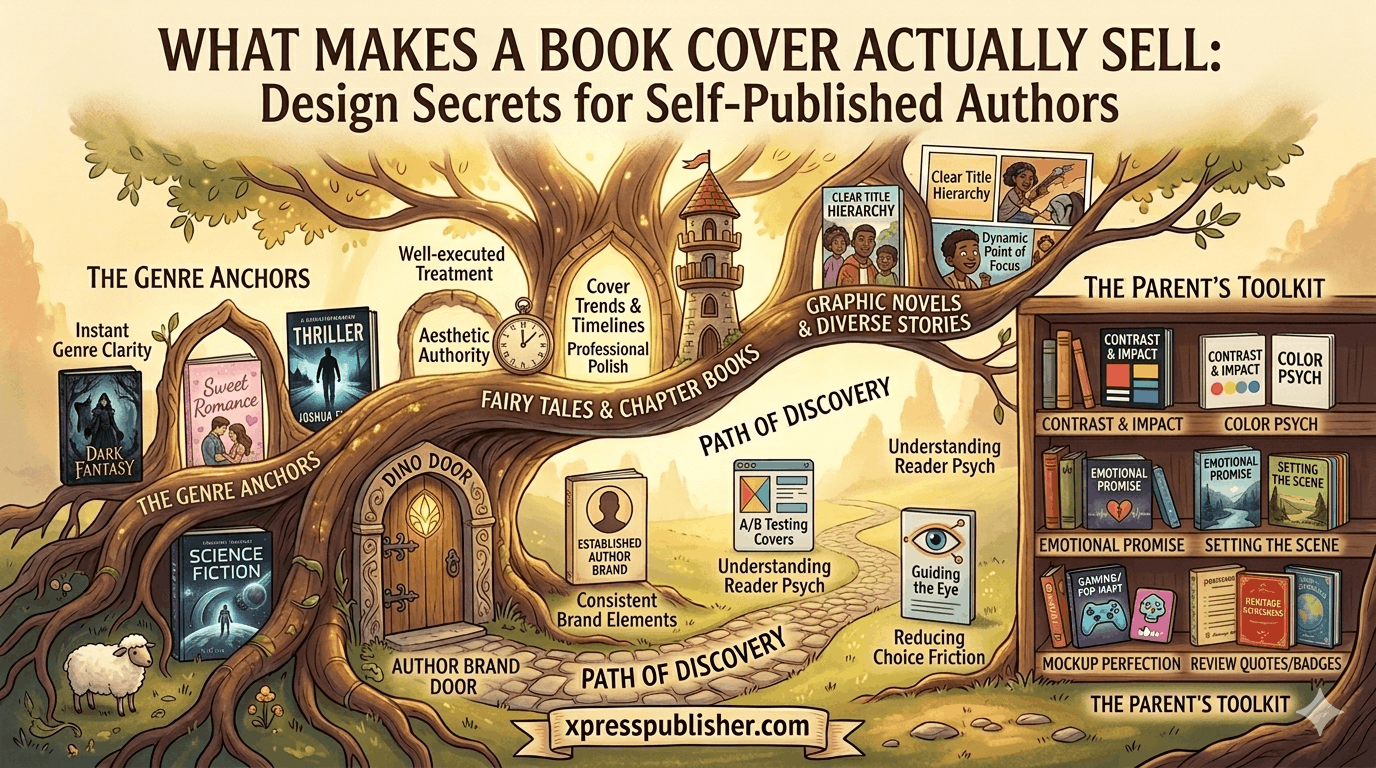
Book cover design is one of the most important decisions a self-published author makes, and also one of the most underestimated. When a reader finds your book on Amazon, they see a small thumbnail sitting next to dozens of competing titles. On BookTok it is a visual in a three-second scroll. In a bookstore, it is the first thing someone picks up or walks past. Getting book cover design right is not optional. It is the difference between a book that gets clicked and one that gets ignored.
Table of contents
- The book cover design genre signal problem
- How to research what works in your genre
- The thumbnail test every cover must pass
- Book cover design pricing at every level
- Why fonts matter in book cover design
- Five common book cover design mistakes
- How to brief your designer
- Frequently asked questions
The book cover design genre signal problem
The most important function of book cover design is not to be beautiful. It is to signal to the right reader, instantly, that this book belongs in a genre they enjoy. Readers in every category have built up strong visual ideas about what books look like. Most of them do not think through a cover consciously. They simply know whether it feels right or it does not.
A thriller reader scanning Amazon expects dark colours, high contrast, and a sense of tension in the pictures. Romance readers look for warm tones, a certain type of font, and images that suggest the emotional feeling of the relationship. Fantasy readers expect detailed drawn art or dramatic scenes. Business non-fiction readers expect clean layout, bold fonts, and nothing that looks like it belongs in the fiction section.
When a cover gets this wrong, readers do not know why they scrolled past it. The book never got a chance. This is the single most common mistake in self-published book cover design: a cover the author loves but one that does not speak the visual language of its genre.
How to research what works in your genre
Go to Amazon and search for your genre. Look at the top 20 bestsellers and study the covers carefully. What colours appear often? What types of pictures are used? What font style? How big is the author name compared to the title?
You are not looking to copy anyone. Instead, you are learning the visual rules of your genre so that your cover fits naturally within them. A cover that stands out by being completely different from everything else in the genre is almost always a mistake. Readers use those visual cues as a filter, and a cover that ignores them gets filtered out.
This research step takes about an hour and is the most useful thing you can do before briefing a designer. Authors who skip it almost always end up with extra revision rounds while they try to work out why the first concepts do not feel right.
The thumbnail test every cover must pass
Before you approve any book cover design, look at it as a thumbnail. Shrink it to the size it will appear on an Amazon search results page, roughly 100 by 160 pixels on most screens. Is the title readable? Is there a clear focal point? Does it still look like a book from your genre?
Many covers look impressive at full size and completely fall apart when shrunk down. Text becomes hard to read. Images turn muddy and unclear. When this happens the cover loses its identity entirely. If it does not work as a thumbnail, it does not work for online retail, which is where most book sales happen.
The practical way to run this test is to open Amazon, search for the top ten books in your specific category, take a screenshot of the search results page, and place your cover file at the same size in the same row. If it looks like it belongs there, you are close. If it looks out of place, that is the feedback you need before going back to the designer.
Book cover design pricing at every level
Pre-made covers from stock sites start around $50 to $150. They are created in advance without knowing your specific book and are often bought by more than one author. Pre-made covers work as a short-term option or for authors testing a genre before fully committing. However, you have no ability to change the visual direction beyond swapping in your title and name.
Custom book cover design from freelance designers ranges from $150 to $800 depending on experience and what is included. Quality varies a great deal in this range. The gap between a $150 cover and a $500 cover from the right designer is often huge. Review portfolios carefully and make sure the designer has real experience in your genre, not just in design in general.
A top designer with a strong portfolio and publishing experience typically charges $500 to $1,200 for a custom cover. This is not too much for a book you have spent months or years writing. The cover is the first marketing spend your book ever makes, and getting it wrong costs far more than getting it right. For a full breakdown of where book cover design fits in your overall budget, read our guide on how much it costs to self-publish a book in 2026.
Why fonts matter in book cover design
The font choice on your cover carries real meaning. Script fonts signal romance, warmth, and softness. Heavy block fonts are used for thrillers, action stories, and modern fiction. Classic serif fonts suggest literary quality, historical stories, or serious non-fiction. Using a font that goes against your genre sends a confusing message to readers, even when they cannot explain exactly what feels off.
Your title also needs to be easy to read when the cover is small. Fancy fonts that look good at large sizes often become impossible to read at the small size most readers will first see your cover. When in doubt, easy to read always beats fancy.
For more on preparing your book files alongside the cover, read our complete guide to manuscript formatting for self-published authors.
Five common book cover design mistakes self-published authors make
Designing for personal taste rather than genre. Your readers are not buying the cover for you. They are using it to decide whether the book is for them. A cover built around the author’s own preferences rather than the genre’s visual rules will not perform well.
Too much text on the cover. A book cover needs your title and your name. It does not need a subtitle, a series label, a tagline, a blurb, and a reviewer quote all fighting for space. Every extra element reduces visual clarity and makes the cover harder to read when small.
Skipping the print version setup. Print covers include a spine and back cover sized to your page count and trim size. Authors who only design for ebook and then try to adapt for print often end up with files that do not meet the required specs and have to redo part of the cover.
Not briefing the designer clearly. A vague brief produces vague results. The clearer your genre, target reader, and reference covers are, the fewer rounds of changes you will need. Most extra rounds happen because the brief was not clear enough at the start.
Picking a designer with no genre experience. A designer who is great at branding or marketing work may not know the specific visual rules of romance or thriller or children’s books. Always check that their past work includes covers in your specific genre before hiring.
For more on where book cover design fits in the full publishing process, read our guide on how to get your book on Amazon and our overview of whether self-publishing is worth it in 2026.
How to brief your designer for great book cover design
A strong brief is the single most useful thing you can do to get a great cover on the first try rather than the third. Here is what a good book cover design brief should include.
Your genre and the specific type within it. Not just thriller, but psychological thriller or action thriller. The specific type is where the visual rules live and where your designer needs to focus.
Three to five reference covers you want yours to compete with visually. Rather than asking the designer to copy them, you are showing them the visual space your book needs to sit in. This is the most useful piece of information a brief can contain.
One or two things you want to avoid. Knowing what you do not want is just as helpful to a designer as knowing what you do want, so be specific rather than vague.
A short note on the book’s tone and main conflict. Not the full blurb, just enough for the designer to understand what the book delivers so they can make choices that match its identity and not just its genre label.
Frequently asked questions about book cover design
How much does professional book cover design cost?
For a custom professional cover, expect to pay $300 to $800 for a freelance designer with a strong portfolio in your genre. Full-service publishing companies typically charge $400 to $1,000, but that price includes the benefit of having design, formatting, and publishing managed as one package. Pre-made covers in the $50 to $250 range work well for standard genre titles on tighter budgets.
Can I design my own book cover?
You can, and tools like Canva make it easier than it used to be. However, most self-designed covers are easy to spot as self-designed because the genre signals are off or the fonts are wrong for the category. If budget is the issue, a well-chosen pre-made cover from a professional designer is a better option than designing it yourself in most cases.
Does book cover design actually affect sales?
Yes, significantly. Most book discovery on Amazon happens through search results where readers see covers before anything else. A cover that does not connect with its target reader at small size produces a lower click rate, which means fewer people read the blurb and fewer people buy, regardless of how good the book actually is.
What size should a book cover be for Amazon KDP?
Amazon KDP recommends a cover image of at least 2,560 pixels on the longest side with an ideal ratio of 1.6:1 height to width. Print covers are sized differently depending on your trim size and page count. Your designer should be able to work out the exact print cover size once your interior file is ready.
How many rounds of changes should I expect?
Most professional cover designers include two to three rounds of changes in their standard package. If you need more rounds than this, it usually means the brief was not clear enough at the start. A well-briefed designer should be close to the final result by the second round.
At XpressPublisher, our design team produces custom book covers for authors across fiction, non-fiction, biography, children’s books, and more in the USA and UK. Cover design is handled alongside interior formatting and publishing so everything is ready at the same time. View our work in the XpressPublisher portfolio or get a free proposal for your book today.
Call 805-635-2324 (USA) or +44 784 689 5422 (UK). Email info@xpresspublisher.com. Rated 4.2 Great on Trustpilot.