
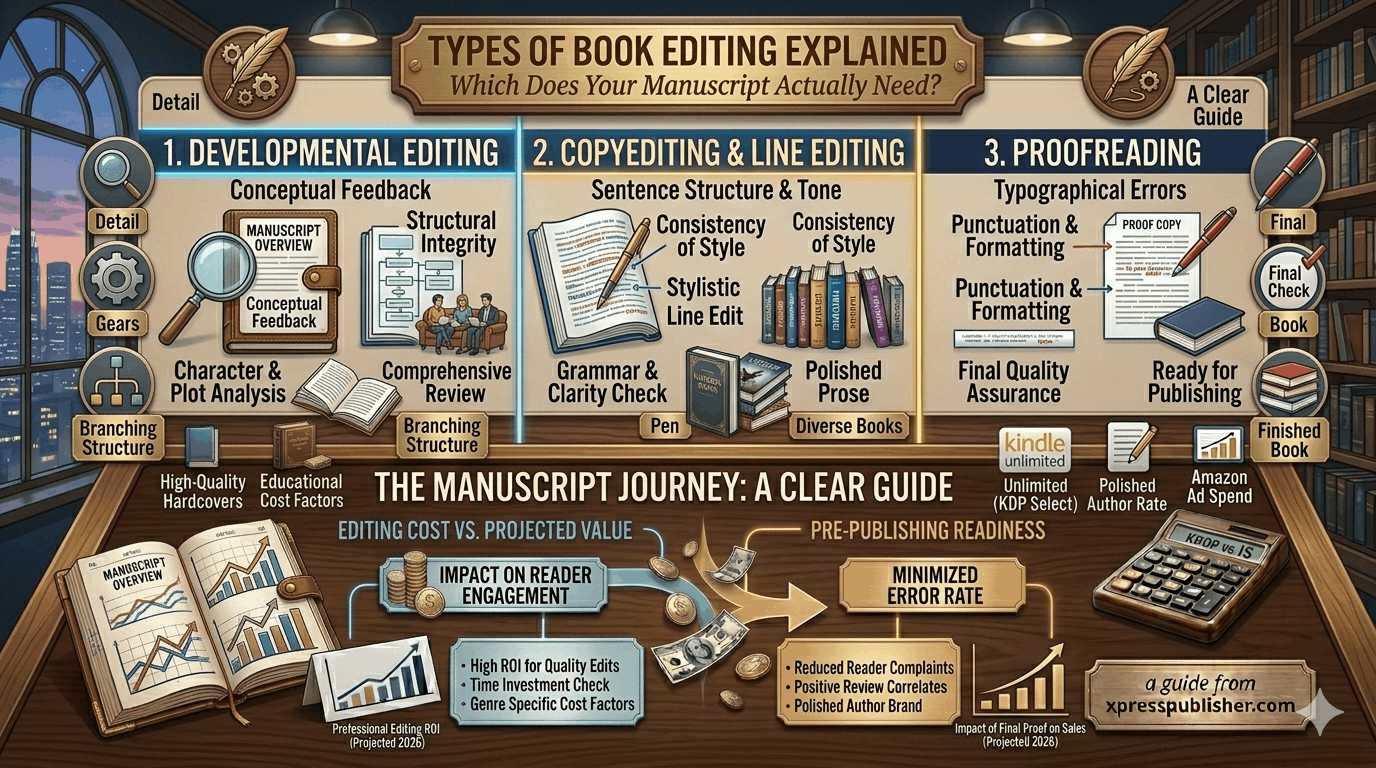
The types of book editing are one of the most misunderstood parts of the publishing process. Many first-time authors send their manuscript to a proofreader when they actually need a developmental editor. Others pay for a full structural edit when copy editing is all they require. Understanding the difference between each type of editing — what it covers, what it costs, and when you need it — prevents wasted money and produces a better book. Here is the complete breakdown.
The 4 Main Types of Book Editing
Four distinct types of book editing address different layers of a manuscript — from big-picture structure down to individual word choices and punctuation. Furthermore, they happen in a specific order. You should never proofread a manuscript before structural editing is complete, because structural changes will invalidate the proofreading entirely.
Type 1 — Developmental Editing
Developmental editing (also called structural editing or substantive editing) addresses the highest level of your manuscript — its overall structure, argument, pacing, character development, plot logic, and narrative coherence. A developmental editor reads your entire manuscript and evaluates whether it works as a whole. Do the chapters flow in the right order? Does the argument build logically? Do the characters behave consistently?
Developmental editors typically deliver a long editorial letter — sometimes 10–20 pages — identifying the major issues and recommending solutions, along with inline comments throughout the manuscript. They do not fix your sentences. Instead, they tell you what needs restructuring, rewriting, cutting, or expanding at a fundamental level.
Developmental editing is the most expensive type of editing. Rates typically range from $0.03 to $0.09 per word, meaning a 90,000-word novel might cost $2,700 to $8,100. Consequently, it makes sense to invest in developmental editing before any other type of edit — fixing structure first saves you from paying a copy editor to polish prose you later cut entirely.
Not all books need developmental editing. Experienced writers with well-structured manuscripts can often go straight to copy editing. However, for first-time authors and complex manuscripts, developmental editing is almost always worth the investment.
Type 2 — Copy Editing
Copy editing addresses the sentence and paragraph level of your manuscript. A copy editor works through your text line by line, improving clarity, consistency, and flow without changing your voice or meaning. Copy editing covers grammar, syntax, word choice, sentence structure, repetition, continuity errors, and factual consistency. It also ensures your manuscript follows a consistent style guide — whether Chicago Manual of Style, AP, or a house style.
Copy editing is the type of editing most self-published authors mean when they say they want an “editor.” Every manuscript needs it before publication, regardless of genre or length. Rates typically range from $0.015 to $0.04 per word — roughly $1,350 to $3,600 for a 90,000-word novel.
Moreover, copy editing catches errors that slip through even after multiple author revisions — inconsistent character names, timeline contradictions, repeated words used too close together, and unclear pronoun references. A good copy editor improves readability significantly without making your writing feel like someone else wrote it.
Type 3 — Line Editing
Line editing sits between developmental editing and copy editing in scope. A line editor works at the sentence level but focuses on style, voice, and rhythm rather than strict grammar correction. Line editing tightens overwritten passages, strengthens weak verbs, varies sentence length for rhythm, and ensures the writing has energy and momentum throughout.
Some editors combine copy editing and line editing into a single service. Others offer them separately. For most self-published authors, a strong copy editor who also does light line editing is sufficient. However, if your manuscript’s prose style is central to its appeal — literary fiction, memoir, lyrical non-fiction — dedicated line editing before copy editing produces noticeably stronger results.
Type 4 — Proofreading
Proofreading is the final quality check before publication. A proofreader reads the fully formatted, publication-ready manuscript and catches any remaining errors — typos, punctuation mistakes, formatting inconsistencies, missing words, and layout problems that appear during typesetting. Proofreading is not editing. A proofreader does not rewrite sentences or suggest structural changes. They simply verify the final document is error-free.
Proofreading should always happen after formatting, not before — because the formatting process frequently introduces new errors. Rates are lower than other types of editing, typically $0.01 to $0.02 per word — approximately $900 to $1,800 for a 90,000-word novel. Above all, skipping proofreading is a false economy. Readers notice typos and formatting errors, and those errors affect reviews and professional credibility permanently.
Which Types of Book Editing Does Your Manuscript Need?
The answer depends on your experience level, your manuscript’s condition, and your budget. Here is a practical framework:
- First-time author, fiction: Developmental edit → Copy edit → Proofread
- Experienced author, well-drafted manuscript: Copy edit → Proofread
- Non-fiction with complex argument: Developmental edit → Copy edit → Proofread
- Memoir or literary fiction: Developmental edit → Line edit → Copy edit → Proofread
- Business book with clear structure: Copy edit → Proofread
At minimum, every book needs a professional copy edit and proofread before publication. Authors who skip editing to save money almost always regret it — negative reviews about editing quality are permanent and public on Amazon. For a full picture of what professional self-publishing costs, read our guide on how much it costs to self-publish in 2026.
How to Find the Right Editor for Your Book
Different editors specialise in different types of editing and different genres. A developmental editor who specialises in thrillers may not suit a children’s picture book. Always request a sample edit before committing — most professional editors will edit your first 1,000–2,000 words at a reduced rate so you can assess their approach before signing a contract.
Additionally, check that your editor has experience in your specific genre. Genre conventions vary enormously. An editor who works primarily in non-fiction may not understand the structural requirements of a fantasy novel. At XpressPublisher, our editorial team covers fiction, non-fiction, memoir, and children’s books. Get a free consultation to discuss what your manuscript needs.
For a practical guide to the full self-publishing process, also read our free self-publishing checklist for 2026 and our comparison of traditional vs self-publishing.
Frequently Asked Questions — Types of Book Editing
What are the different types of book editing?
The four main types of book editing are developmental editing (big-picture structure, plot, and argument), line editing (prose style and rhythm), copy editing (grammar, clarity, and consistency), and proofreading (final error check before publication). They happen in this order — structural issues first, surface errors last.
What is the difference between copy editing and proofreading?
Copy editing improves the manuscript at the sentence level — grammar, clarity, word choice, consistency, and flow — and happens before formatting. Proofreading is the final quality check after formatting, catching any remaining typos, punctuation errors, and layout issues introduced during typesetting. Proofreading does not rewrite or restructure — it simply verifies the final document is error-free.
Do I need developmental editing for my book?
Not every book requires developmental editing. First-time authors and complex manuscripts benefit most from it. Experienced authors with well-structured manuscripts can often go straight to copy editing. If you are unsure, ask a professional editor to review your first few chapters — a brief assessment quickly clarifies whether the manuscript needs structural work first.
How much do different types of book editing cost?
Developmental editing typically costs $0.03–$0.09 per word ($2,700–$8,100 for a 90,000-word novel). Copy editing costs $0.015–$0.04 per word ($1,350–$3,600). Line editing is similar in price to copy editing. Proofreading is the most affordable at $0.01–$0.02 per word ($900–$1,800). Rates vary by editor experience, genre, and manuscript condition.
In what order should I get my book edited?
Always edit from big-picture to small: developmental editing first, then line editing if needed, then copy editing, then proofreading after formatting. Never proofread before structural editing is complete — changes made during developmental editing will invalidate the proofreading and waste your money.