
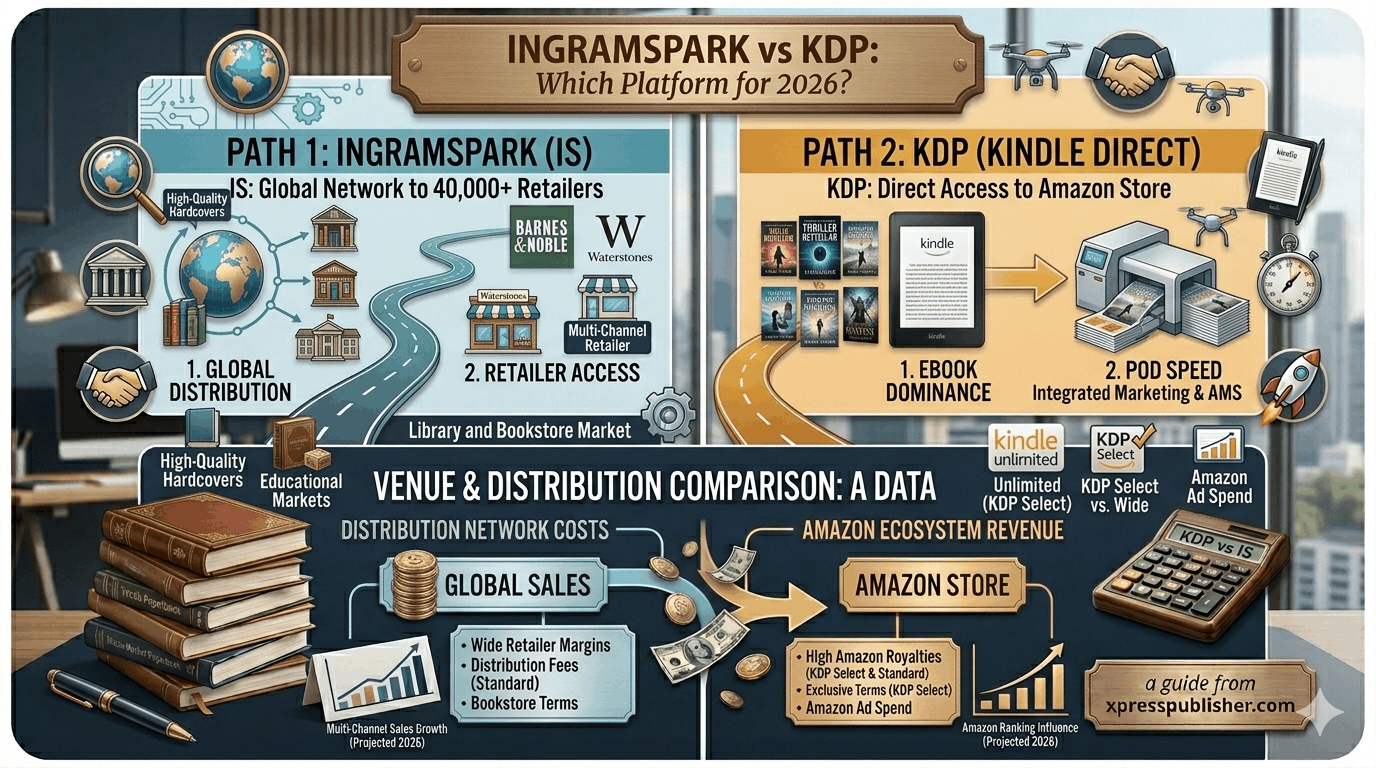
IngramSpark vs KDP is the most important distribution decision most self-published authors face in 2026. Each platform lets you publish your book and sell it to readers worldwide. Neither charges you to get started. Well-established and widely used by professional indie authors, both are legitimate publishing routes. However, they work differently, pay differently, reach different markets, and serve different publishing goals. Understanding exactly how each one works will save you time, money, and frustration.
IngramSpark vs KDP: What Each Platform Actually Does
Amazon KDP (Kindle Direct Publishing) is Amazon’s self-publishing platform. When you upload your book to KDP, it becomes available on Amazon.com, Amazon.co.uk, and other Amazon marketplaces globally. KDP also powers Kindle ebooks, Kindle Unlimited, and Amazon’s print-on-demand paperback service. Because Amazon accounts for roughly 60–70% of all ebook sales in the USA and UK, KDP alone reaches the majority of the self-published book market.
IngramSpark is a publishing and distribution platform owned by Ingram Content Group — the largest book distributor in the world. When you publish through IngramSpark, your book joins Ingram’s global distribution network of more than 40,000 retailers, libraries, schools, and wholesalers worldwide. This includes independent bookstores, Barnes & Noble, Waterstones, library systems, and academic distributors. Furthermore, IngramSpark supports both print-on-demand paperbacks and hardcovers, as well as ebook distribution to non-Amazon platforms.
IngramSpark vs KDP: Royalties and Earnings Compared
Royalties work very differently on each platform. On KDP, you earn 70% royalties on ebooks priced between $2.99 and $9.99, and 35% on ebooks outside that range. For print books, KDP pays 60% of your list price minus the printing cost. For a $14.99 paperback, the printing cost for a standard 300-page black-and-white book is approximately $3.85. That leaves you with around $5.14 per copy sold on Amazon directly.
On IngramSpark, you set both your list price and your trade discount — the percentage you give to retailers. Your earnings equal your list price minus the trade discount minus the printing cost. Consequently, if you set a $14.99 list price with a 40% trade discount, the retailer receives $6.00 and you net roughly $3 to $5 per copy. IngramSpark’s per-copy earnings are lower because retailers take a bigger cut — but in return, your book reaches far more retail channels than KDP alone provides.
For a complete breakdown of what self-publishing actually earns, read our guide on how self-publishing royalties actually work.
IngramSpark vs KDP: Bookstore Distribution
This is the most important difference between the two platforms. KDP distributes exclusively through Amazon channels. Independent bookstores, library systems, and non-Amazon retailers generally do not order books from Amazon’s distribution network for competitive and logistical reasons.
IngramSpark, by contrast, is the preferred distribution source for independent bookstores and libraries worldwide. If you want physical bookstore stocking, library orders, or non-Amazon retail availability, IngramSpark is the only practical route for self-published authors. However, bookstores require specific terms — at least a 40% trade discount and a returnable setting. Both are straightforward to set in IngramSpark, though they do reduce per-copy earnings.
IngramSpark vs KDP: Ebook Distribution
For ebooks, KDP gives you direct access to Amazon’s Kindle store and Kindle Unlimited. If you enrol in KDP Select, you access KU’s subscriber base — substantial in romance, fantasy, thriller, and genre fiction — but your ebook must stay exclusive to Amazon for the 90-day enrolment period.
IngramSpark distributes ebooks to non-Amazon platforms including Apple Books, Kobo, Barnes & Noble Nook, Scribd, and library lending systems. That said, most authors use Draft2Digital for wide ebook distribution instead, reserving IngramSpark specifically for print. Additionally, read our guide on audiobooks for indie authors if you plan to expand into audio alongside print and ebook.
IngramSpark vs KDP: Cost and Setup
KDP is completely free. There are no setup fees, no annual fees, and no per-title charges. You upload your files, set your price, and your book goes live. This makes KDP the natural starting point for most first-time authors.
IngramSpark charges a one-time title setup fee of $49 for a print book and $25 for an ebook as of 2026. However, promotional codes from the Alliance of Independent Authors frequently waive these fees. Moreover, IngramSpark charges a small fee for file revisions after initial setup — so upload final, fully proofed files from the start.
Which Authors Should Use KDP Only?
KDP alone suits authors who primarily publish ebooks, whose target readers buy mainly on Amazon, or who write genre fiction where Kindle Unlimited readership drives significant income. In fact, many successful romance, fantasy, and thriller authors use KDP Select exclusively and earn more than wide-distribution authors, simply because KU readership in those genres runs so high.
Which Authors Should Use IngramSpark?
IngramSpark is essential for authors who want bookstore distribution, library orders, or non-Amazon retail reach. It suits non-fiction authors whose readers buy from varied retailers, children’s book authors whose books sell through independent shops, and any author who wants global distribution beyond Amazon. Above all, using both KDP and IngramSpark together is the standard approach most professional indie authors take.
IngramSpark vs KDP: The Smart Strategy for Most Authors
The most effective approach uses both platforms strategically. Publish your print book on KDP and IngramSpark. On KDP, set your normal price. On IngramSpark, set a 40–55% trade discount and mark the book as returnable to maximise bookstore and library availability. Publish your ebook on KDP — optionally in KDP Select for KU access. Distribute your ebook to non-Amazon platforms through Draft2Digital.
Thus, the dual-platform approach gives you maximum reach: Amazon sales through KDP, bookstore and library access through IngramSpark, and wide ebook availability through Draft2Digital. For help setting up your book correctly on both platforms, get a free consultation from XpressPublisher. Also read our free self-publishing checklist to make sure you cover every step from manuscript to distribution.
Frequently Asked Questions — IngramSpark vs KDP
Should I use IngramSpark or KDP for my self-published book?
Most professional self-published authors use both. KDP gives direct access to Amazon — the largest book retailer in the world — with no setup fees and the highest per-copy royalties on Amazon sales. IngramSpark gives access to bookstores, libraries, and global retailers through Ingram’s distribution network. Using both together gives you maximum market reach.
Does IngramSpark distribute to Amazon?
Yes, IngramSpark distributes to Amazon. However, when you publish on both platforms, Amazon typically prefers to source your book from KDP rather than IngramSpark. Most authors who use both platforms block IngramSpark’s Amazon distribution to avoid pricing conflicts and ensure Amazon sources from KDP at the higher royalty rate.
Is IngramSpark free to use?
IngramSpark charges a one-time title setup fee of $49 for print books and $25 for ebooks as of 2026. These fees are frequently waived through promotional codes from writing organisations like ALLi (Alliance of Independent Authors). KDP, by comparison, is completely free with no setup fees.
What trade discount should I set on IngramSpark?
Set a minimum 40% trade discount if you want independent bookstores to consider stocking your book. A 55% discount matches traditional publisher terms and maximises your book’s attractiveness to retailers and library purchasing systems. Higher discounts reduce per-copy earnings but significantly increase chances of retail and library placement.
Can I publish on both KDP and IngramSpark at the same time?
Yes. You can publish your print book on both simultaneously. Most authors disable IngramSpark’s Amazon distribution channel when using both platforms to avoid conflicts and ensure Amazon sources from KDP at better rates. Your ebook can also be on KDP while Draft2Digital handles non-Amazon distribution — unless your ebook is enrolled in KDP Select, which requires Amazon exclusivity.