
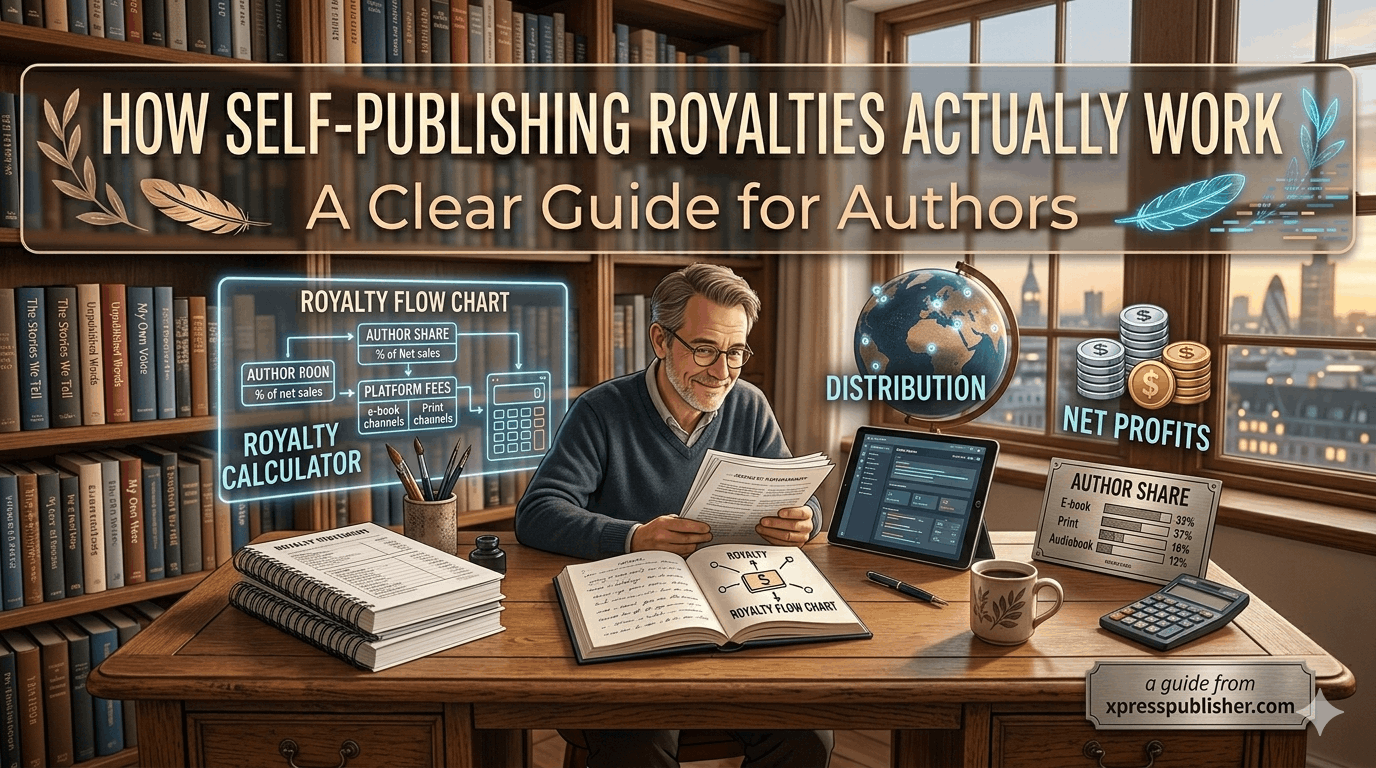
Self-publishing royalties work differently depending on the platform, the format, and the pricing decisions you make. Most authors understand the basic idea — you publish a book, someone buys it, you receive a percentage — but the real picture is more nuanced. Understanding exactly how your royalties are calculated, where your money comes from, and which decisions affect your earnings most is the difference between treating your book as a hobby and treating it as a business. Here is a clear, honest breakdown of how self-publishing royalties actually work in 2026.
Self-Publishing Royalties on Amazon KDP — Ebooks
Amazon KDP offers two royalty tiers for ebooks. The 35% tier applies to books priced below $2.99 or above $9.99 in most markets, and to certain territories where the 70% rate is unavailable. The 70% tier applies to books priced between $2.99 and $9.99 in the US, UK, Canada, Australia, and most major English-language markets.
At the 70% tier, Amazon also deducts a delivery fee based on your ebook’s file size. For a standard novel with no images, this fee is typically a few cents and has minimal impact on earnings. However, for heavily illustrated books — children’s picture books, cookbooks, or heavily designed non-fiction — the delivery charge can be significant. Calculate it before you set your price using KDP’s royalty calculator.
Furthermore, if you enrol in Kindle Unlimited, Amazon pays you per page read rather than per sale. The per-page rate fluctuates monthly based on how KDP divides its global KU royalty pool. It has historically averaged $0.004 to $0.005 per page read. For a 300-page novel read in full, that is roughly $1.20 to $1.50 per read. For authors whose books KU subscribers genuinely read cover to cover, this adds up meaningfully.
Self-Publishing Royalties on Amazon KDP — Print Books
Print royalties on KDP work differently from ebook royalties. You receive 60% of your list price minus the printing cost. The printing cost depends on page count, paper type (white or cream), trim size, and whether you are printing in black and white or colour. For a standard 300-page black and white novel priced at $14.99, the printing cost is approximately $3.85, leaving you with roughly $5.14 per copy sold on Amazon directly.
Consequently, print royalties are lower than ebook royalties on a per-copy basis, but print sales contribute meaningfully to total income for authors with established readerships. For a full guide to pricing your book on Amazon, read our post on how to get your book on Amazon.
Self-Publishing Royalties on IngramSpark
IngramSpark calculates self-publishing royalties differently. You set a list price and a trade discount — the percentage the retailer receives. Your earnings are the remaining percentage after the trade discount and printing cost are subtracted.
The trade discount you set determines how attractive your book is to retailers and bookstores. A 40% discount is the minimum most independent bookstores will consider. A 55% discount matches what traditional publishers typically offer, making your book competitive for bookstore orders and library purchasing systems.
For a $14.99 book with a 40% trade discount, the retailer receives $6.00. After Ingram deducts the printing cost from the remaining $8.99, your net earnings typically fall between $3 and $5 per copy depending on print specifications. Moreover, IngramSpark gives your book access to Ingram’s global distribution network. Read our full comparison of Amazon KDP vs IngramSpark to understand which platform fits your goals.
How to Price Your Book for Maximum Self-Publishing Royalties
Price your book by studying what successful titles in your specific genre and format are selling for — not by calculating what you want to earn per copy and working backwards. Readers have established price expectations for different genres and formats.
For ebooks, most genre fiction performs best in the $2.99 to $6.99 range. Non-fiction commands higher prices. For print, $12.99 to $16.99 is standard for commercial fiction. Business and self-help non-fiction typically prices successfully at $19.99 to $24.99. Additionally, pricing strategy interacts directly with Kindle Unlimited — books enrolled in KDP Select cannot be distributed elsewhere as ebooks, so the decision between KU exclusivity and wide distribution affects your total royalty picture significantly.
Payment Timelines for Self-Publishing Royalties
One reality the royalty percentages do not tell you is how long it takes to receive your money. Amazon pays monthly with a roughly 60-day lag from the date of sale to payment. IngramSpark pays quarterly with a similar lag. As a result, plan your cash flow around this reality — particularly if you have upfront production costs to recover.
The authors who build sustainable income from self-publishing almost always do it through multiple books rather than a single title. Each new book increases the discoverability of all your previous books. Readers who find book three buy books one and two. This compounding effect is the fundamental economic case for treating self-publishing as a long-term business. For a full picture of production costs before royalties, see our guide on how much it really costs to self-publish a book in 2026.
If you want help modelling realistic earnings projections for your specific book across different price points and platforms, our team at XpressPublisher is happy to walk through it with you in a free consultation.
Frequently Asked Questions About Self-Publishing Royalties
What percentage royalty do self-published authors earn on Amazon KDP?
Self-published authors earn 35% or 70% royalties on ebooks through Amazon KDP. The 70% rate applies to books priced between $2.99 and $9.99 in most major markets including the USA, UK, Canada, and Australia. Books priced outside this range earn 35%. For print books, authors earn 60% of the list price minus the printing cost, which varies by page count and format.
How does Kindle Unlimited affect self-publishing royalties?
In Kindle Unlimited, authors are paid per page read rather than per sale. The per-page rate is set monthly from a shared global KU royalty pool and has historically averaged $0.004–$0.005 per page. For a 300-page novel read in full, this equals roughly $1.20–$1.50 per read. Books enrolled in KDP Select for KU must be exclusive to Amazon for ebooks, so authors cannot sell the ebook on other platforms during the enrolment period.
How much do self-published authors earn per book on IngramSpark?
IngramSpark royalties depend on your list price, the trade discount you set, and the printing cost. For a $14.99 paperback with a 40% trade discount, authors typically net $3–$5 per copy after the retailer discount and printing cost are deducted. Setting a higher trade discount (55%) gives you better bookstore access but reduces your per-copy earnings.
When do self-published authors get paid their royalties?
Amazon KDP pays monthly with a roughly 60-day lag from the date of sale. IngramSpark pays quarterly with a similar lag. Both platforms have a minimum payment threshold — typically $10 for KDP and $50 for IngramSpark — before a payment is issued. Authors should plan cash flow around these timelines, especially when recovering upfront production costs.
Is it better to price an ebook at $2.99 or $4.99 for royalties?
Both prices qualify for the 70% KDP royalty tier. At $2.99 you earn approximately $2.07 per sale. At $4.99 you earn approximately $3.49 per sale. The right price depends on your genre — romance and new author discovery books often perform better at $2.99–$3.99, while established non-fiction and series fiction can command $4.99–$6.99 without significant sales drop-off. Study comparable bestsellers in your category before deciding.