
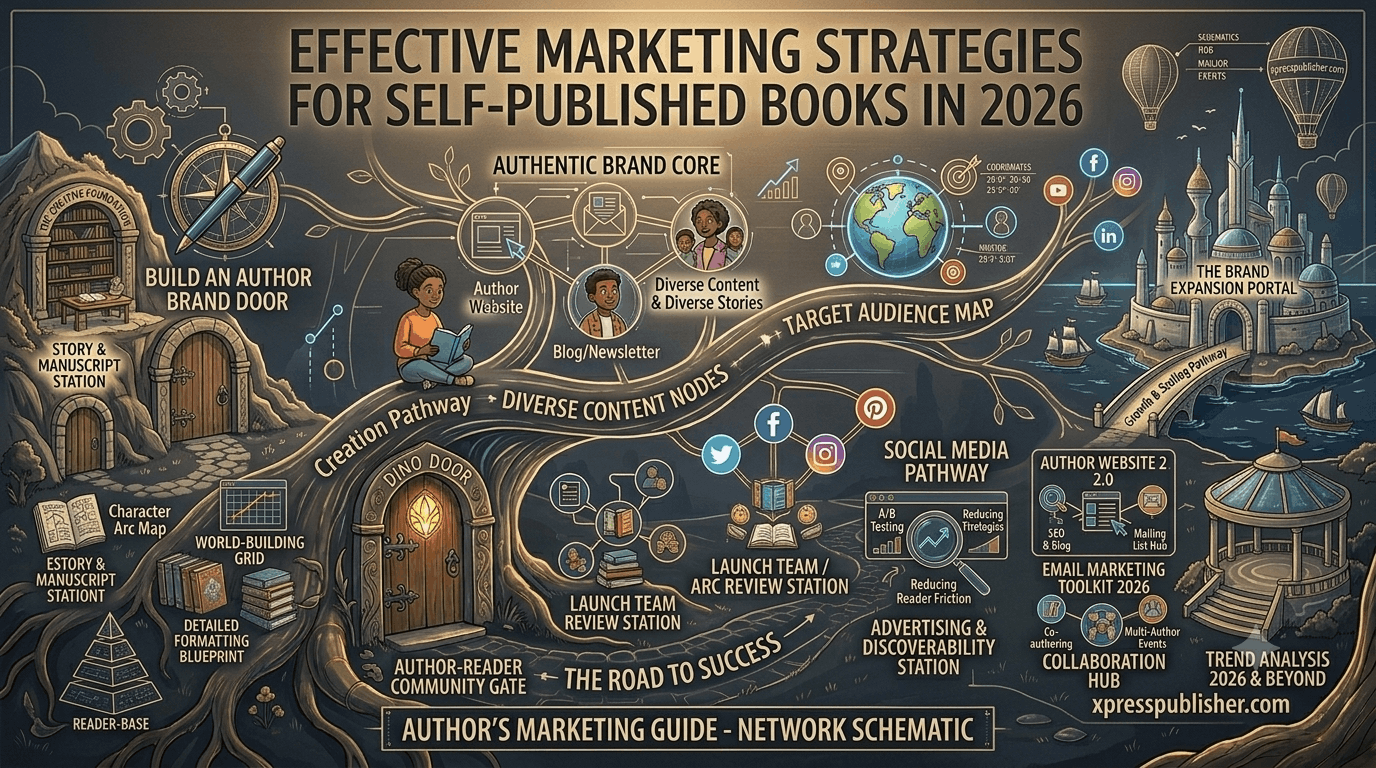
Book marketing strategies for self-published authors do not need to be complicated. The problem is that most advice is either too vague to act on or assumes a budget most debut authors do not have. This guide gives you a clear, ranked set of book marketing strategies that actually move copies in 2026, with honest guidance on what each one requires from you in time, money, and effort.
Table of contents
- The foundation every book marketing strategy depends on
- Amazon listing optimisation
- Email list building
- Getting reviews before and after launch
- Social media book marketing strategies that help sales
- Paid advertising: when and how
- Free PR and media coverage
- Marketing your backlist
- Your 90-day book marketing plan
- Frequently asked questions
The foundation every book marketing strategy depends on
Before any book marketing strategy can work, your book needs to be ready to convert. That means a professional cover that fits your genre, a description that sells rather than summarises, correct categories and keywords on Amazon, and enough reviews to give readers social proof. These are not marketing tactics. They are the foundation without which every book marketing strategy fails regardless of how much time or money you put into it.
Many self-published authors spend money on ads, social media, and promotions before these foundations are in place. The result is always the same: money spent, no return. Fix the product page first. Every effective book marketing strategy starts there.
Amazon listing optimisation: the highest-return book marketing strategy
Your Amazon listing is the single most important marketing asset your book has. Every reader who finds your book through any channel, whether social media, word of mouth, ads, or search, lands on this page. If the listing does not convert them into a buyer, every other book marketing strategy you use is wasted.
Write a description that sells
Most book descriptions read like a plot summary or a school report. Neither works. A strong description opens with a hook that speaks to the reader’s desire or fear, builds tension or curiosity in the middle, and ends with a clear reason to buy now. Think of it as sales copy, not a synopsis. The goal is to make the reader feel that your book was written specifically for them.
You can use basic HTML in Amazon’s description field to add bold text, line breaks, and paragraph spacing. A well-formatted description looks more professional than a wall of text and is significantly easier to skim on a mobile screen, which is where most Amazon browsing happens.
Choose specific keywords and categories
Amazon gives you seven keyword slots and two category choices. Most authors fill them with broad, obvious terms and wonder why their book never surfaces in search. Instead, think like your reader. What specific phrase would they type into Amazon’s search bar when looking for a book exactly like yours? Those specific phrases, not single words, are what belong in your keyword slots.
For categories, go as specific as your book honestly fits. Ranking in a narrow subcategory earns you a bestseller badge that appears on your product page and increases conversion. Being invisible in a broad category with thousands of competitors does nothing for you. After publishing, you can also contact Amazon KDP support to request up to ten categories total, which most authors never know is possible.
Email list building: the most effective long-term book marketing strategy
Of all the book marketing strategies available to self-published authors, building an email list has the strongest long-term return. An email list is the one audience you truly own. Social platforms change their algorithms. Amazon changes its rules. Your email list belongs to no platform and can be taken anywhere.
Start building before your book is published. Offer something genuinely useful to your target reader in exchange for their email address. For fiction authors, this could be a free short story, a prequel chapter, or a deleted scene. For non-fiction authors, it could be a checklist, a template, or a short guide related to your book’s topic. Even 200 engaged subscribers at launch will drive more sales than 10,000 social media followers who barely notice your posts.
Mailchimp and ConvertKit both have free plans that are more than enough for new authors. Set up a simple landing page, link it from your author website and social profiles, and start building from day one. Every week you wait is a week of lost list growth.
Getting reviews: the book marketing strategy that powers everything else
Reviews are the most powerful conversion tool a self-published book can have. Amazon’s algorithm weights review count heavily in search rankings. Books with 10 or more reviews outperform those with fewer in nearly every metric. Getting to these thresholds quickly is one of the most effective book marketing strategies at any budget level.
Advance reader copies before launch
Send advance review copies, known as ARCs, to readers before your publication date. These are free copies given in exchange for an honest review posted on or around launch day. You can find ARC readers through author Facebook groups, genre communities on Reddit, BookTok, and platforms like NetGalley and BookSirens. The goal is to have reviews ready to post the moment your book goes live, rather than waiting months for organic reviews to accumulate.
Post-launch review strategies
After launch, the most effective approach is simply to ask. Add a note at the end of your book asking readers to leave a review if they enjoyed it. Email your list when the book goes live and ask subscribers to review it if they read it. Follow up with ARC readers who have not yet posted. None of this is pushy when done honestly, and the results compound over time as more reviews bring more visibility and more visibility brings more readers.
Social media book marketing strategies that actually help sales
Social media is not the strongest book marketing strategy for direct sales, but it is valuable for discoverability and audience building when used correctly. The mistake most authors make is trying to be on every platform at once. Pick one platform where your target readers actually spend time and focus on it consistently rather than posting sporadically everywhere.
BookTok for genre fiction
TikTok’s book community has genuinely changed how genre fiction gets discovered. Romance, fantasy, thriller, and romantasy have all seen indie authors break through to bestseller lists through organic BookTok momentum. You do not need to post every day or become a content creator. What matters is making your book easy to talk about: a strong hook, a quotable line, a cover that photographs well. When readers can describe your book easily, they share it, and that sharing does your marketing for you.
Pinterest for non-fiction and lifestyle books
Pinterest works differently from other social platforms. It functions like a search engine, and pins drive traffic for years rather than hours. Authors who create branded pin graphics for their blog posts and book content consistently report steady referral traffic long after the pin was first published. If you write non-fiction, self-help, parenting, or any visually appealing genre, Pinterest deserves a place in your book marketing strategy.
Paid advertising: when this book marketing strategy works and when it does not
Paid advertising works as a book marketing strategy when used at the right time with the right foundation in place. Used too early or without the right setup, it wastes money reliably.
Amazon ads
Amazon advertising works best when your listing is already converting. A strong cover, a compelling description, the right categories, and at least 10 reviews are the minimum before you spend money on Amazon ads. Start with automatic targeting at $5 to $10 per day, let Amazon identify which search terms your book appears for over two to three weeks, then shift to manual targeting on the terms that are converting. Expect 60 to 90 days of testing before your campaigns are properly optimised.
BookBub and newsletter promotions
BookBub Featured Deals are highly competitive to get but enormously effective when you do. For authors who cannot get a BookBub Featured Deal, BookBub Ads and similar newsletter promotions through services like The Fussy Librarian, Robin Reads, and Bargain Booksy can drive meaningful sales spikes at a lower cost. These work best during a temporary price reduction of your ebook, typically to $0.99 or free, which creates the perception of value that drives clicks.
Free PR and media coverage
Earned media coverage is one of the most underused book marketing strategies available. Most authors assume that press coverage is only for traditionally published authors. That is not true. Local newspapers, podcasts in your niche, online publications, and genre blogs are all potential sources of coverage if you approach them with a genuine story angle rather than a straightforward sales pitch.
The story angle is the key. A local newspaper does not care that you published a book. They do care that a local author wrote a book about a topic relevant to their readers right now. Lead with the value you offer to their audience, and the book mention follows naturally.
Marketing your backlist as your catalogue grows
One of the most powerful book marketing strategies becomes available only once you have more than one title: marketing your backlist through your frontlist. When a new book launches, readers who discover it will look for more of your work. A strong backlist means every new reader you gain becomes a reader of your entire catalogue, not just one book.
This is why authors who publish consistently see their income grow faster than their publishing pace would suggest. Each new book markets every previous book at the same time. The first book is always the hardest to sell. By book three or four, the earlier books are selling themselves through reader discovery.
Your 90-day book marketing plan
Here is a practical timeline for launching a self-published book with strong book marketing strategies in place from the start.
| Timeframe | Key actions | Goal |
|---|---|---|
| 12 weeks before launch | Start email list, set up ARC reader list, finalise cover and description | Build pre-launch audience |
| 8 weeks before launch | Send ARCs, start social posting, build Amazon author page | Secure early reviews |
| 4 weeks before launch | Email list announcement, schedule social content for launch week, set up Amazon listing | Build anticipation |
| Launch week | Email your list, post daily, ask ARC readers to post reviews, contact local media | Maximise first-week sales |
| Weeks 2 to 4 | Start Amazon ads once you have 10 reviews, follow up with remaining ARC readers | Sustain momentum |
| Months 2 to 3 | Test BookBub ads, submit to newsletter promotions, pitch podcast appearances | Expand reach |
Frequently asked questions about book marketing strategies
What is the most effective book marketing strategy for self-published authors?
The most effective single book marketing strategy depends on where you are in your publishing journey. For a first book with no audience, Amazon listing optimisation and ARC reviews give the best return because they improve the conversion rate of every person who finds your book. For authors with an established readership, email marketing consistently outperforms every other channel in terms of direct sales generated per subscriber.
How much should I spend on book marketing?
A sensible starting point is to allocate 10 to 15 percent of your expected first-year revenue to book marketing. For a debut author with realistic expectations, that might be $200 to $500 in total. Prioritise spending on your cover and Amazon listing first since these improve every sales opportunity. After those are in place, test paid channels with small budgets of $5 to $10 per day before scaling anything that works.
How long does it take for book marketing to show results?
Organic book marketing strategies like SEO, consistent social media, and email list building take three to six months to show meaningful results. Paid strategies like Amazon ads show results faster but require a testing period of 60 to 90 days to optimise properly. The authors who succeed at self-publishing are those who treat book marketing as an ongoing activity rather than a one-time launch event.
Do I need social media for book marketing?
No, not necessarily. Social media helps with discoverability in certain genres, particularly romance and fantasy on BookTok, but it is not required. Authors who focus on Amazon listing optimisation, email marketing, and getting reviews consistently outperform authors who are active on social media but have weak product pages and no email list. Social media works best as a supplement to a strong foundation, not as a replacement for one.
What is the biggest book marketing mistake self-published authors make?
Running paid ads before their book is ready to convert. A weak cover, a thin description, or a listing with no reviews will produce a low click-through rate and even lower conversion regardless of how much you spend. The ad spend accelerates what is already there. If what is already there is not working, ads make you lose money faster. Fix the product first, then market it.
At XpressPublisher, we help authors in the USA and UK not just publish professionally but market their books to real readers. Read more in our guides on book marketing for self-published authors, how to get your book on Amazon, and how much self-publishing actually costs. Or get a free proposal today.
Call 805-635-2324 (USA) or +44 784 689 5422 (UK). Email info@xpresspublisher.com. Rated 4.2 Great on Trustpilot.