
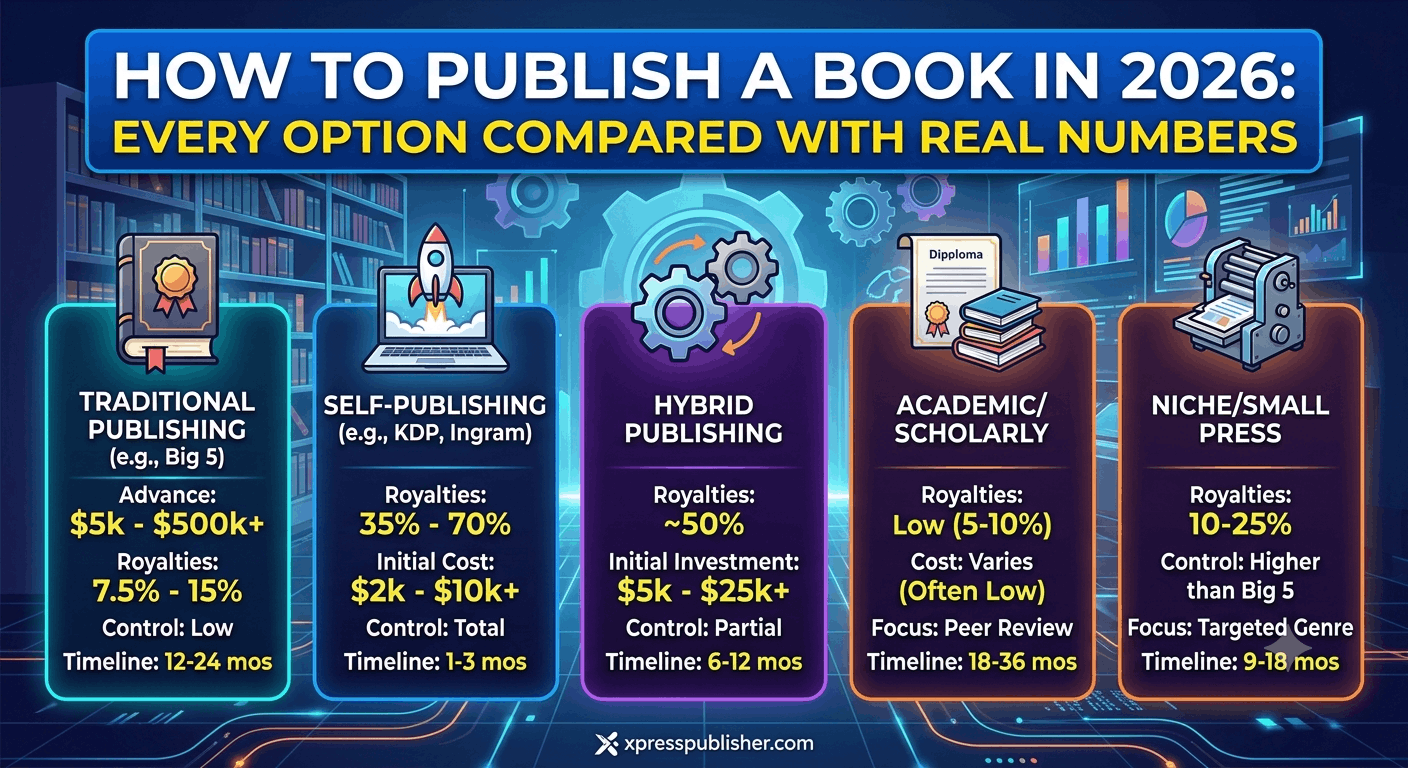
There are five ways to publish a book in 2026. Most authors know two of them. Choosing without understanding all five means permanently surrendering rights, royalties, or control you didn’t know you were giving up. This guide covers every option with real numbers, in plain language.
The Five Book Publishing Paths
Book publishing in 2026 falls into five distinct paths. Each has a different cost structure, a different timeline, different rights implications, and a different author-income model. None is universally better than the others. The right choice depends on your goals, your manuscript, and what you’re willing to trade.
| Path | Upfront cost | Time to market | Author royalty | Rights |
|---|---|---|---|---|
| Traditional (Big 5) | $0 | 2–4 years | 10–15% list price | Publisher retains 7+ years |
| Small / indie press | $0 | 12–24 months | 15–30% of net | Publisher retains, shorter terms |
| Hybrid publisher | $3,000–$25,000 | 12–18 months | 50–70% of net | Author usually retains |
| Full-service publisher | $1,500–$5,000 | 6–12 weeks | 100% of platform royalties | Author retains all |
| DIY self-publishing | $0–$500 | 4–8 weeks | 100% of platform royalties | Author retains all |
The royalty figures above deserve a clarifying note. A traditional publisher’s “10–15% of list price” sounds small, but it covers wide distribution, bookstore placement, and marketing spend. A self-published author’s “100% of platform royalties” means 70% of the ebook price or 60% of the print price minus printing costs. Both are significantly higher per copy than traditional royalties. However, the author absorbs all production costs and handles all marketing. The right comparison is not which percentage is bigger. It’s which structure suits your book and your situation.
Traditional Book Publishing: What It Actually Requires
Traditional publishing through the Big 5 publishers (Penguin Random House, HarperCollins, Simon & Schuster, Hachette, Macmillan) and their imprints is the path most first-time authors aspire to. It is also the path most first-time authors can’t access without first meeting several specific prerequisites.
First, you need a literary agent. The major publishers do not accept unsolicited manuscripts from authors. You must query agents, receive representation, and then have your agent submit to publishers on your behalf. Querying is itself a process that can take 6–18 months for a successful outcome.
Second, you need a platform. Traditional publishers increasingly expect authors to bring their own audience. A debut novelist with 50,000 social media followers in the right genre gets a very different reception than one without. A nonfiction author with a podcast, a YouTube channel, or a recognised professional credential has a meaningful advantage.
Third, timelines are long. From signing with an agent to seeing your book in a bookstore, two to four years is standard. Revisions requested by the publisher, editorial cycles, cover design, and catalogue scheduling all take time.
In return for all of that: broad bookstore distribution, library placement, co-op placement (your book face-out on a display table), marketing support, and the credibility that comes with a recognised publisher’s imprint. For the right author with the right book, those returns justify the path. For most authors, the access requirements make it a non-starter.
Small Press and Independent Publishers
Independent and small press publishers occupy the space between the Big 5 and self-publishing. They vary enormously in quality, reach, and terms. Some have meaningful distribution relationships and genuine marketing capabilities. Others are essentially glorified book packagers with a traditional-sounding name.
The key questions to ask any small press before signing: Who distributes your books? How are they placed in bookstores — through Ingram, Baker & Taylor, or direct? What is your marketing spend per title on average? Can you name three of your recent titles I can look up on Amazon and in bookstores? Who owns the rights and under what conditions can they revert to me?
Small presses often publish niche subject matter, literary fiction, regional titles, and books that the Big 5 consider too specialised for their lists. If your book fits a specific niche and a credible small press covers that niche, this path is worth exploring seriously.
Hybrid Book Publishing
Hybrid publishers occupy a genuinely confusing middle ground, partly because the term covers a wide range of companies with very different models. In theory, a hybrid publisher combines the professional services of a traditional publisher with the author-friendly terms of self-publishing. That means retained rights and higher royalties alongside editing, cover design, distribution, and marketing. In practice, the execution varies dramatically.
Some hybrid publishers charge $3,000–$8,000 for professional production, provide real bookstore distribution through Ingram, offer genuine marketing support, and return 60–70% of net royalties to the author. These are legitimate options for authors who want professional credibility alongside retained rights.
Others charge $15,000–$25,000 for packages of dubious value. They retain rights in ways that limit the author’s options. Their distribution is indistinguishable from what any author could set up directly through IngramSpark for $49. Vetting a hybrid publisher requires the same questions you’d ask a small press, plus a direct accounting of what each fee actually produces.
The Hybrid Publishers Collective and the Independent Book Publishers Association both provide resources for evaluating hybrid publishers. Neither endorses specific companies, but both define standards that legitimate hybrid publishers should meet.
Full-Service Professional Book Publishing
Full-service professional publishing is a specific model that sits distinctly between hybrid publishing and DIY self-publishing. The author pays for professional production work — editing, cover design, interior formatting, and distribution setup — and keeps 100% of all platform royalties. No ongoing royalty share. No rights transfer. The book is yours; the publisher handles the work that turns a manuscript into a market-ready title.
This is how XpressPublisher works. Authors in the US and UK bring us finished (or near-finished) manuscripts. We handle cover design, professional editing, interior formatting for both print and ebook, and distribution setup through Amazon KDP and IngramSpark. Every royalty from every platform flows directly to the author. The production fee is a one-time cost. After that, the economics of the book are the author’s entirely.
The practical advantage over DIY self-publishing is quality. A professionally designed cover, a properly formatted interior, and a well-structured distribution setup produce a book that competes with traditionally published titles on the same shelf. DIY production at a budget level rarely achieves this. The practical advantage over hybrid publishing is transparency: the author pays for exactly what is produced, retains all rights, and keeps all royalties.
DIY Self-Publishing
DIY self-publishing means the author manages every step of production and distribution independently. That means hiring their own freelance editor, cover designer, and formatter, then uploading to KDP, IngramSpark, and other platforms. Done well, this produces the same result as a full-service publisher at lower cost. Done poorly, it produces the most common version of a self-published book — one that looks self-published.
The economics of DIY self-publishing are the same as full-service: 100% of platform royalties, full rights retained, fastest path to market. The variable is execution. Authors who understand book production, have strong project management skills, and can access reliable professional freelancers (editor, cover designer, formatter) can produce professional-quality books independently. Authors who don’t have those things, or who don’t want to manage the production process, are better served by a full-service publisher.
For a detailed breakdown of what every step costs and what breaks if you skip any of them, see our complete 25-step self-publishing guide.
The Full Book Publishing Comparison
| Factor | Traditional | Small Press | Hybrid | Full-Service | DIY |
|---|---|---|---|---|---|
| Upfront cost | $0 | $0 | $3K–$25K | $1.5K–$5K | $0–$500 |
| Time to market | 2–4 years | 12–24 months | 12–18 months | 6–12 weeks | 4–8 weeks |
| Author royalty | 10–15% list | 15–30% net | 50–70% net | 100% platform | 100% platform |
| Rights retained | No | Limited | Usually yes | Yes — all | Yes — all |
| Bookstore distribution | Broad | Moderate | Varies widely | KDP + IS (40K+) | KDP + IS (40K+) |
| Marketing support | Some | Limited | Varies | Production only | None |
| Cover/content control | Publisher | Shared | Shared | Author | Author |
| Agent required | Yes | Sometimes | No | No | No |
How to Choose the Right Book Publishing Path
The decision depends on four things: your manuscript, your platform, your timeline, and what you’re willing to trade.
If you have a large existing platform and your book suits a mainstream commercial market: pursue traditional publishing. The distribution, credibility, and marketing infrastructure are worth the trade-offs for the right author.
If your book covers a specific niche and a credible small press covers that niche: research that press thoroughly and submit. A well-matched small press can provide access to a specialist audience that self-publishing makes harder to reach.
If you want professional credibility, retained rights, and higher royalties than traditional publishing offers: evaluate hybrid publishers very carefully. Verify distribution, verify royalty terms, and verify what every fee produces. A good hybrid publisher is a legitimate option. A bad one is an expensive lesson.
If you want professional production quality, full rights, 100% platform royalties, and a fast path to market: a full-service publisher is the practical choice. You pay for production once. Everything after that is yours.
If you have strong production skills, reliable freelancers, and want to manage the process yourself: DIY self-publishing gives you the same economics with more control and lower cost — if you can execute it at a professional standard.
Also worth reading alongside this guide: our breakdown of which self-publishing platforms to use once you’ve chosen your path, and our guide to book editing costs, which is the largest production expense in any path other than traditional.
If you’re weighing the full-service route, XpressPublisher’s publishing packages cover the complete production pipeline for authors in the US and UK — editing, cover design, formatting, and distribution setup — with all rights and royalties staying with you.
Frequently Asked Questions About Book Publishing
What is the best way to publish a book in 2026?
There is no single best way to publish a book. The right path depends on your manuscript, your existing platform, and what you want from the publishing experience. Traditional publishing offers wide bookstore distribution and marketing support but requires an agent, takes 2–4 years, and gives the publisher significant rights and control. Self-publishing gives you faster timelines, full rights, and significantly higher per-copy royalties, but requires either professional production investment or strong DIY skills. Most authors in 2026 who want professional results without sacrificing rights choose between a full-service publisher and a well-vetted hybrid publisher.
How much does it cost to publish a book?
Traditional publishing costs the author nothing upfront — the publisher covers production costs in exchange for rights and a royalty percentage. Self-publishing production costs range from $200 for a basic DIY approach to $5,000 or more for full professional production (editing, cover design, formatting, distribution setup). Hybrid publishers charge $3,000–$25,000 depending on the package. Full-service publishers that retain no royalties and return all rights typically charge $1,500–$5,000 for production work. The platform upload fees (KDP, IngramSpark) are minimal or free regardless of production path.
Do I need a literary agent to publish a book?
You need a literary agent to publish with a major traditional publisher (the Big 5 and their imprints). Major publishers do not accept unsolicited manuscripts from authors. Some small and independent presses accept direct submissions without an agent, though this varies by publisher. Hybrid publishers, full-service publishers, and self-publishing platforms do not require an agent. Agents typically take 15% of the author’s earnings from deals they negotiate, which is standard and not a red flag.
What royalties do authors earn from book publishing?
Royalties vary significantly by publishing path. Traditional publishers typically pay 10–15% of the list price for print books and 25% of net receipts for ebooks. Small presses pay 15–30% of net. Hybrid publishers return 50–70% of net to the author. Self-published authors on Amazon KDP earn 70% of the ebook list price (for books priced $2.99–$9.99) and 60% of the print list price minus the per-unit printing cost. The self-publishing royalty percentages are substantially higher per copy; the trade-off is that the author covers production costs and manages marketing independently.
How long does it take to publish a book?
Publication timelines vary dramatically by path. Traditional publishing takes 2–4 years from query to bookstore (including agent querying, submission, acquisition, editorial, and production cycles). Small presses take 12–24 months. Hybrid publishers typically take 12–18 months. A full-service professional publisher can produce and distribute a book in 6–12 weeks from a completed manuscript. DIY self-publishing through KDP can go live in 24–72 hours after upload, though the production work (editing, cover design, formatting) typically takes 4–8 weeks.
What is a hybrid publisher and is it legitimate?
A hybrid publisher combines elements of traditional publishing (professional production, distribution, marketing) with self-publishing terms (author retains rights, higher royalty share). Hybrid publishing is a legitimate model when the publisher provides genuine distribution infrastructure, transparent fee structures, and verifiable production quality. It becomes problematic when fees are very high ($15,000+), royalty terms are unclear, distribution is limited, or rights reversion clauses are restrictive. Before working with any hybrid publisher, verify their distribution network, request a list of recent titles you can look up on Amazon and in bookstores, and have any contract reviewed by a publishing attorney or the Authors Guild.