
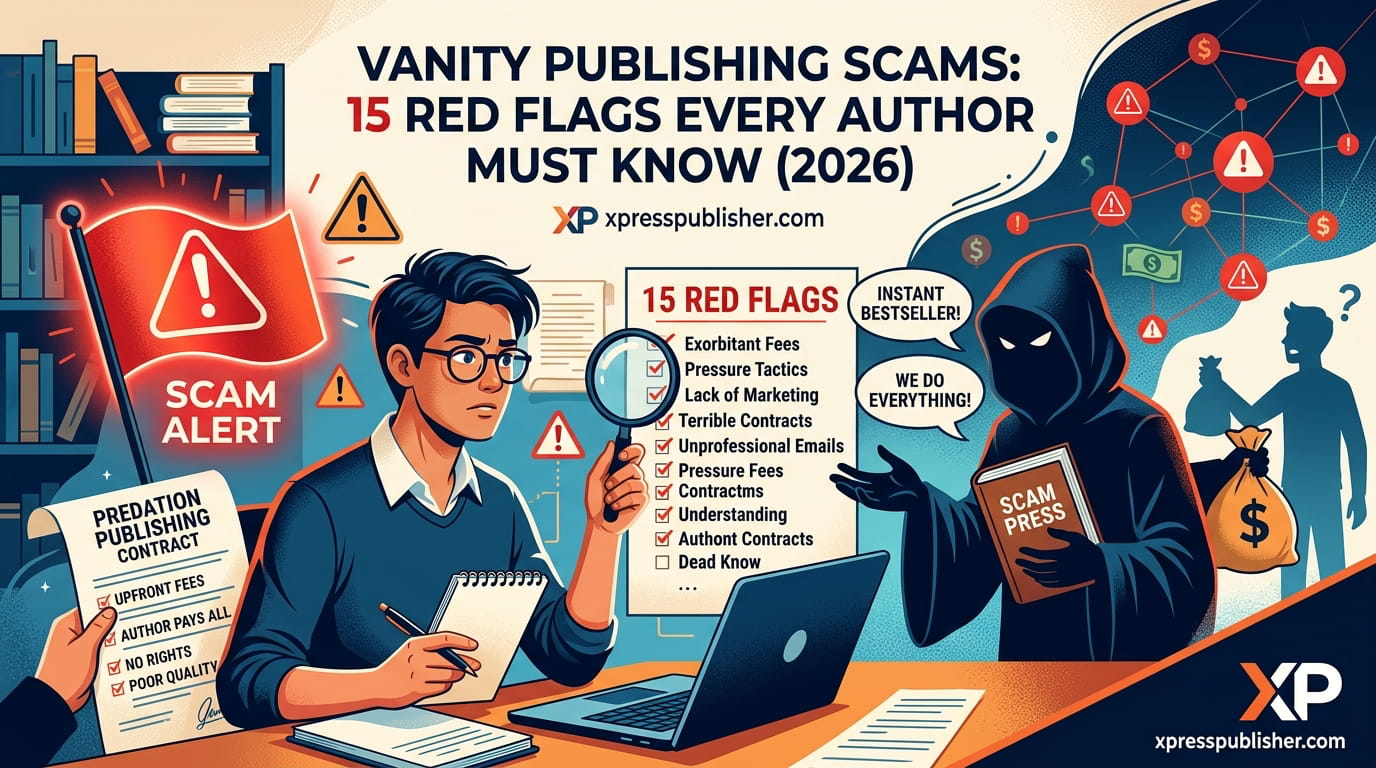
Vanity publishing companies have taken billions of dollars from authors who wanted to publish their books and didn’t know what they were signing. In 2026, the tactics have become more sophisticated: predatory publishers now use AI to build convincing websites, fake testimonials, and polished service pages that are indistinguishable from legitimate publishers at first glance. The fundamentals, however, have not changed. This guide gives you the complete picture — what vanity publishing is, how it differs from legitimate self-publishing and hybrid publishing, the 15 red flags that identify a predatory company, and the specific questions to ask before you sign anything.
What Vanity Publishing Actually Is
The defining characteristic of a vanity publisher is simple: they make money from authors, not for authors. In traditional publishing and legitimate full-service publishing, revenue comes from book sales. In vanity publishing, revenue comes from author fees — upfront charges for editing, design, distribution, marketing, and a growing list of add-on services that are sold aggressively after the initial contract is signed.
The traditional publishing industry has a clear rule of thumb: money flows toward the author, not away from them. A traditional publisher pays an advance. A self-publishing platform charges nothing and takes a percentage of sales. A legitimate full-service publisher charges for production work (editing, cover design, formatting, distribution setup) at transparent, market-rate prices while returning all rights and 100% of platform royalties to the author. A vanity publisher charges whatever it can extract, often retaining rights, controlling distribution, and continuing to sell additional services at inflated prices for years after the initial contract.
Knowing this distinction is the foundation of everything else in this guide.
Vanity Publishing vs. Hybrid Publishing vs. Full-Service Publishing
The terminology in this space is deliberately confusing, partly because vanity publishers have co-opted the word “hybrid” to describe themselves. Here is the actual distinction.
| Model | Who pays | Who keeps rights | Who keeps royalties | Revenue source |
|---|---|---|---|---|
| Traditional publisher | Publisher pays author (advance) | Publisher (7+ years typically) | Author 10–25% | Book sales |
| Legitimate hybrid publisher | Author pays for production; market-rate fees, transparent pricing | Author | Author 50–70% net | Book sales + author fees |
| Full-service publisher (e.g. XpressPublisher) | Author pays once for production work only | Author — all rights | Author — 100% of platform royalties | Production fees only |
| Vanity publisher | Author pays everything, often at inflated rates | Publisher retains rights or restricts distribution | Low or unclear; publisher extracts ongoing fees | Author fees, not book sales |
| DIY self-publishing (KDP, IngramSpark) | Author pays nothing to publish | Author — all rights | Author — 60–80% depending on platform | Platform percentage of book sales |
The key test for any company describing itself as a hybrid publisher: do they earn meaningful revenue from your book sales, or primarily from your fees? A company that makes money when your book sells has an incentive to help it sell. A company that makes money from your fees has an incentive to keep charging you for things, regardless of whether your book is selling.
The Vanity Publishing Red Flag Checklist
The following 15 red flags are drawn from complaints aggregated by Writer Beware, the Alliance of Independent Authors (ALLi), and author community reports. Any single item warrants caution. Multiple items together warrant walking away.
1. They accept your manuscript instantly. A response within 24–48 hours is almost always a red flag. Legitimate publishers — traditional or hybrid — take time to evaluate a manuscript. Instant acceptance signals that manuscript quality is not their selection criterion. Your willingness to pay is.
2. They solicited you. If a publisher contacted you out of nowhere — after a contest entry, a social media post, a query to someone else — proceed with extreme caution. Unsolicited offers to publish, particularly those that arrived as emails or messages, are a standard lead-generation tactic of predatory publishers.
3. Fees are required upfront before any work begins. Legitimate publishers and full-service publishing companies provide clear, itemised pricing for specific deliverables. Vanity publishers require large upfront payments — often $3,000–$20,000 — with vague descriptions of what the money covers.
4. Services are bundled into non-transparent packages. “Gold package,” “Author Premier,” “Publishing Pro” — packages that bundle multiple services at a single price without itemising individual costs make it impossible to compare against market rates. Professional editors, cover designers, and formatters all have published market rates. If a company won’t break its packages into per-service costs, they’re likely marking up standard services by 300–500%.
5. They charge inflated rates for standard services. Copyright registration costs $45–$65 with the US Copyright Office. ISBN registration through Bowker costs $125 for one. If a company quotes $200 or more for either of these line items, they are extracting money from you on tasks any author can complete independently in under an hour.
6. They promise guaranteed bookstore placement. No publisher can guarantee that Barnes & Noble, Amazon, or independent bookstores will stock your book. IngramSpark provides wholesale distribution access that makes bookstore ordering possible — but no company can guarantee orders. A promise of bookstore placement is almost universally hollow.
7. They pressure you to purchase additional services. After signing, legitimate publishers and publishing services deliver what was agreed and stop. Predatory publishers follow up repeatedly with offers for marketing packages, book trailers, press release distribution, social media campaigns, and review services — often framed as urgent or limited-time. Each new offer is another revenue extraction from the author.
8. They pressure you to buy copies of your own book. Some vanity publishers structure their royalty model to require large minimum purchase orders of your own book. Buying 100 copies of your own book at $15 each is a $1,500 charge that the publisher earns immediately, regardless of whether you ever sell those books.
9. The contract is vague on royalty terms. If a contract doesn’t specify exactly what percentage of what base price you earn, don’t sign it. “Competitive royalties” and “generous author compensation” are not royalty terms. You need: the percentage, the base amount (list price vs. net receipts), and whether that rate changes under any circumstances.
10. The contract gives the publisher your rights for an extended term. Any contract that retains the publisher’s involvement with your book for more than three to five years requires careful legal review. Rights reversion clauses — the terms under which rights return to you — should be explicit. If the company can hold your rights indefinitely or for seven-plus years, compare that to your other options before signing.
11. The ISBN will be registered to them, not to you. An ISBN registered to the publisher lists that publisher as the publisher of record. This affects how your book appears in trade databases, who controls the title’s market presence, and what happens if you want to work with a different publisher or platform later. Your own ISBN, purchased through Bowker (US) or Nielsen (UK), gives you full control.
12. Reviews and testimonials are difficult to verify. Search for the company’s client books on Amazon. Are they selling? Do they have reviews from readers (not just paid editorial reviews)? A publishing company’s success should be visible in their clients’ books. If you cannot find verifiable evidence of client success, that evidence likely does not exist.
13. They use high-pressure sales tactics. “This offer expires at midnight.” “We only have two spots left in this publishing round.” “Your manuscript has been selected from thousands of submissions.” These are lead-nurturing tactics, not editorial communications. Legitimate publishers don’t create artificial urgency around your publishing decision.
14. Communication becomes slow or evasive after payment. A clear pattern in author complaint reports: responsive, enthusiastic communication before payment, followed by slow responses, missed deadlines, and vague updates after the cheque clears. If a company’s communication speed changes meaningfully at the point of payment, that change is information.
15. They cannot be verified through independent sources. Search the company name plus “complaints,” “reviews,” “scam,” and “Writer Beware.” Search the Alliance of Independent Authors (ALLi) Self-Publishing Services Directory, which rates companies across multiple criteria. Ask in author communities (specifically subreddits like r/selfpublish and Facebook groups for indie authors) whether anyone has experience with the company. The absence of verifiable, positive independent feedback is itself a red flag.
Questions to Ask Before Signing Anything
Before committing money or rights to any publishing company, get written answers to these questions. Legitimate companies will answer them clearly. Evasive or vague responses are your signal.
- “Who will own the ISBN for my book — my name/imprint, or yours?”
- “What exactly are the royalty terms — percentage of what base, paid how, when?”
- “Under what conditions do rights revert to me, and how long does that process take?”
- “Can I have an itemised breakdown of what each service in this package costs individually?”
- “Can you provide contact information for three recent authors I can speak with directly?”
- “What happens to my contract and my rights if your company is acquired or closes?”
- “Is there any exclusivity requirement for my print or digital distribution?”
If a company refuses to answer any of these questions in writing, that refusal tells you everything you need to know before signing.
Where to Verify Any Publishing Company
Writer Beware (writerbeware.com) — maintained by the Science Fiction and Fantasy Writers of America. They compile complaints and evidence against publishers, agents, and publishing services. Their Scam Archive is updated regularly and includes documented cases with specifics.
Alliance of Independent Authors (allianceindependentauthors.org) — ALLi’s Self-Publishing Services Directory rates publishing companies across multiple criteria: author services quality, royalty terms, rights terms, and customer service. They maintain an “Approved,” “Caution” and “Watchdog” tiered rating system based on submitted contracts and author reports.
Author communities — Specific author communities such as r/selfpublish on Reddit and Facebook groups for indie authors in your genre often have firsthand experience with companies. Search before asking, as many companies come up repeatedly in complaint threads.
The Safe Alternatives
The safest publishing paths — the ones where money flows toward you, not away from you — are DIY self-publishing through platforms like Amazon KDP and IngramSpark, and working with a legitimate full-service publisher that charges for specific production work at transparent rates while returning all rights and royalties to you.
For a complete breakdown of every publishing option — traditional, small press, hybrid, full-service, and DIY — with real costs and royalty rates, see our guide to how to publish a book. For what self-publishing platforms actually pay, see our self-publishing platforms comparison.
XpressPublisher is a full-service publisher serving authors in the USA and UK. Authors retain all rights. All platform royalties flow directly to the author. We charge for production work — editing, cover design, formatting, and distribution setup — at transparent, itemised rates. The production fee is paid once. Everything after that is the author’s entirely. If you’d like to see what that looks like in practice, our publishing packages are available here.
Frequently Asked Questions About Vanity Publishing
What is vanity publishing and how does it differ from self-publishing?
Vanity publishing is a model where authors pay a company to publish their book, typically at inflated rates, often with the company retaining rights or controlling distribution. The defining characteristic: the company makes money from author fees, not from book sales. Self-publishing through platforms like Amazon KDP or IngramSpark costs nothing to publish — the platform takes a percentage of each sale. The author retains full rights and earns the majority of royalties. In vanity publishing, you pay to publish. In self-publishing, the platform earns only when your book earns.
Is it always wrong to pay a publisher?
Not always. Legitimate full-service publishers charge authors for specific production work — editing, cover design, formatting, and distribution setup — at transparent, market-rate prices, while returning all rights and all platform royalties to the author. This is a legitimate service model. The problem is when fees are inflated beyond market rates, when services are vague or bundled opaquely, when rights are retained, or when the company’s primary revenue comes from author fees rather than from helping authors sell books. The test: does the company earn money when your book sells, or only from your fees?
What are the biggest red flags of a vanity publisher?
The most reliable red flags are: instant acceptance of your manuscript with no meaningful editorial feedback; large upfront fees with vague or bundled service descriptions; inflated charges for services you could complete yourself (like ISBN registration or copyright filing); promises of guaranteed bookstore placement; pressure to purchase add-on services after signing; unclear or unfavourable royalty terms; extended rights retention with no clear reversion clause; and inability to provide verifiable, independently reviewable client success stories. Any single flag warrants investigation. Multiple flags warrant walking away.
How do I check if a publishing company is legitimate?
Search the company name on Writer Beware (writerbeware.com), which maintains an archive of complaints against publishers and publishing services. Check the Alliance of Independent Authors (ALLi) Self-Publishing Services Directory, which rates companies based on submitted contracts and author reports. Search for the company name plus “complaints,” “scam,” or “reviews” in author communities on Reddit (r/selfpublish) and relevant Facebook groups. Ask to speak with recent clients directly — legitimate companies will facilitate this; predatory companies typically won’t.
Can vanity publishers really get my book into bookstores?
Not reliably. Bookstore placement requires catalogue distribution through Ingram (the primary wholesale distributor for bookstores) and typically requires professional book packaging, returnable inventory terms, and a favourable wholesale discount. Any author can achieve Ingram catalogue access through IngramSpark for $49 per title — this makes your book orderable by any bookstore. Whether a specific bookstore chooses to stock your title is a separate decision that no publisher can guarantee. Vanity publishers who promise guaranteed bookstore placement are typically referring to catalogue listings, not actual shelf presence.
What should I do if I’ve already signed with a vanity publisher?
First, read your contract carefully for rights reversion clauses — the conditions under which rights return to you and the process for requesting reversion. Many vanity publishing contracts include reversion clauses tied to sales thresholds or time periods. Second, contact the Alliance of Independent Authors or consult a publishing attorney if the contract is unclear or if the company is unresponsive to reversion requests. Third, do not pay for additional services — the primary profit mechanism of vanity publishers is escalating add-on sales after the initial contract. Fourth, document all communications in writing going forward, as this will be important if you need to pursue a formal complaint or legal action.