
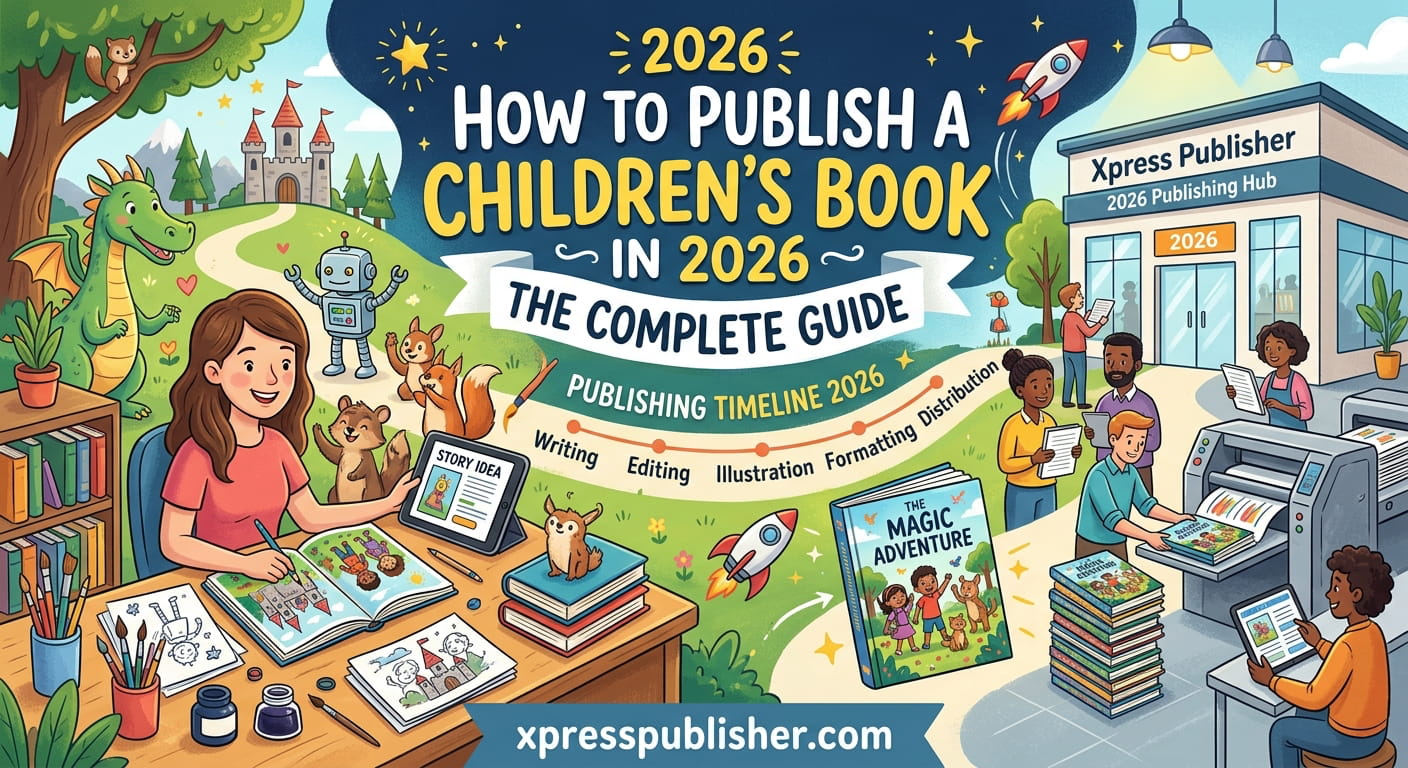
Most aspiring children’s book authors underestimate one thing before everything else: this is not a word-heavy genre. It’s a visual one. The illustrations carry 70–80% of the storytelling in a picture book, and they cost more than most first-time authors budget for. Getting that number right at the start — and understanding how the type of book you’re writing changes everything about production, format, and distribution — is what separates a book that looks professional from one that clearly isn’t.
This guide covers how to publish a children’s book from manuscript to Amazon listing, with real costs at each stage, illustrator sourcing, KDP formatting requirements, and the category strategy that determines whether readers find your book at all.
The Four Types of Children’s Books: Know Which One You’re Writing
The production requirements, illustration approach, page count, and Amazon category strategy are completely different depending on which type of children’s book you’re publishing. Most guides treat “children’s book” as a single category. It isn’t. Here is the full breakdown.
| Type | Age range | Page count | Illustration style | Typical total cost to publish |
|---|---|---|---|---|
| Board book | 0–3 years | 10–20 pages | Simple, bold, rounded — each page one clear image | $3,000–$8,000 (complex production; thicker pages) |
| Picture book | 3–8 years | 24–40 pages | Full-colour, detailed, narrative — illustrations carry the story | $4,000–$10,000 |
| Early reader | 5–8 years | 32–64 pages | Colour or black-and-white spot illustrations every few pages | $2,000–$5,000 |
| Chapter book | 7–12 years | 80–150 pages | Minimal spot illustrations or none | $1,500–$4,000 |
The vast majority of self-publishing authors are writing picture books. Consequently, most of this guide focuses on picture book publishing — specifically the 32-page format that is standard in the industry. The other types follow the same process with different specifications at the formatting stage.
Note on board books: Amazon KDP does not currently support board book format for self-published authors. Board books require specialist printing. IngramSpark offers this option, but the per-unit cost is significantly higher than standard paperback, and production requires specialised file preparation. Most first-time authors should not start with a board book.
Step 1: Create a Book Dummy Before You Commission Any Illustrations
A book dummy is a rough layout of your complete book — each page or spread sketched out, showing where text falls and what illustration the page needs. You create it before contacting any illustrator. This step prevents the most expensive mistake in children’s book publishing: commissioning illustrations before the story and pacing are finalised.
Illustrators charge by the spread (a spread = two facing pages). Changing your mind about pacing, removing a scene, or restructuring the story after artwork is complete means either paying for revisions or accepting a book that doesn’t match what you intended. A book dummy costs nothing. Fixing finished illustrations costs hundreds of dollars per page.
For a standard 32-page picture book, your dummy will have approximately 14–16 full-colour spreads. Each spread is one billable illustration unit. Before approaching any illustrator, your dummy should show exactly which pages get full spreads, which get single-page illustrations, and where text falls on each page.
Step 2: Find and Contract Your Illustrator
Illustration is the largest cost in publishing a children’s book and the decision that most determines whether the book succeeds. The three main sources for illustrators are:
Reedsy — A curated marketplace of professional children’s book illustrators with verified portfolios. Pricing runs $80–$200+ per spread, with most projects coming in at $2,500–$6,000 for a 32-page picture book. The quality floor is high. This is the safest source for a first-time author who doesn’t know how to evaluate portfolio samples independently.
Fiverr and Upwork — Both platforms have children’s book illustrators at every price point from $30 to $150 per spread. Quality varies significantly. Before commissioning, always request a paid test page ($50–$150) showing your main character in a scene from the book. The test page tells you more than any portfolio because it shows how they interpret your specific brief, not someone else’s.
Direct outreach — Find illustrators whose existing style matches the book you’re imagining by searching children’s book illustrators on Instagram, Behance, and Dribbble. Many of the best independent illustrators don’t use marketplaces. Direct relationships also tend to produce better communication and more invested work.
What Illustrators Actually Charge in 2026
| Budget level | Per-spread cost | 32-page book total | What to expect |
|---|---|---|---|
| Budget | $30–$60/spread | $1,000–$2,000 | Entry-level; inconsistent quality; limited revisions; high vetting required |
| Mid-range | $80–$150/spread | $2,500–$5,000 | Professional; genre experience; reliable quality; reasonable revision rounds |
| Professional | $150–$250/spread | $5,000–$8,000 | Award-quality; established portfolio; full rights; print-ready files at correct specs |
| Top-tier | $250–$400+/spread | $8,000–$15,000+ | Recognised names; long lead times; results that compete with traditional publishers |
The most common investment range for a professionally produced self-published picture book is $2,500–$5,000 for illustration. Budget authors who go below $1,000 consistently report that the result looks unprofessional and that they end up commissioning new illustrations for a revised edition.
Illustration contract essentials: specify who owns the illustrations (ideally work-for-hire, giving you all rights), whether the illustrator can display the work in their portfolio (standard to allow), how many revision rounds are included, the file format and resolution (300 DPI TIFF or PNG in CMYK for print), and your delivery deadline. Never commission without a written contract.
Step 3: Format Your Book for Print
Children’s book formatting is more complex than adult book formatting because every page has illustrations, text, and colour elements that must meet precise technical specifications. The main requirements for KDP Print are:
- Colour space: CMYK (not RGB — RGB images look different in print than on screen)
- Resolution: 300 DPI minimum for all images
- Bleed: 0.125 inches beyond the trim line on all sides for full-bleed spreads
- File format: PDF/X-1a preferred for print submission
- Minimum pages: Amazon KDP requires a minimum of 24 pages for print books
- Trim sizes: Common children’s book sizes include 8.5×8.5, 8×10, 8×8. KDP supports all of these.
Software options for layout: Adobe InDesign (professional standard, steep learning curve), Affinity Publisher (professional quality, more affordable at a one-time fee), or Canva Pro (easiest to learn, less precise control). Most professional formatters use InDesign. For a first-time author without design experience, hiring a formatter who specialises in children’s books ($200–$800) produces better results than learning InDesign from scratch.
Step 4: Publish a Children’s Book on Amazon KDP
To publish a children’s book on Amazon KDP, you’ll need your formatted PDF, your cover file (separate from the interior), and a completed KDP account. The upload process is the same as for any print book, with two specific decisions that significantly affect children’s book discoverability.
Colour printing selection: Choose “Premium Colour” for a 32-page picture book. Standard colour produces noticeably duller results for illustrated children’s books. Premium colour costs more per unit — approximately $3.60 for a 24-page book, scaling up with page count — but the quality difference is visible and affects reviews.
KDP Kids Category setup: Amazon has a dedicated children’s book discovery section at kdp.amazon.com/en_US/help/topic/GQTT4W3T5AYK5L37 called the KDP Kids’ Book Creator, but the category selection at listing setup is where discoverability is determined. Browse the Amazon children’s categories specifically:
- Books > Children’s Books > Animals
- Books > Children’s Books > Bedtime & Dreams
- Books > Children’s Books > Growing Up & Facts of Life
- Books > Children’s Books > Arts, Music & Photography
Additionally, choose the most specific sub-categories available. A book in “Children’s Books > Animals > Dinosaurs” is easier to rank in than one in “Children’s Books > Animals.” Contact KDP support after publication to request up to 10 categories total — most authors leave 8 unclaimed.
Also consider setting up on IngramSpark alongside KDP. IngramSpark distributes to bookstores, libraries, and international retailers. For children’s books specifically, school and library distribution matters — many children’s titles move significant volume through educational channels that Amazon alone doesn’t reach. For full details on the KDP vs IngramSpark decision, see our print-on-demand comparison guide.
What It Costs to Publish a Children’s Book in 2026
| Cost item | Budget route | Mid-range | Professional |
|---|---|---|---|
| Illustrations (32-page picture book) | $1,000–$2,000 | $2,500–$5,000 | $5,000–$10,000 |
| Editing (manuscript) | $300–$500 | $500–$1,200 | $1,200–$2,500 |
| Interior formatting/layout | $0 (DIY) | $200–$500 | $500–$800 |
| Cover design (if separate from interior) | $0 (included in illustration) | $200–$400 | $400–$800 |
| ISBN | $0 (KDP free) | $125 (Bowker) | $125 (Bowker) |
| Copyright registration | $65 | $65 | $65 |
| TOTAL | $1,365–$2,565 | $3,590–$7,290 | $7,290–$14,290 |
The most common budget for a professionally produced self-published picture book is $4,000–$8,000. Authors who invest below $2,000 in total production typically see it reflected in reviews within the first three months. The illustration investment is where the book either competes or doesn’t.
Royalties for Self-Published Children’s Books
Colour printing costs significantly more than black-and-white, which directly affects per-copy royalties. Here is the approximate royalty structure for a standard premium-colour picture book on KDP Print:
| Retail price | KDP royalty (60% of list price) | Less approx. printing cost | Author earns per sale |
|---|---|---|---|
| $12.99 | $7.79 | ~$3.25 (24 pages, premium colour) | ~$4.54 |
| $15.99 | $9.59 | ~$3.25 | ~$6.34 |
| $18.99 | $11.39 | ~$3.25 | ~$8.14 |
Most self-published picture books are priced between $12.99 and $16.99. Pricing above $18.99 risks being out of step with reader expectations in the category. Pricing below $11.99 reduces your royalty below $3 per sale, which makes recouping illustration costs very slow.
For authors who want professional support with the complete process — illustration coordination, layout, KDP setup, and distribution — XpressPublisher works with children’s book authors in the USA and UK. You retain all rights and all royalties from every platform. Also worth reading: our complete self-publishing checklist and our guide to book editing types and costs.
Frequently Asked Questions About Publishing a Children’s Book
How much does it cost to publish a children’s book in 2026?
The total cost to publish a children’s picture book professionally in 2026 ranges from $4,000 to $10,000, with illustrations being the largest single expense at $2,500–$8,000 for a 32-page book. A budget approach using lower-cost illustrators can bring the total below $2,000, but quality typically reflects the investment. Additional costs include editing ($500–$1,200), interior formatting ($200–$500), and optional ISBN registration ($125). Amazon KDP charges no upfront fee — printing costs are deducted per sale.
Can I publish a children’s book on Amazon KDP without an illustrator?
Yes, if you illustrate the book yourself or use AI image generation tools. However, the illustration quality determines the majority of a children’s book’s commercial success — readers and reviewers notice immediately when illustrations don’t meet professional standards. If you plan to sell your book commercially rather than produce it for personal or family use, professional illustration is the single highest-impact investment you can make. Authors who self-illustrate successfully typically have formal art training or established professional illustration experience.
How many pages should a children’s picture book be?
The industry standard for a children’s picture book is 32 pages, which accommodates 14–16 full-colour spreads and leaves room for title page, copyright page, and dedication. Amazon KDP requires a minimum of 24 pages for print books. Books shorter than 24 pages can reach the minimum by adding an “About the Author” page, activity pages, or additional blank pages. Books over 40 pages are unusual for picture books and may feel long for the 3–8 age range.
How do I find an illustrator for my children’s book?
The three main sources are Reedsy (curated professional marketplace, $80–$200+ per spread), Fiverr and Upwork (wide price range, $30–$150 per spread, requires more vetting), and direct outreach to illustrators you find on Instagram, Behance, or Dribbble. Before committing to any illustrator, request a paid test page ($50–$150) showing your main character in a specific scene. Always use a written contract specifying rights, revision rounds, file specifications, and delivery dates.
How much do self-published children’s book authors make?
A self-published picture book priced at $15.99 on Amazon KDP earns approximately $6.34 per sale after printing costs. At 100 sales per month, that’s $634/month. At 300 sales per month, $1,902/month. Children’s books also have strong backlist longevity — parents, grandparents, and teachers discover and recommend titles for years after publication. School and library sales through IngramSpark add additional revenue that Amazon alone doesn’t capture. Authors who market actively through school visits, parent communities, and book fairs consistently outperform those who rely on Amazon discovery alone.
Can I publish a board book on Amazon KDP?
Amazon KDP does not currently support board book format for self-published authors. Board books require specialist thick-page printing that KDP’s print-on-demand system doesn’t offer. IngramSpark offers board book printing as a specialty format at a higher per-unit cost. For most first-time authors, a standard picture book paperback or hardcover is the more practical starting point — the distribution is broader, the production is more straightforward, and the per-unit economics are better.