
Amazon book reviews are the most powerful lever in your book’s discoverability. A book with zero reviews and a book with 50 reviews listed at the same price and in the same category are not competing for the same buyer. One converts. The other is largely invisible. This guide covers the specific, Amazon-policy-compliant strategies for building your review count before launch and sustaining it afterward — including exactly what Amazon allows, what it prohibits, and the review request templates you can use today.
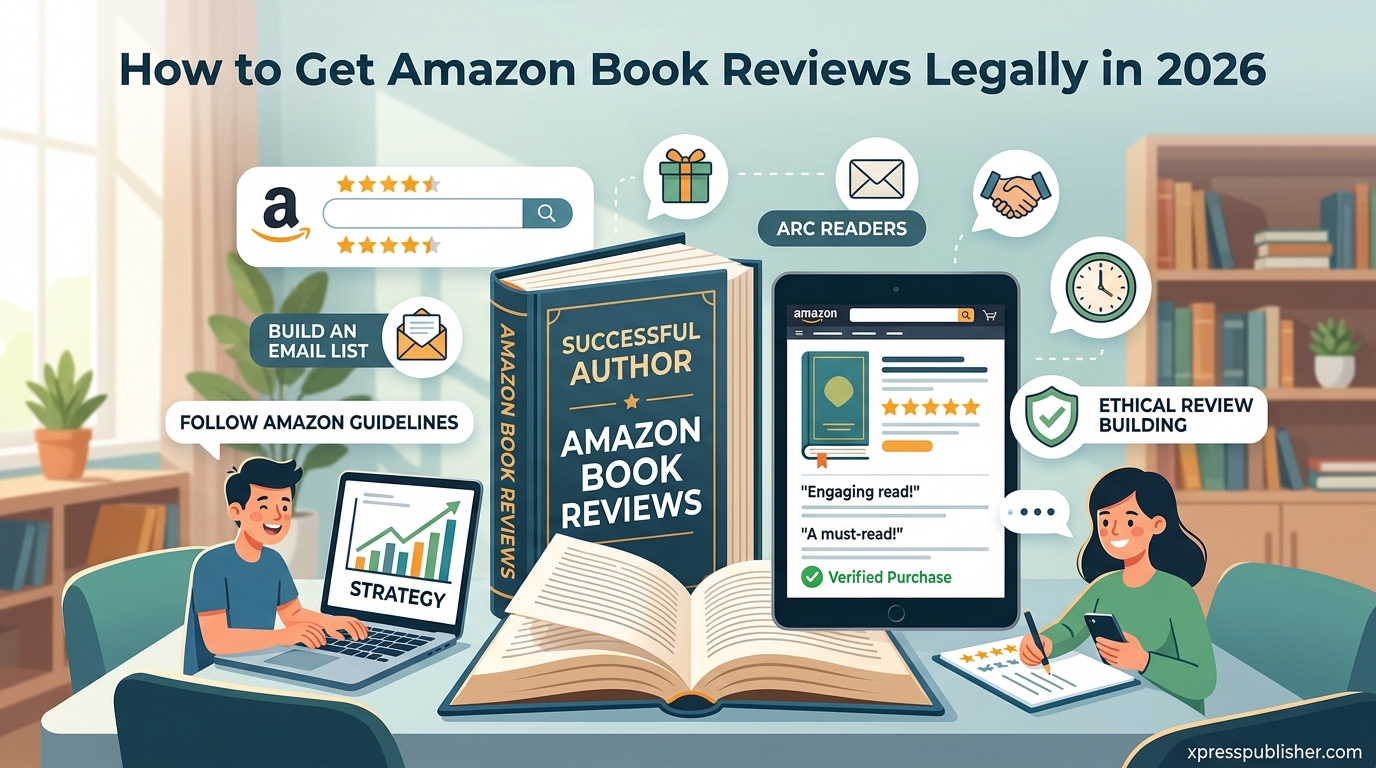
What Amazon Book Reviews Actually Do
Reviews serve three simultaneous functions, and understanding all three changes how you approach the review-building process.
First, they affect Amazon’s algorithm. Reviews are one of several signals Amazon uses to determine how prominently to surface a book in search results, category pages, and “also-bought” recommendations. More reviews — and specifically a steady rate of new reviews — signal to the algorithm that readers are engaging with the book. That signal improves visibility, which generates more sales, which generates more reviews. The compounding works in both directions.
Second, they affect click-through rate. A reader scrolling through category results makes a split-second decision to click or scroll past. A book with 47 reviews and a 4.3-star average looks fundamentally different from the same book with zero reviews. The star display is a trust signal, and it’s visible in the search result before the reader even reaches your listing.
Third, they affect on-page conversion. Once a reader arrives at your listing, the review section is typically the first thing they scroll to after reading your description. The content of your reviews — what readers say they liked, what resonated, what felt authentic about the experience — does more selling than almost any other element of your listing.
Specifically, the first 10–20 reviews are the hardest to get but also the most valuable. Once you pass that threshold, Amazon Ads become more efficient, organic discovery improves, and readers start trusting the book enough to click buy. Getting to 15–25 honest reviews is the first real goal for any newly published book.
Amazon Book Reviews: The Definitive Allowed vs. Not Allowed Table
Amazon has tightened its review enforcement significantly through 2025 and into 2026. Authors who built review counts through grey-area approaches are finding their numbers shrink. The authors who played the long game and prioritised genuine, policy-compliant reviews are coming out ahead. Here is the complete picture of what is and isn’t permitted.
| Strategy | Policy status | Key conditions |
|---|---|---|
| ARC copies in exchange for honest reviews | ✅ ALLOWED | Reviewer must be free to post any rating; must disclose they received a free copy |
| Gifting Kindle copies through Amazon | ✅ ALLOWED | Allows verified-purchase reviews; gifted copies qualify |
| Asking your email list for honest reviews | ✅ ALLOWED | Ask for an honest review, never specifically a positive one |
| Review request in book back matter | ✅ ALLOWED | Standard practice; should explicitly say “honest review” |
| Book bloggers and bookstagrammers | ✅ ALLOWED | No specific rating requirement; they must disclose free copy |
| BookTok creators in your genre | ✅ ALLOWED | Same as above; disclosure required; no rating guarantee |
| NetGalley, Reedsy Discovery, BookSirens | ✅ ALLOWED | Established compliant ARC platforms; reviewers self-select |
| BookFunnel ARC distribution | ✅ ALLOWED | Standard compliant method; widely used |
| Compliant review platforms (e.g. iWrity, Pub Nook) | ✅ ALLOWED | Reader opts in; no rating guaranteed; honest review only |
| Asking friends and close family | ⚠️ GREY AREA | Amazon detects close relationships and may suppress these reviews |
| Review swaps (“I’ll review yours if you review mine”) | ❌ NOT ALLOWED | Amazon explicitly bans direct review exchanges |
| Paying for reviews in any form | ❌ NOT ALLOWED | Any monetary compensation for a review violates TOS |
| Requiring positive reviews from ARC readers | ❌ NOT ALLOWED | Must be truly honest; no minimum star rating |
| Offering gift cards after a review is posted | ❌ NOT ALLOWED | This is paying for reviews regardless of timing |
| Services guaranteeing 4-star or 5-star reviews | ❌ NOT ALLOWED | Violates TOS; reviews typically removed; account at risk |
| Fiverr review gigs | ❌ NOT ALLOWED | Very high risk of review removal and account suspension |
The single rule that covers all of the NOT ALLOWED column: you cannot give anything of value in exchange for a specific rating or for a review that isn’t genuinely the reviewer’s honest opinion. You CAN ask for honest reviews. The key word is “honest” — reviewers must be free to post any rating they choose. Giving free copies (ARCs) in exchange for honest reviews is explicitly permitted. The reviewer must disclose they received a free copy.
The ARC Strategy: Building Reviews Before Launch
The most effective review-building strategy for any book is building an ARC reader list and getting reviews posted on or shortly after launch day. A book that launches with 15–25 honest reviews from ARC readers enters the market at a fundamentally different starting position than one that launches cold.
What an ARC is. An Advance Review Copy is a free digital copy of your book given to readers before publication. In exchange, you ask for an honest review posted around your launch date. You do not specify a rating. You do not follow up to push for positive feedback. The exchange is: book for honest opinion.
How to build your ARC reader list. Start 6–8 weeks before your launch date. The best sources for ARC readers are genre-specific Facebook groups (search “[genre] ARC readers” or “[genre] book club” and you’ll find active communities), subreddits for your genre, dedicated ARC platforms like BookFunnel (where you create an ARC campaign), NetGalley (broader reach, better for mainstream genres), and Reedsy Discovery. For Christian books specifically, faith community groups and church connections are underutilised and highly effective.
What to say when asking for ARC readers. Keep it simple. Here is a template you can use directly:
“Hi — I’m [your name], and I’ve just finished [book title], a [genre/description] book that [one-line description]. I’m looking for readers who enjoy [genre] to read it before its [launch date] publication date and share their honest thoughts on Amazon afterward. Any rating is welcome — I only ask for your genuine reaction. If you’re interested, reply with your email and I’ll send your free copy through BookFunnel. Thank you!”
The phrase “any rating is welcome” is important. It signals to potential ARC readers that you’re not looking for manufactured praise. It also protects you: you’re explicitly not conditioning the free book on a specific outcome.
Your Email List and Back Matter
If you have an existing email list — even a small one — it’s your most reliable source of genuine reviews. These readers already know your work. They signed up because they want to hear from you. A direct, personal email asking for their honest opinion on your new book is the highest-conversion review request you can make.
The key is timing. Send the email shortly after launch, not before. Your email list readers ideally should purchase the book directly from Amazon (creating a verified purchase review), and they need to have read it before they can review it meaningfully. A sequence that works:
- Launch day: Email announcing the book is live, with a direct Amazon link
- Week 2: Follow-up email to anyone who clicked the link but hasn’t reviewed, asking if they enjoyed it and if they’d be willing to leave an honest review
- Week 4: Optional final reminder framed around thanking readers who have reviewed and inviting anyone who hasn’t to share their thoughts
Additionally, every book should include a review request in the back matter. This is a brief, warm paragraph at the end of the book asking readers to leave their honest thoughts on Amazon. Include the direct URL to your Amazon listing’s review page. Here is a template:
“If this book resonated with you, I’d be genuinely grateful if you’d take two minutes to leave an honest review on Amazon. Your feedback helps other readers find books they’ll connect with, and it makes a real difference to independent authors. To leave your review, visit [book title] on Amazon and click ‘Write a customer review.’ Thank you for reading.”
Note the language: “honest review,” not “five-star review.” That phrasing matters both for Amazon policy compliance and for the authenticity of the response you get.
Book Bloggers, Bookstagrammers, and BookTok
Reaching readers through content creators in your genre is a high-value, Amazon-compliant review strategy. These readers have self-selected into your genre audience, they have existing engagement with their followers, and a review from a credible bookstagrammer or BookTok creator does double duty: it’s both an Amazon review and marketing content for the platform where they post.
To find relevant creators: search your genre hashtags on Instagram (#[genre]books, #[genrebookstagrammer]), search BookTok on TikTok for your genre, and look at who is reviewing books similar to yours on Goodreads. Message them directly with a personalised note. Don’t copy-paste the same outreach to every creator — they can tell, and they don’t respond well to it.
Your outreach should include: a brief description of the book, why you thought it might suit their audience specifically, an offer of a free review copy, and no mention of what rating you’re hoping for. The words “completely honest review” or “no rating expectations” in the message go a long way toward getting a positive response.
How Many Amazon Book Reviews You Actually Need
Authors obsess over high review counts, but the threshold that actually matters is lower than most guides suggest.
0–4 reviews: The book is effectively invisible to new readers. Very low conversion rates. Amazon Ads are expensive and inefficient.
5–14 reviews: The book has a basic social proof signal. Conversion improves. Amazon Ads become viable but not efficient.
15–25 reviews: The first meaningful threshold. At this level, most readers have enough social proof to feel comfortable purchasing. Amazon Ads start to show measurable ROI. Organic search placement improves.
50+ reviews: The algorithm notices. Browse placement and category ranking improve. “Also bought” recommendations start to drive meaningful organic traffic.
100+ reviews: The book is well-established in the algorithm. At this point, the review count itself becomes a trust signal rather than just a number.
For most self-published books, the goal in the first 90 days is 15–25 genuine reviews. Everything else follows from there more naturally than it does from zero.
Protecting Your Reviews: What Causes Removal
Amazon removes reviews for several reasons, and knowing them helps you avoid accidentally triggering a removal sweep.
Reviews from people with a detectable relationship to the author (family members, close friends, people who follow you on social media and appear in your network) are increasingly suppressed or removed. Amazon’s systems look for patterns of connection. This is why “ask your friends and family first” is genuinely risky advice in 2026, even though it seems harmless.
Reviews from paid services — even services that claim to provide genuine readers — are removed when Amazon identifies the payment pattern. Multiple reviews posted in quick succession from accounts with similar characteristics (new accounts, limited review history, similar IP addresses) trigger removal algorithms.
Reviews where the reviewer received compensation beyond a free copy — gift cards, payment, services in exchange — violate TOS and are removed when detected.
The practical conclusion: genuinely earned reviews from real readers who received ARCs or purchased the book are far more durable than anything obtained through shortcuts. They’re also more valuable when they stay up, because they contain real language from real readers that converts future buyers.
For more on how your review count connects to your Amazon listing performance, see our complete guide to how KDP works and our 25-step self-publishing checklist — particularly Steps 20 and 22, which cover ARC setup and launch week strategy. If you’d like professional support preparing your book for launch, XpressPublisher’s publishing packages cover the full production pipeline for authors in the US and UK.
Frequently Asked Questions About Amazon Book Reviews
Can I give away free copies in exchange for reviews on Amazon?
Yes. Giving away free copies (Advance Review Copies or ARCs) in exchange for honest reviews is explicitly permitted by Amazon’s review policy. The conditions are: the reviewer must be genuinely free to post any rating they choose, you cannot require a positive review or a minimum star rating, and the reviewer should disclose that they received a free copy. Services like BookFunnel, NetGalley, and Reedsy Discovery are all Amazon-compliant ARC distribution platforms.
Are review swaps allowed on Amazon?
No. Amazon explicitly bans direct review exchanges where you review someone’s book and they review yours. This creates a conflict of interest. Even informal swaps among authors are against Amazon’s review policy. Platforms that facilitated direct review exchanges have been removed from compliance with Amazon’s TOS. The reason: review swaps are incentivised reviews, which Amazon defines as reviews given in exchange for something of value.
Can my friends and family leave reviews on Amazon?
Technically yes, but with significant risk. Amazon’s algorithms detect close relationships between reviewers and authors through shared networks, browsing data, and purchasing patterns. Reviews from people Amazon identifies as closely connected to you are frequently suppressed or removed, even if the review is completely genuine. Many authors who asked friends and family to review early on found those reviews disappeared later. It’s a high-risk, low-reliability strategy compared to building a genuine ARC reader list.
How many reviews does a book need to sell well on Amazon?
The first meaningful threshold is 15–25 honest reviews. At this level, most new readers have enough social proof to feel comfortable purchasing, Amazon Ads become viable, and organic search placement improves noticeably. Reaching 50+ reviews significantly improves algorithm-driven placement in browse and search results. The first 10–20 reviews are the hardest and most valuable — getting there quickly through a pre-launch ARC strategy gives your book its best chance of gaining early momentum.
What is a verified purchase review and does it matter?
A verified purchase review comes from an Amazon account that purchased the book through Amazon. It carries more weight in Amazon’s algorithm than an unverified review. Kindle Unlimited borrows count as qualifying purchases, so KU readers can leave verified reviews. Gifted Kindle copies also generate verified reviews. ARC reviews left by readers who received free copies are typically unverified — they count and are displayed, but verified reviews are algorithmically stronger. A mix of verified and unverified reviews is normal and healthy for any self-published book.
Can I ask readers to leave reviews in my book?
Yes. Including a review request in your book’s back matter is a standard, Amazon-compliant practice. The request should ask for an honest review — never specifically a positive or five-star review. Include the direct link to your Amazon listing’s review page to make it as easy as possible. A simple, warm request at the end of your book that thanks readers for their time and asks for their genuine thoughts is one of the highest-ROI actions you can take for long-term review building.