
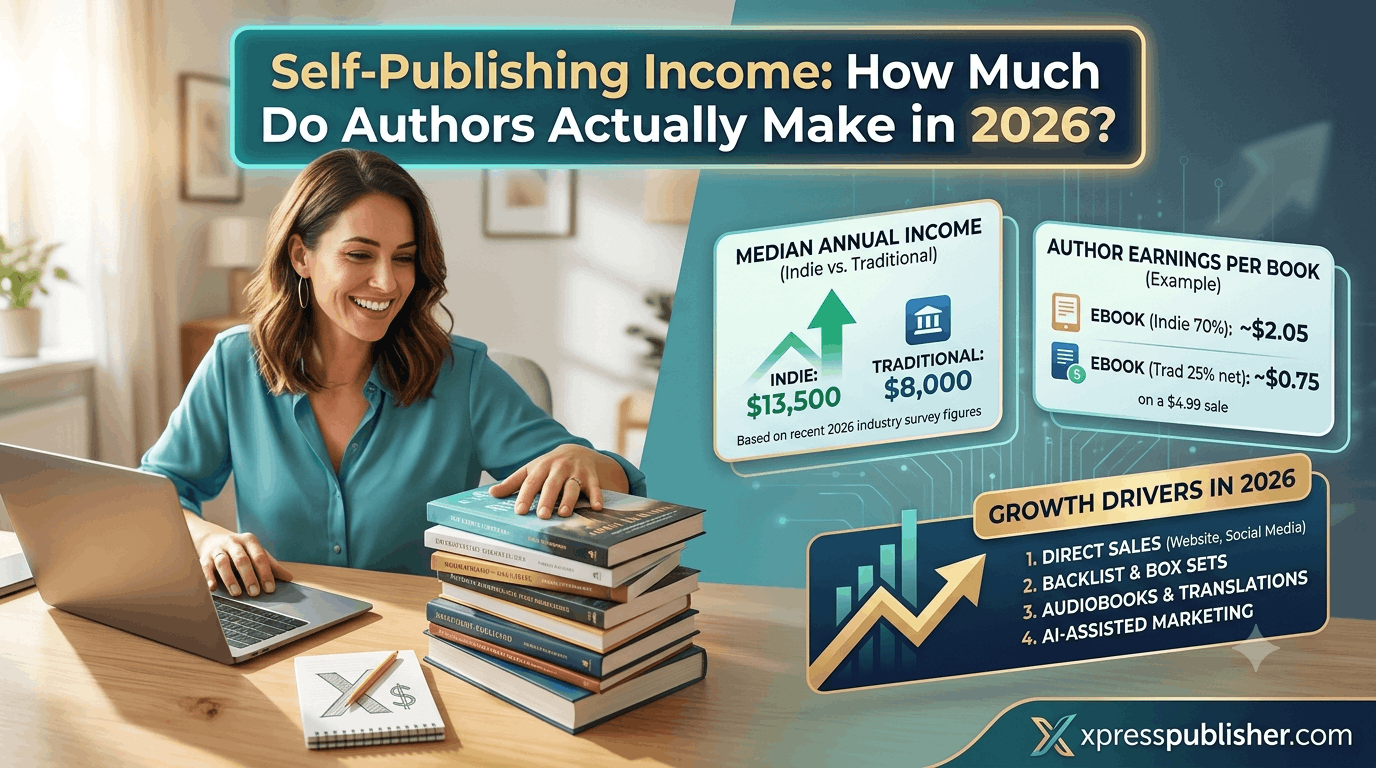
Self publishing income varies more than almost any guide acknowledges. At the bottom: authors who earned under $50 in their first year. At the top: authors generating $200,000+. Both are self-published. Both used Amazon KDP. The difference is not talent or luck — it is a specific set of variables, most of which are within your control. This guide breaks all of them down with real numbers.
The Five Self-Publishing Income Tiers
Most income articles show you the top earners. That’s not useful unless you understand the full distribution. Here is what the realistic picture looks like across all five tiers.
| Tier | Monthly income | Annual income | What it typically requires |
|---|---|---|---|
| Tier 1: New author | $0–$100 | $0–$1,200 | 1 book, no ongoing marketing, sales trail off after launch month |
| Tier 2: Active hobby | $100–$500 | $1,200–$6,000 | 1–3 books, reviews in place, basic category and keyword optimisation |
| Tier 3: Part-time income | $500–$2,500 | $6,000–$30,000 | 3–8 books, active marketing, genre positioning, some paid ads |
| Tier 4: Full-time income | $2,500–$10,000 | $30,000–$120,000 | 8–15+ books, paid ads, email list, strong niche presence |
| Tier 5: Top earner | $10,000+ | $120,000+ | Large backlist, mastered ads and email marketing, high Kindle Unlimited traction |
The distribution is heavily skewed toward the lower tiers. Most self-published authors who publish one book and don’t actively market it will land in Tier 1 or low Tier 2. That’s not a failure of the platform — it’s the predictable outcome of publishing without an ongoing strategy.
What Different Sales Volumes Actually Produce
Royalty percentages mean very little in the abstract. Here is what the math looks like at different sales volumes for the two most common formats.
Ebook at $4.99 on KDP (70% royalty = $3.49 per sale):
| Monthly sales | Monthly income | Annual income |
|---|---|---|
| 25 sales | $87 | $1,047 |
| 50 sales | $175 | $2,094 |
| 100 sales | $349 | $4,188 |
| 250 sales | $873 | $10,473 |
| 500 sales | $1,745 | $20,940 |
| 1,000 sales | $3,490 | $41,880 |
Paperback at $14.99 on Amazon KDP (~$5.14 royalty after print cost):
| Monthly sales | Monthly income | Annual income |
|---|---|---|
| 25 sales | $129 | $1,542 |
| 50 sales | $257 | $3,084 |
| 100 sales | $514 | $6,168 |
| 250 sales | $1,285 | $15,420 |
| 500 sales | $2,570 | $30,840 |
| 1,000 sales | $5,140 | $61,680 |
Two things are immediately clear from those tables. First, paperback royalties per copy are meaningfully better than ebook royalties at equivalent price points — which is why print distribution matters beyond just having a print option. Second, the volumes required for a full-time income from a single title are high. Most authors who build sustainable income do it across multiple titles, not from one book that sells 1,000 copies a month.
What It Actually Takes to Hit $1,000 a Month
This is the number most aspiring authors are thinking about when they search for self publishing income data. Here is the exact math across four scenarios.
| Scenario | Format and price | Per-sale royalty | Sales needed per month |
|---|---|---|---|
| One ebook | $4.99 KDP | $3.49 | 287 sales |
| One ebook | $7.99 KDP | $5.59 | 179 sales |
| One paperback | $14.99 KDP Print | ~$5.14 | 195 sales |
| Three ebooks at $4.99 | $4.99 each | $3.49 each | ~96 per title |
| Kindle Unlimited (300-page book) | KU subscription | ~$1.35 per full read | 741 complete read-throughs |
Notably, the three-ebook scenario is significantly more achievable than the single-ebook scenario. Readers who find book two often buy book one. By book three, the catalogue is doing compounding work. This is why volume matters in self-publishing in a way that it simply doesn’t in traditional publishing.
The Multi-Book Effect on Self-Publishing Income
The most important insight in any honest self publishing income guide: income compounds dramatically with catalogue size, not just marketing spend. Adding a second book in the same genre often doubles total income, not because the second book sells twice as many copies, but because each book markets the others.
Here is what that compounding typically looks like for a mid-genre author with steady marketing:
| Books in catalogue | Typical monthly income range |
|---|---|
| 1 book | $0–$150 |
| 3 books | $100–$800 |
| 5 books | $300–$2,000 |
| 8 books | $700–$5,000 |
| 12+ books | $1,500–$15,000+ |
These are ranges, not guarantees. Genre, marketing effort, and cover quality all move the needle within each row. However, the trend is consistent: authors who build a catalogue earn more than authors who publish one exceptional book and wait.
This is also why professional self-publishing coaches universally recommend committing to a series or a niche before committing to a single standalone title. The economics of backlist compounding are real, and they’re the primary driver of Tier 4 and Tier 5 incomes.
Which Genres Generate the Most Self-Publishing Income
Genre is one of the largest variables in self publishing income, and it’s almost always underestimated by first-time authors.
Romance and its sub-genres — contemporary romance, paranormal romance, romantic suspense — consistently generate the highest per-author income in self-publishing. Readers in these genres consume books at extremely high volumes, build loyal author followings quickly, and are highly engaged in Kindle Unlimited. An author with 10 romance novels in a strong sub-niche can generate full-time income more reliably than almost any other category.
Science fiction, fantasy, and thriller readers show similar patterns. Specifically, readers in these genres read in series, which means each new book in a series compounds the income of all previous books. Many of the top self-publishing earners operate in one of these four categories.
Nonfiction self-publishing income works differently. Individual titles often generate lower per-month income than commercial fiction, but the income is more stable over time. A well-positioned nonfiction book in a specific professional or self-help niche can generate steady sales for years without ongoing marketing. Moreover, nonfiction authors often develop additional income streams — speaking, consulting, online courses — that the book enables rather than replaces.
Christian and inspirational nonfiction is a growing self-publishing market with engaged community distribution. Sales through church networks, Bible study groups, and ministry events can significantly exceed what retail platforms show in reporting. For a real example, see how XpressPublisher authors Joe Roach and Hadassah Roach built reader reach through faith community distribution alongside their Literary Titan award-winning titles.
Children’s books are frequently cited by aspiring authors but are one of the hardest categories for meaningful self-publishing income. Print costs are higher, ebook sales are lower in children’s, and the production quality bar for a market-ready children’s book is very high.
Kindle Unlimited vs. Wide Distribution: The Income Comparison
One of the most consequential decisions in self-publishing income strategy is whether to use KDP Select (Kindle Unlimited exclusivity) or publish wide across all platforms.
KDP Select pays per page read from a shared monthly royalty pool. Historically, the rate has been around $0.004 to $0.005 per page. For a 300-page book, a full read-through generates roughly $1.20 to $1.50. The advantage is Kindle Unlimited’s large subscriber base — particularly in fiction genres where readers are willing to explore new authors at zero marginal cost.
Going wide — publishing on KDP, Kobo, Apple Books, Barnes & Noble Press, and other platforms — captures readers who specifically avoid Amazon or Kindle devices. In some international markets, Kobo is larger than Kindle. Wide distribution also eliminates the 90-day exclusivity requirement that KDP Select imposes, giving you full flexibility.
In practice, romance, fantasy, thriller, and science fiction authors tend to earn more in KDP Select because their readers are highly concentrated in Kindle Unlimited. Nonfiction authors typically earn more wide, because nonfiction readers are less concentrated in KU and more likely to purchase directly across multiple platforms. For a detailed platform-by-platform breakdown, see our self-publishing platforms comparison.
What Actually Separates the Top Earners
The authors in Tier 4 and Tier 5 share a specific set of characteristics. None of them are about talent. All of them are about strategy.
They treat publishing as a business. Top earners track their cost per acquisition, their read-through rate between books in a series, their ad spend versus revenue, and their email list growth. They make decisions based on data, not on what feels right.
They publish frequently. Most top self-publishing earners release 3 to 6 books per year in commercial fiction genres. This pace keeps them visible in Amazon’s new release algorithms and feeds their reader base consistently.
They invest in production quality. Professional cover design, properly formatted interiors, and strong book descriptions are not optional at the top of the market. These are the inputs that determine click-through rate, conversion, and review quality — all of which feed Amazon’s ranking algorithm.
They build direct reader relationships. An email list of engaged readers is the single most reliable source of launch-week sales, which is the primary driver of Amazon algorithm visibility for new books. Authors without an email list are entirely dependent on advertising and organic discovery.
They understand paid advertising. Specifically, Amazon Advertising and Facebook Ads. Most Tier 4 and Tier 5 authors run profitable ad campaigns. Learning to run ads that return more than they cost is a learnable skill — but it requires time, testing, and a catalogue deep enough to justify the cost per acquisition.
Setting Realistic Expectations
The honest version of self publishing income expectations: most authors who publish one book and take a passive approach will make under $1,000 in their first year. This is not a reason to avoid self-publishing. It’s a reason to approach it with a plan.
The authors who build meaningful income share one characteristic above all others: they treat it as a long game. First book. Build readers. Second book. Third book. Learn what’s working. Improve with each title. The income usually starts to compound around books three to five.
Self-publishing income is real. It takes time, multiple titles, consistent effort, and in most cases some marketing investment. For authors who are willing to treat it as a business, the ceiling is meaningfully higher than traditional publishing has ever offered. And unlike traditional publishing, you keep all the rights and the vast majority of the revenue.
If you want professional support with the production side — cover design, interior formatting, and distribution setup through Amazon KDP and IngramSpark — while retaining full rights and all royalties, XpressPublisher’s publishing packages cover the complete production pipeline for authors in the US and UK.
Frequently Asked Questions About Self-Publishing Income
How much do self-published authors make on average?
Self-publishing income varies enormously. Most authors who publish one book without ongoing marketing earn under $500 in their first year. Authors with 3–5 books, active marketing, and strong Amazon optimisation typically earn $500–$2,500 per month. Full-time self-publishing income ($2,500–$10,000/month) usually requires 8 or more titles, paid advertising experience, an email list, and consistent publishing output. A small percentage of authors earn $10,000+ per month, almost universally through a large backlist in commercial fiction genres with mastery of paid advertising.
How much does Amazon KDP pay per book sold?
For ebooks priced $2.99–$9.99, KDP pays 70% of the list price (minus a small delivery fee based on file size). An ebook priced at $4.99 generates approximately $3.49 per sale. For ebooks priced below $2.99 or above $9.99, the rate drops to 35%. For print books, KDP pays 60% of the list price minus the per-unit printing cost, which varies by page count and trim size. A 300-page paperback priced at $14.99 typically generates $4.50–$5.50 per sale after printing costs.
Can self-publishing replace a full-time salary?
Yes, but it typically requires 3–5 years of consistent effort, multiple books (usually 8 or more), and active marketing. The authors who reach full-time income from self-publishing almost universally share three characteristics: they publish frequently (3–6 books per year in commercial fiction, or 1–2 highly targeted nonfiction titles per year), they invest in professional production quality, and they treat marketing as a core part of the business rather than an afterthought. It is achievable, but it is not quick.
Is Kindle Unlimited better for income than selling ebooks directly?
It depends on your genre. For romance, fantasy, thriller, and science fiction, Kindle Unlimited often generates more income than direct sales — because readers in these genres are heavily concentrated in KU and willing to try new authors at no marginal cost. For nonfiction, the picture is usually reversed: nonfiction readers are less concentrated in KU and more likely to purchase directly, making wide distribution (KDP plus Kobo, Apple Books, B&N Press) more profitable. The 90-day exclusivity required by KDP Select is the key trade-off: you gain KU revenue but lose the ability to sell on any other ebook platform.
Why do some self-published authors make so much more than others?
The primary drivers of high self-publishing income are: catalogue size (more books compound income faster), genre selection (commercial fiction genres with strong Kindle Unlimited readership generate more income than niche categories), production quality (professional covers and formatting increase click-through and conversion rates), marketing investment (authors who run profitable Amazon or Facebook ad campaigns consistently outperform those who don’t), and reader relationships (an email list creates reliable launch-week sales that drive Amazon’s visibility algorithm). Writing quality matters, but it is not the primary differentiator between high and low earners.
How long does it take to start making money from self-publishing?
Most authors see their first sales within days of publication, but meaningful income typically takes 1–3 years to develop. The first year is usually about learning: what readers respond to, how Amazon’s algorithm works, what marketing channels are effective for your genre. Income tends to grow significantly with each additional book published. Authors who publish their third or fourth book in the same genre often report that their total income doubled or tripled despite the new book not performing significantly better than earlier ones — because the catalogue is working together.