
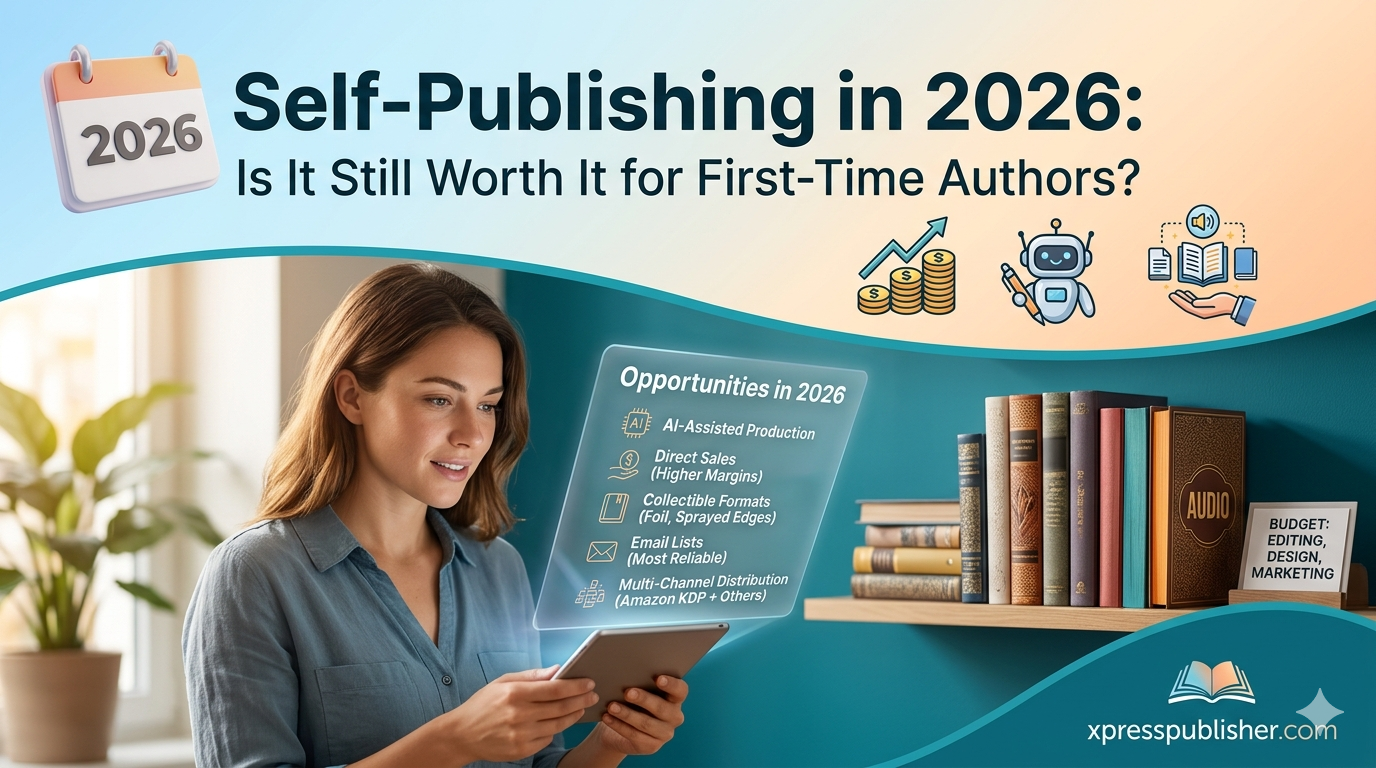
Every week, someone finishes their manuscript and types the same question into Google. Is self-publishing actually worth it in 2026? The answers they find are all over the place. Some authors say it changed their life. Others say it cost them money and led nowhere. Interestingly, both groups are telling the truth.
The difference is rarely the platform or the genre. It is almost always the approach. This guide gives you the honest picture so you can make the right call for your book.
The short answer: is self-publishing worth it in 2026?
Yes, for most authors. But only if you treat it like a business.
Self-publishing in 2026 offers higher royalties than traditional publishing. It also gives you full creative control and a much faster path to publication. Over 50% of Kindle’s Top 400 books are by indie authors. Moreover, Amazon reports that more than 2,000 self-published authors have crossed $100,000 in royalties. Readers are out there waiting. Tools have never been better. And the quality bar readers expect has never been higher either.
Table of contents
- The real numbers behind indie publishing in 2026
- What has actually changed this year
- Who self-publishing works best for
- Where first-time authors go wrong
- Self-publishing vs traditional publishing
- What does self-publishing actually cost?
- How to start the right way
- Frequently asked questions
The real numbers behind indie publishing in 2026
The data makes a strong case for self-publishing. Over 50% of Kindle’s Top 400 books are written by indie authors. That is not a niche corner of the market. In fact, it is half of one of the most competitive bookselling environments in the world.
Ebook revenue in the UK grew 17% last year. On top of that, the number of readers who prefer digital formats is on track to reach 1.1 billion by 2028. Audiobook consumption also grew 36% year on year, according to the Alliance of Independent Authors.
More than 2,000 self-published authors have crossed $100,000 in lifetime royalties on Amazon alone. As an example, Adam Croft self-published nine books and sold half a million copies before signing any traditional deal. Clearly, the economics of self-publishing are genuinely attractive for authors who take it seriously.
What has actually changed in self-publishing in 2026
Self-publishing today looks very different from three years ago. Here are the four changes that matter most for first-time authors right now.
Audiobooks are no longer optional
AI narration tools have dramatically reduced the cost of producing an audiobook. What used to cost $3,000 to $5,000 now costs a few hundred dollars for many titles. Because audiobook consumption grew 36% last year, skipping audio means missing a fast-growing revenue stream. Read our complete guide to audiobooks for indie authors to learn how to produce yours affordably.
Distribution beyond Amazon is now a real strategy
Authors who rely entirely on Kindle Unlimited are more exposed than ever to algorithm changes and policy updates. Platforms like IngramSpark, Kobo, and Apple Books are growing in importance. Additionally, direct-to-reader sales are increasing steadily. Our Amazon KDP vs IngramSpark comparison explains which combination of platforms suits different types of books.
Author branding matters more than your launch day
Every credible industry voice in 2026 is saying the same thing. Discoverability now requires a recognisable author identity, not just a well-timed ad campaign. Readers who follow an author will buy every new book. However, readers who find one book through an ad and cannot follow you anywhere are gone the moment the campaign ends. Learn how to build your author brand before your first launch.
The quality bar has risen sharply
Readers now hold self-published books to the same standard as traditionally published books in most genres. Covers that look out of place, amateur interiors, and unedited manuscripts get penalised more harshly than they did five years ago. As a result, this is the most important shift for any first-time author to understand before publishing.
Who self-publishing works best for
Self-publishing is not the right path for every author or every book. Here is an honest breakdown of where it works well and where it has real limitations.
Genre fiction authors
Romance, thriller, mystery, fantasy, sci-fi, and cozy mystery readers are voracious. Each month, they buy multiple books and follow series loyally. Most discover new titles through Kindle Unlimited, BookTok, and genre communities. Notably, more than half the books in these categories are already independently published. The stigma that once existed in genre fiction is essentially gone.
Non-fiction authors with specific expertise
Consultants, coaches, speakers, and industry professionals do very well when they treat their book as a business tool rather than a standalone revenue source. A well-produced book in your professional field builds authority fast. Moreover, it opens speaking opportunities and attracts clients in ways that a traditionally published book from three years ago simply cannot match on timing alone.
Authors building a catalogue
A first book rarely earns back its production costs straight away. By the third and fourth books, however, the compounding effect of an existing readership starts to show clearly in sales figures. Authors who think in terms of a catalogue rather than one big launch are consistently the ones who build sustainable income from self-publishing.
Literary fiction authors
This is where self-publishing involves a harder trade-off. The prestige of a traditional imprint still carries weight in literary circles. Access to certain review publications and awards eligibility matters to some authors. If those things are important to your goals, the traditional submission process is worth pursuing. If they are not, then self-publishing gives you the same creative ceiling with much better commercial terms.
Where first-time authors go wrong
Authors who have bad experiences with self-publishing almost always share one or more of these three mistakes.
They skipped professional editing
Being confident in your writing is not the same as being able to assess it objectively. Your brain reads what it meant to write, not what is actually on the page. As a result, reviews mentioning typos, awkward phrasing, and structural issues are almost always avoidable. Understanding which type of editing your book needs before spending anything is one of the most valuable things you can do as a first-time author.
They underinvested in their cover
Your cover is the primary marketing asset your book has — not a luxury. Readers browsing Amazon thumbnails make a decision in under two seconds. Furthermore, a cover that looks out of place in its genre is nearly impossible to overcome with good reviews alone. Our guide to book cover design for self-published authors explains exactly what makes a cover sell.
They expected sales without any marketing
Uploading to Amazon does not produce sales on its own. Readers have to find your book first. That requires Amazon ads, social media, an email list, advance review outreach, or some mix of all four. As a result, what actually works in book marketing in 2026 is worth understanding well before your launch date.
Self-publishing vs traditional publishing: key differences
| Factor | Self-publishing | Traditional publishing |
|---|---|---|
| Royalties per book | $4 to $6 on a $14.99 paperback | $1.05 to $1.50 on a $14.99 paperback |
| Time to publication | 4 to 12 weeks from finished manuscript | 2 to 5 years from query to bookshelf |
| Creative control | Complete — title, cover, price, rights | Publisher has final say on most decisions |
| Upfront cost | $1,200 to $4,500 for a professional result | Zero — publisher covers production costs |
| Bookstore distribution | Possible via IngramSpark, not guaranteed | Standard for major publishers |
| Marketing support | Entirely your responsibility | Varies widely, often minimal for debuts |
| Rights ownership | You keep all rights permanently | Publisher acquires rights, often long-term |
| Best suited for | Genre fiction, practical non-fiction | Literary fiction, academic writing |
For a deeper comparison, read our full article on traditional publishing vs self-publishing in 2026.
What does self-publishing actually cost in 2026?
This is the question most first-time authors ask after deciding to go independent. The cost depends on how much you do yourself versus how much you hand off to professionals. Here is a realistic breakdown of the main expenses.
- Editing and proofreading: $600 to $1,200 for a standard novel
- Cover design: $400 to $800 for a professional genre-appropriate cover
- Interior formatting: $150 to $500 for print PDF and ebook EPUB
- Marketing: $200 to $500 for a basic launch window
- ISBN: $0 to $125 depending on the platform
Overall, a professionally produced book costs roughly $1,200 at the lean end and up to $4,500 for a full-service approach. Our complete self-publishing cost breakdown for 2026 covers every line item so you can budget accurately before spending anything.
How to start self-publishing the right way
So you have decided self-publishing is the right path. Here is the order of steps that gives you the best chance of a strong result.
First, polish your manuscript before paying for anything. Beta readers, writing groups, and revision passes are all free. Every problem you catch yourself is money you do not spend on an editor. Then, at minimum, invest in a professional copyedit. Without it, you risk reviews that hurt your reputation before you even build one.
Next, commission your cover from a designer with a strong portfolio in your exact genre. Research the top 20 books in your category on Amazon first, then brief your designer with specific visual examples. After that, get your manuscript formatted properly for both print and ebook before uploading anywhere.
Also, take time to learn how royalties work on the platforms you plan to use. Our guide to self-publishing royalties explains the numbers on both KDP and IngramSpark clearly. Finally, build your email list from day one and start thinking about your second book while preparing the first. A well-made debut with modest but growing sales is a far stronger foundation than a rushed book that collects bad reviews.
Frequently asked questions about self-publishing in 2026
Is self-publishing on Amazon free?
Publishing on Amazon KDP has no upfront platform fees. Instead, Amazon takes a percentage of each sale. However, producing a book professionally still costs money, since editing, cover design, and formatting all require investment. In short, the platform is free but the production is not — unless you do everything yourself.
How much do self-published authors make in 2026?
Earnings vary a lot depending on genre, quality, marketing, and catalogue size. Many authors earn $100 to $500 per month from a single well-produced book. Those earning $5,000 or more per month usually have multiple books in a series and have also invested properly in production and promotion. According to Amazon, more than 2,000 self-published authors have crossed $100,000 in total royalties.
Do I need a literary agent to self-publish?
No, you do not. A literary agent is required only when submitting to major traditional publishers. Self-publishing skips agents entirely. Instead, you upload directly to Amazon KDP or IngramSpark and receive your royalties without any intermediary involved.
How long does self-publishing take from start to finish?
When done properly, allow 4 to 12 weeks from a finished manuscript to a published book. Specifically, editing takes 2 to 4 weeks, cover design takes 1 to 2 weeks, and formatting takes 3 to 7 days. Finally, platform review on Amazon KDP typically takes 24 to 72 hours after upload.
Can a self-published book get into physical bookstores?
Yes, through IngramSpark. Any bookstore or library that orders through Ingram’s distribution network can stock your book, which covers most retailers globally. However, getting actively placed on shelves requires a trade discount of at least 40% and some direct outreach to local stores. It is achievable, although it does not happen automatically.
Is self-publishing still looked down on in 2026?
In genre fiction and practical non-fiction, the stigma is essentially gone. Readers in those categories choose books based on cover, reviews, and description rather than the publisher’s name on the spine. In contrast, literary fiction and academic writing still see traditional publishing carry more prestige. Ultimately, whether that matters depends entirely on your goals as an author.
What is the biggest mistake first-time self-published authors make?
Without doubt, the biggest mistake is skipping professional editing. It is the single most common cause of poor reviews, low ratings, and disappointing sales. You simply cannot objectively assess your own manuscript after months of working on it. A professional editor finds what you cannot see, and that investment pays for itself in the reading experience your book delivers.
At XpressPublisher, we have helped hundreds of authors across fiction, non-fiction, biography, children’s books, and informational titles publish professionally in the USA and UK. If you are serious about self-publishing in 2026, get in touch for a free proposal. We respond within 24 hours.
Call 805-635-2324 (USA) or +44 784 689 5422 (UK). Email info@xpresspublisher.com. Rated 4.2 Great on Trustpilot.