
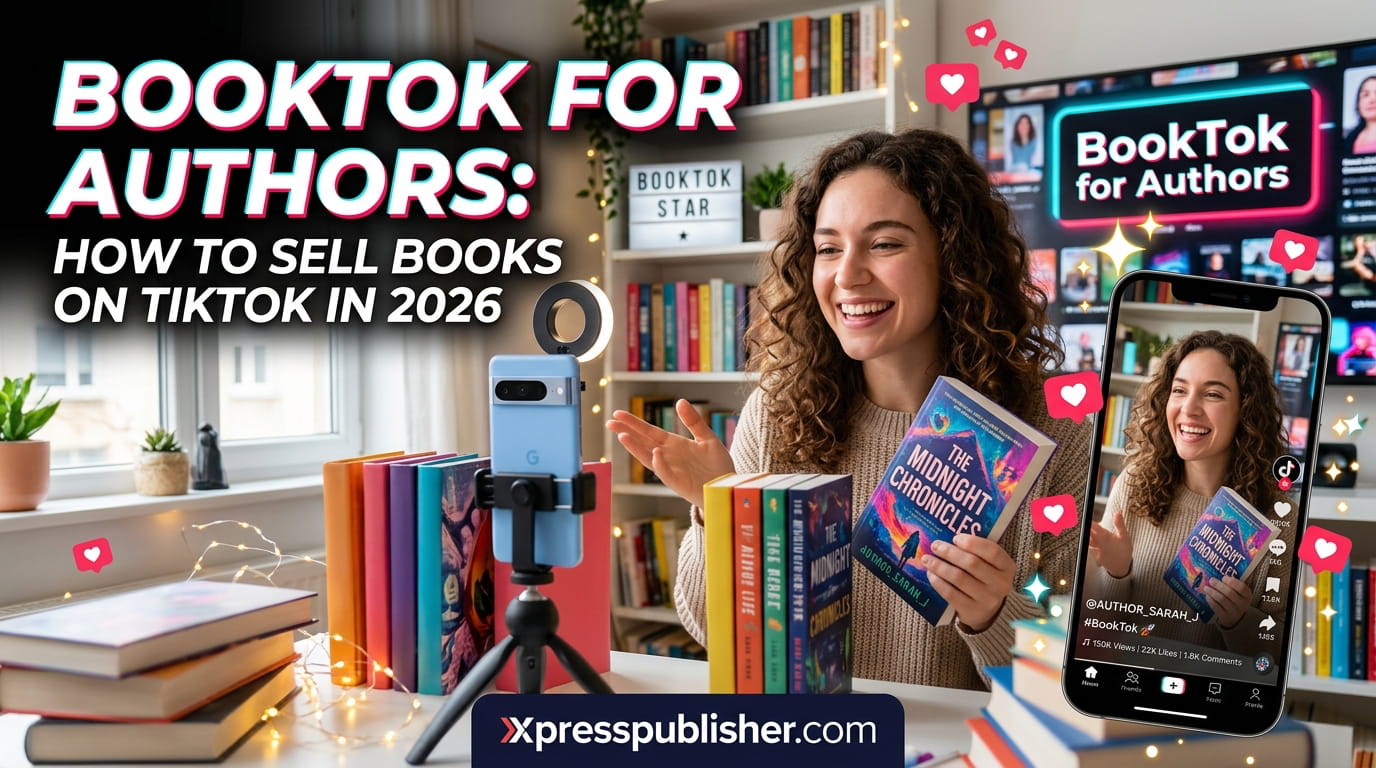
BookTok drove approximately 59 million print book sales in 2024. Not one book — 59 million. The #BookTok hashtag has accumulated over 200 billion views and 36 million videos. In 2026, BookTok for authors is no longer an optional extra. It is the single most powerful organic book-discovery channel available to indie authors, and it gives a debut with no followers the same algorithmic shot as a household name. What it is not is easy. This guide covers what actually works, what genres perform best, and how to build a strategy around it without wasting months on content that doesn’t convert.
Why BookTok for Authors Works Differently From Other Platforms
TikTok’s algorithm is not follower-based. It’s engagement-based. A new author who posts their first video has the same chance of reaching 100,000 people as an author who has been on the platform for two years — if the content earns enough watch-time, likes, comments, and shares in the first few hours of posting. This is structurally different from Instagram, Facebook, or Twitter, where follower count largely determines reach.
Moreover, 45% of TikTok users have purchased a book after seeing it on the platform. Books featured on BookTok see an average 600% increase in sales. Those are not outlier numbers — they represent the consistent effect of the right book reaching the right reader at the right moment of emotional engagement.
The BookTok audience in 2026 has also settled into clear genre preferences. The viral, anything-can-blow-up energy of its earliest years has settled into something more durable: a genre-specific, algorithm-driven discovery engine. Understanding which genres this favours — and which it doesn’t — saves authors significant time and frustration.
Which Genres Perform Best on BookTok
BookTok is not neutral across genres. The platform strongly favours emotionally driven, character-centric fiction with strong trope identities. The genres that consistently outperform on BookTok are:
- Romance — in all sub-genres, but especially enemies-to-lovers, forced proximity, second chance, and sports romance. Romance readers are the most active BookTok community.
- Romantasy — the hybrid of romance and fantasy that has exploded since 2022 and remains dominant in 2026.
- Fantasy — particularly dark fantasy, fae, and epic fantasy with strong character dynamics.
- Psychological thriller — plot-twist content performs exceptionally well for this genre.
- Dark academia — aesthetic-driven content is natural for this category.
- Young adult — the original BookTok audience; highly active and highly share-prone.
Genres that see less BookTok traction: business nonfiction, technical or instructional nonfiction, children’s books, and most literary fiction. This doesn’t mean these genres can’t build an audience on TikTok — it means the algorithm’s natural distribution patterns favour emotional, story-driven content. Nonfiction authors who frame their content around emotional transformation (“here’s what changed when I applied this idea”) outperform those who use informational, lecture-style content.
For Christian nonfiction — a growing category on XpressPublisher — BookTok has a dedicated faith community under hashtags like #ChristianBookTok, #FaithBookTok, and #ChristianReads. This community is smaller than romance or fantasy but highly engaged and deeply loyal to authors they discover through it.
Setting Up Your Author Profile for BookTok
Before posting, set up your profile to convert viewers into followers and followers into readers. Several things matter more than most authors expect.
Switch to a Creator or Business account. This gives you access to analytics, which tells you which content is working and which isn’t. Without analytics, you’re flying blind.
Your bio is your pitch. State your genre and what you write in one line. “I write dark romance with morally grey heroes” tells the algorithm — and every viewer who clicks your profile — exactly who you’re for. Vague bios lose followers. Specific bios attract the right ones.
Link your book directly. TikTok allows a clickable link in bio. Link to your Amazon listing, your Linktree (if you have multiple books), or your website’s book page. Make the path from viewing your video to buying your book as short as possible.
Pin your best-performing video. Your pinned video is the first thing new profile visitors see. Pin the video that best represents your content and that has performed well — not your first video or your favourite video.
The 7 Content Types That Sell Books on BookTok
BookTok content that sells books falls into recognisable patterns. Specifically, the following seven content types consistently outperform promotional posts in converting viewers to buyers.
| Content type | Hook formula | Why it works |
|---|---|---|
| Trope reveal | “If you like [trope], my book has [trope]…” | Targets readers who already know they love the trope; pre-qualifies buyers |
| Plot twist teaser | “This book starts as [X] and ends as [Y]…” | Creates curiosity; viewers watch to understand the gap |
| Emotional reaction | Reading a specific scene with visible, genuine emotional response | Authenticity builds trust; shows real impact rather than claiming it |
| Character dynamic | “This character does [specific thing] and I haven’t recovered” | Emotional investment in characters drives sales faster than plot summaries |
| Aesthetic edit | Book cover + setting imagery + mood-matched trending audio | Visual and audio emotion; highly shareable; builds genre identity |
| “Books like” comparison | “If you loved [famous book], this is your next read” | Captures existing fanbases of comparable titles; the algorithm connects audiences |
| Reading pace brag | “I started this at 10pm. It’s now 4am.” | Social proof of compulsive readability; urgency; shareability |
The content type to avoid: the straight pitch. “My book is available now, here’s what it’s about, please buy it.” The BookTok community responds to authenticity and reacts negatively to content that reads as pure advertising. Every promotional video that leads with the sale rather than the reader’s emotional experience underperforms the equivalent authentic content.
The BookTok Hashtag Strategy
Hashtags on TikTok serve a different function than on Instagram. They’re primarily a categorisation signal to the algorithm, not a discovery channel for users browsing hashtags. The practical guidance:
Use #booktok on every post. This is non-negotiable. It’s the signal that categorises your content for the BookTok audience. Without it, the algorithm has no context for who should see your video.
Add up to 4 genre-specific hashtags per post. Relevant examples by genre:
- Romance: #romantiktok, #romancebooks, #romancereads, #enemiestolovers
- Fantasy: #fantasybooktok, #fantasybookclub, #fantasyreads, #romantasy
- Thriller: #thrillerbooktok, #psychologicalthriller, #thrillerreads
- Christian: #christianbooktok, #faithbooks, #christianreads
- Author content: #indieauthor, #selfpublished, #writertok, #authorlife
Don’t use more than 5 hashtags total. Beyond that, the additional tags produce diminishing returns and can make content look spam-adjacent to the algorithm.
Working With BookTok Creators
You don’t have to create content yourself to benefit from BookTok. Working with established BookTok creators — also called BookTokers — is a well-established author marketing strategy in 2026.
There are two approaches. First, send free copies for honest review consideration. Find creators in your genre by searching your genre’s hashtags and identifying accounts with engaged audiences (comments and shares matter more than follower count). Message them directly with a brief, personalised pitch. Many will review books they’re genuinely interested in at no charge. This is organic and compliant — it’s the ARC model applied to video content.
Second, pay for sponsored content. BookTokers with audiences of 10,000–100,000 followers in your genre typically charge $50–$500 per video for sponsored posts. Larger creators charge significantly more. Sponsored content must be disclosed (“paid partnership” or “gifted”) but doesn’t look substantially different from organic content if executed well. Working with BookTok creators — sending books for honest review consideration, or paying for sponsored content from creators whose audience matches your genre — is a well-established organic-adjacent strategy.
TikTok Shop for Authors
TikTok Shop became a meaningful channel for physical book sales in 2025 and has grown significantly into 2026. It allows creators to link products directly within videos and livestreams, removing the step of navigating from TikTok to an external website.
For self-published authors, setting up TikTok Shop requires having print books available through a distributor that integrates with TikTok’s commerce infrastructure. Currently, this works best for authors who sell print books directly (through their own inventory or through a print-on-demand service that ships directly to buyers). The connection between seeing a book on BookTok and buying it in-app is a genuine friction reduction that drives impulse purchases.
If you’re using IngramSpark or KDP Print for your physical books and want to explore TikTok Shop, verify current integration options directly through TikTok’s Seller Centre — the platform’s commerce features have been updated frequently.
TikTok Ads for Books
TikTok advertising for books is significantly underutilised compared to Facebook and Amazon Ads, which creates a genuine opportunity. According to Publishers Weekly, BookTok-related content helped drive nearly 59 million print book sales in 2024. The ad creative that performs best on TikTok looks like organic BookTok content — it doesn’t look like an ad.
The practical approach: post organic BookTok content consistently for 4–6 weeks before running ads. This tells the algorithm what your content is and who engages with it. Then boost the organic videos that performed best. A video that already achieved 50,000 organic views gives TikTok’s ad system a clear audience signal to expand on. Boosting underperforming content doesn’t work — the algorithm interprets low organic engagement as a quality signal.
Budget starting point: $5–$15/day for initial testing. Run for 7–10 days before evaluating results. Track cost per click to your Amazon listing, not just video views — views are vanity metrics for book marketing; purchases are what matter.
The Mistake That Kills BookTok Success
The single most common mistake authors make on BookTok: treating it as a launch platform rather than a long-term community investment. The authors who are seeing the most consistent BookTok success in 2026 are those who treat it as a long-term community investment rather than a promotional channel to activate around launches.
Authors who post 20 videos during launch week and then disappear don’t build the consistent algorithmic presence that generates sustained discovery. The BookTok audience rewards consistency. Two to three videos per week, maintaining genuine engagement with commenters, participating in trends — this produces compounding discoverability over months. A single launch spike doesn’t.
Also worth noting: backlist titles go viral on BookTok regularly. Publication date is not a factor in TikTok’s algorithm. A book published three years ago can explode in sales from a single video in 2026. This is genuinely different from most marketing channels and is part of why consistent BookTok presence has long-term value beyond individual launch windows.
For more on building your overall book marketing and self-publishing strategy, see our guide to Amazon KDP keywords and our complete breakdown of getting Amazon book reviews. Both feed into the same discoverability engine as BookTok — reviews convert the traffic BookTok sends. To get your book professionally produced and ready for every channel, XpressPublisher’s publishing packages cover the complete production pipeline for authors in the US and UK.
Frequently Asked Questions About BookTok for Authors
What is BookTok and how does it help authors sell books?
BookTok is the book-focused community on TikTok, identified by the #booktok hashtag. It has accumulated over 200 billion views and driven tens of millions of book sales. BookTok helps authors sell books through TikTok’s engagement-based algorithm, which distributes content based on watch time, likes, and shares rather than follower count — giving debut authors the same reach potential as established names. Approximately 45% of TikTok users have purchased a book after seeing it on the platform, and books featured on BookTok see an average 600% increase in sales.
Which book genres do best on BookTok?
Romance (especially enemies-to-lovers, forced proximity, and sports romance), romantasy, fantasy, psychological thriller, dark academia, and young adult fiction consistently outperform other genres on BookTok. The platform favours emotionally driven, character-centric fiction with clear trope identities. Nonfiction can build an audience on BookTok, but the algorithm’s natural distribution strongly favours story-driven content. Christian fiction and nonfiction has a dedicated community under hashtags like #ChristianBookTok and #FaithBooks.
Do I need a lot of followers to succeed on BookTok?
No. TikTok’s algorithm distributes content based on engagement signals, not follower count. A new account with zero followers can reach hundreds of thousands of readers with a single video that earns strong watch time and engagement in its first few hours. This is fundamentally different from Instagram or Facebook, where follower count largely determines organic reach. Many authors have driven significant book sales from their first few TikTok videos with no existing following.
What kind of BookTok content sells the most books?
The content types that consistently convert viewers to buyers on BookTok: trope reveals (targeting readers who already love a specific trope), plot twist teasers (creating curiosity about a book’s emotional arc), emotional reactions (authentic responses to emotionally powerful scenes), character dynamic videos (connecting viewers to specific characters), aesthetic edits (mood-matched visual content), books-like comparisons (connecting to audiences of comparable titles), and reading pace brags (social proof of compulsive readability). Straight promotional content — “my book is out now, here’s what it’s about” — consistently underperforms all of these.
Can I pay BookTok creators to promote my book?
Yes. Paying BookTok creators for sponsored content is a well-established and Amazon-compliant book marketing strategy. Creators must disclose sponsored posts, typically with “paid partnership” or “gifted” labels. Creators with 10,000–100,000 followers in your genre typically charge $50–$500 per video. You can also send books for honest review consideration at no cost — many BookTokers will review books they’re genuinely interested in without payment, particularly if the book suits their audience and genre focus.
How often should I post on BookTok as an author?
Two to three times per week is a realistic and sustainable posting cadence for most authors. Consistency matters more than volume. TikTok’s algorithm rewards accounts that post regularly over time, building a cumulative engagement history that improves distribution of each new video. Posting 20 times during a launch week and then disappearing produces a short spike but no sustained discoverability. The authors who see the most consistent BookTok results in 2026 treat it as a long-term community investment, not a launch activation channel.