
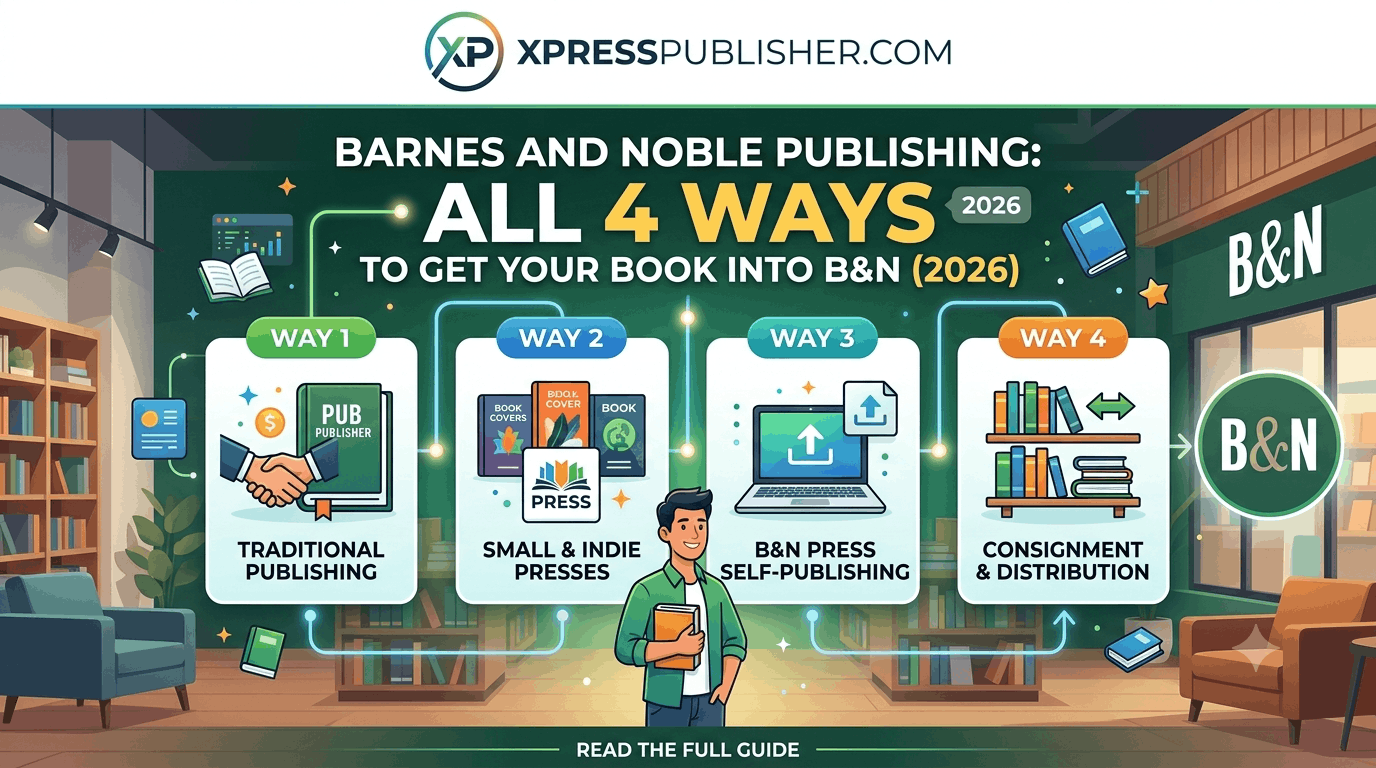
Most self-published authors think Barnes and Noble publishing means signing up for B&N Press. That gets you one website listing. Getting your book into actual Barnes and Noble stores — on physical shelves, in their wholesale catalogue, orderable by library buyers — requires a completely different approach. There are four distinct paths into the B&N ecosystem, and only one of them is the obvious one.
The Four Barnes and Noble Publishing Paths
Before getting into the specifics of each path, here is the map. These four routes are distinct. They serve different goals, require different setups, and produce different results. Some authors need only one. Most authors who want serious B&N presence need at least two.
| Path | What it delivers | Setup cost | Who controls it |
|---|---|---|---|
| B&N Press | BN.com ebook + print-on-demand listing | Free | Author |
| IngramSpark | B&N wholesale catalogue (stores can order) | $49/title | Author via Ingram |
| Local store outreach | Physical shelf placement in specific stores | $0 | Store buyer |
| Traditional publisher | Full retail placement, co-op, store events | $0 (rights trade-off) | Publisher |
Path 1: B&N Press (Barnes and Noble’s Self-Publishing Platform)
B&N Press is Barnes and Noble’s own self-publishing platform. It’s free to use, accepts ebook and print-on-demand titles, and distributes them on BN.com — the Barnes and Noble website. Setup is similar to KDP: you upload your manuscript and cover, set a price, and your book goes live on BN.com within a few business days.
Ebook royalties through B&N Press are 65% for titles priced at $2.99 and above, and 40% for titles priced below $2.99. Print royalties are calculated as a percentage of the list price minus the per-unit printing cost, structured similarly to KDP Print.
What B&N Press does not deliver: physical shelf placement in Barnes and Noble stores. A book published through B&N Press is listed on BN.com as a print-on-demand title. It’s available to order online but is not stocked in stores. A customer who walks into a Barnes and Noble looking for your book will not find it on a shelf unless separate arrangements have been made.
B&N Press also does not connect your book to Barnes and Noble’s wholesale catalogue, which is what store buyers and library procurement systems use. For that, you need Path 2.
B&N Press is best for: authors who want ebook distribution beyond Amazon without the complexity of managing multiple platforms. It’s also a useful complement to KDP for authors going wide (not enrolled in KDP Select). For print distribution beyond BN.com, it is not sufficient on its own.
Path 2: IngramSpark (The Wholesale Route)
IngramSpark is the path most self-publishing guides underexplain when it comes to Barnes and Noble specifically. Here is what it actually does.
IngramSpark is owned by Ingram Content Group, the largest book distributor in North America. When you publish your print book through IngramSpark, it enters Ingram’s wholesale catalogue. That catalogue is the ordering system Barnes and Noble, independent bookstores, academic bookstores, and public libraries all use. A Barnes and Noble buyer, a school district purchasing agent, and an independent bookshop in your city all order through Ingram. When your book is in that catalogue, it is orderable by all of them.
Setup costs $49 per title for print. The file requirements are stricter than B&N Press or KDP: IngramSpark requires print-ready PDFs with correct bleed and trim specifications. A Word document upload is not acceptable. You need a properly formatted interior file. In practice, this means professional formatting software (Vellum, Atticus, InDesign) or a professional formatter.
One specific setting matters enormously for Barnes and Noble placement: the returns policy. Barnes and Noble’s physical stores will not order books they cannot return to the distributor. IngramSpark gives you the option to make your title returnable. Enabling returnability means you pay a fee per returned copy. It is, however, the practical requirement for any realistic chance of physical store placement. Without it, store buyers cannot justify ordering your title regardless of how good the book is.
Additionally, set your wholesale discount at 55% in IngramSpark for Barnes and Noble and bookstore distribution. A 40% discount is technically available, but most bookstores require 55% to make the economics of stocking your book work. Setting a lower discount effectively removes your book from consideration for retail placement.
IngramSpark is best for: any author who wants their print book to be orderable by Barnes and Noble stores, independent bookstores, and library systems. It is the infrastructure layer that makes physical distribution possible. For a full breakdown of IngramSpark’s costs and royalty structure compared to KDP Print and Lulu, see our print-on-demand comparison guide.
Path 3: Local Store Outreach
Getting your book into the Ingram catalogue through IngramSpark is a prerequisite for physical store placement, not a guarantee of it. Barnes and Noble stores make their own stocking decisions. A book in the Ingram catalogue is orderable; whether a specific store decides to stock it is a separate question that often comes down to a direct conversation.
The local outreach approach works like this. You contact the community relations manager or the book buyer at your local Barnes and Noble store, not the corporate office. You introduce yourself as a local author with a book distributed through Ingram — mention that specifically. It tells them the book is returnable and orderable through their existing systems. You offer to do a local author event, a signing, or a reading. You bring or arrange for the store to order a small number of copies on a consignment or returnable basis.
This approach has several things working in its favour. Barnes and Noble stores actively look for local author events, particularly during the holiday season, back-to-school periods, and community events. A local author with a professionally produced book and a clear subject or genre is a genuinely attractive proposition for a community relations manager. The willingness to promote the event through your own network makes it even more so.
The book needs to look the part. A cover that doesn’t match genre expectations, a spine that’s too narrow to read, or an interior that looks self-produced when flipped through will end the conversation before it starts. Physical retail is where production quality matters most visibly.
Local store outreach is best for: authors with community ties, local stories, or topics relevant to a specific region. It’s also the most effective path for Christian authors, memoir writers, and nonfiction authors whose subject matter connects directly to a specific community’s interest. Our Christian book publishing guide covers church and community distribution in more detail.
Path 4: Traditional Publishing
A book published by a traditional publisher with a Barnes and Noble distribution relationship gets access to things self-published authors cannot replicate. These include co-op placement — your book face-out on a featured display table, which publishers pay for. They also include automatic inclusion in seasonal catalogues that Barnes and Noble buyers review, consideration for staff picks programmes, and in some cases author events arranged directly by the publisher’s events team.
This path requires going through the traditional publishing process — literary agent, submission, acquisition, production — which takes 2–4 years and is competitive. For authors specifically targeting Barnes and Noble retail placement as a primary goal, and who are willing to trade rights and royalties for it, this remains the most reliable path to wide physical retail distribution.
For most authors, the combination of Paths 2 and 3 — IngramSpark for wholesale catalogue presence and direct local outreach for physical placement — is the practical alternative that doesn’t require surrendering rights.
Barnes and Noble Press vs Amazon KDP: The Royalty Comparison
Authors deciding whether to publish on B&N Press in addition to KDP often want to know whether the royalties justify the additional platform management. Here is the comparison for ebooks:
| Platform | Ebook price | Royalty rate | Author earns per sale |
|---|---|---|---|
| Amazon KDP | $4.99 | 70% | $3.49 |
| B&N Press | $4.99 | 65% | $3.24 |
| Amazon KDP | $9.99 | 70% | $6.99 |
| B&N Press | $9.99 | 65% | $6.49 |
| Kobo Writing Life | $4.99 | 70% | $3.49 |
B&N Press pays slightly less per sale than KDP for the same ebook price. The question is not whether the royalty is competitive — it’s whether the additional sales volume from Nook readers justifies the setup and management overhead. For most authors, the answer is yes: the setup takes a few hours, ongoing management is minimal, and Nook readers are a distinct audience who prefer to buy through their own platform. Going wide costs nothing except setup time.
Importantly, B&N Press is fully compatible with going wide. If you’re not enrolled in KDP Select, you can publish your ebook on B&N Press, Kobo Writing Life, Apple Books, Google Play Books, and any other platform simultaneously. Our self-publishing platforms comparison covers the full picture of ebook and print distribution options.
Using Multiple B&N Paths Together
The most effective Barnes and Noble publishing strategy for a self-published author uses Paths 1, 2, and 3 together, not just one.
Specifically: publish your ebook on B&N Press for BN.com ebook sales. Publish your print book through IngramSpark (with returnability enabled and 55% wholesale discount) for physical store orderability. Then do local store outreach to convert that orderability into actual shelf placement.
This is also the right order to execute them. Set up IngramSpark before approaching any store. When you make contact with a buyer, your first sentence is: “My book is distributed through Ingram, is fully returnable, and is priced at [X] with a 55% wholesale discount.” That tells the buyer everything they need to know about whether ordering it is logistically straightforward. Without IngramSpark in place, that conversation has nowhere to go.
For authors who want professional production to go into this process — cover design that works in physical retail, properly formatted print files, IngramSpark setup handled correctly — see our complete self-publishing guide and XpressPublisher’s publishing packages. Both books published by Joe Roach and Hadassah Roach through XpressPublisher are set up with exactly this distribution infrastructure. Read their story here.
Frequently Asked Questions About Barnes and Noble Publishing
Can self-published authors get their books into Barnes and Noble stores?
Yes. Self-published authors can get their books into Barnes and Noble stores through a combination of IngramSpark distribution and direct outreach to local store buyers. IngramSpark puts your book in Ingram’s wholesale catalogue, which Barnes and Noble stores use to order inventory. This makes your book orderable — but not automatically stocked. For physical shelf placement, you typically need to contact the community relations manager at your local store, introduce yourself as a local author with a book distributed through Ingram, and propose a local author event or consignment arrangement. The book must be professionally produced, returnable through Ingram, and priced with a 55% wholesale discount.
What is B&N Press and how does it work?
B&N Press is Barnes and Noble’s self-publishing platform. It’s free to use and distributes ebooks and print-on-demand titles on BN.com. Ebook royalties are 65% for titles priced $2.99 and above. Print royalties are calculated as a percentage of list price minus printing costs. B&N Press lists your book on the Barnes and Noble website but does not provide physical bookstore distribution or entry into Barnes and Noble’s wholesale catalogue. For physical store placement, IngramSpark is the required additional step.
Do I need to use both B&N Press and IngramSpark?
For ebook distribution on BN.com, B&N Press alone is sufficient. For print book distribution to Barnes and Noble’s physical stores and into their wholesale catalogue, IngramSpark is what you need — B&N Press print-on-demand does not connect to the same wholesale systems. Many authors use B&N Press for ebook distribution and IngramSpark for print distribution, which gives them both BN.com ebook sales and physical store orderability without duplication.
What wholesale discount should I set in IngramSpark for Barnes and Noble?
Set your wholesale discount at 55% in IngramSpark when targeting Barnes and Noble and other physical bookstores. A 40% discount is the minimum IngramSpark allows, but most bookstores require a 55% discount to make the economics of stocking your book viable. Setting a lower discount effectively removes your book from consideration for retail placement, even if it’s technically in the catalogue. Enable the returnable option at the same time — bookstores will not stock non-returnable titles.
How do I contact a Barnes and Noble store about stocking my book?
Contact the community relations manager at your local Barnes and Noble store directly — not corporate headquarters. Find the store’s phone number on BN.com’s store locator, call during business hours, and ask to speak with the community relations manager. Introduce yourself as a local author with a book distributed through Ingram (mention that specifically). Offer to do a local author event, signing, or reading. Come prepared with: a copy of your book, your IngramSpark ISBN and ordering information, proof that the book is returnable and available at 55% discount, and a clear sense of who your readers are and why they’d come to an event at that store.
Is Barnes and Noble Press worth using if I’m already on Amazon KDP?
Yes, if you are not enrolled in KDP Select. KDP Select requires Amazon exclusivity for your ebook during each 90-day enrollment period, which prevents you from publishing on B&N Press or any other ebook platform. If you are not in KDP Select, setting up B&N Press takes a few hours and adds a distribution channel for the portion of readers who prefer to buy through Barnes and Noble. The royalty (65%) is slightly lower than KDP’s 70% tier, but the additional sales from Nook readers are incremental revenue that costs nothing beyond the setup time.