
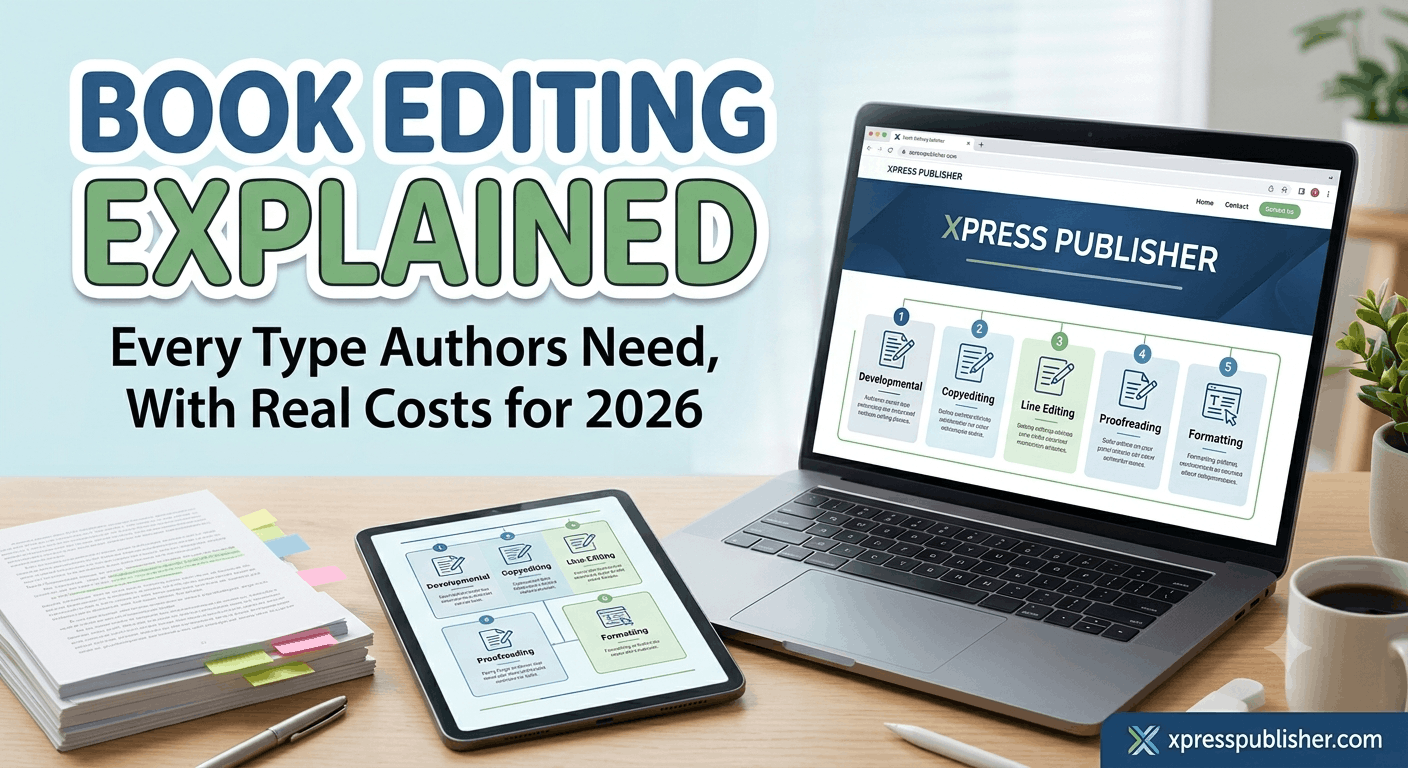
The most expensive book editing mistake is getting the wrong type of edit at the wrong time. A proofreader cannot fix a structural problem. A developmental editor is not a proofreader. These are different jobs, done by different people, at different stages of your manuscript’s life. Most first-time authors don’t know the difference until they’ve already paid for the wrong one.
This guide covers every type of book editing, what each one actually does, what it costs, and how to know which one your book needs right now.
The Five Types of Book Editing
Professional book editing breaks into five distinct types. Each addresses a different layer of the manuscript, and each requires a different skill set from the editor. Here is what each one covers.
| Type | What It Covers | What It Doesn’t Cover | When You Need It |
|---|---|---|---|
| Developmental edit | Structure, pacing, argument flow, character arcs, chapter organisation, whether the book works as a whole | Grammar, spelling, sentence-level prose | After your first full draft, before line editing |
| Structural edit | Organisation of chapters and sections, sequencing, transitions between major sections, logic of the argument | Sentence-level writing, typos | Nonfiction with complex structure; often combined with developmental |
| Line edit | Sentence rhythm, word choice, clarity, voice consistency, paragraph flow, cutting weak passages | Big-picture structure, grammar rules, typos | After structural work is done, before copy editing |
| Copy edit | Grammar, punctuation, spelling, consistency (character names, timelines, facts), style guide adherence | Story structure, sentence rhythm, plot holes | After all content revisions are complete |
| Proofread | Final errors: typos, widows and orphans, spacing issues, formatting inconsistencies | Anything requiring rewriting or restructuring | After interior formatting, immediately before publication |
In traditional publishing, manuscripts go through all five layers before reaching readers. Most self-published books skip at least three of them. That gap is visible in the final product — in reviews, in reader retention, and in how the book is perceived by anyone who reads it professionally.
Which Type of Book Editing Does Your Manuscript Need?
Not every book needs every type. Here is how to think through it honestly.
If this is your first or second draft and you’re not yet sure the structure works: start with a developmental edit. Send your manuscript to a developmental editor before spending money on anything else. A developmental edit on a structurally broken manuscript saves you from investing in line editing, copy editing, and formatting — only to discover the foundation needs to come apart.
If your structure is solid but the prose feels rough or inconsistent: a line edit is what you need. Specifically, a line editor will work through every paragraph and improve the rhythm, clarity, and voice — without touching the big picture.
If your manuscript is finished, revised, and you’re confident in the content: go straight to copy editing followed by a proofread. This is the standard minimum for any professionally published book. Copy editing alone is not enough — a proofread after formatting catches errors that were introduced in the layout process.
If you’re publishing nonfiction with a complex argument or structure: a structural edit before line editing is worth the investment. Nonfiction readers give up faster than fiction readers when the logic doesn’t follow.
How Much Does Book Editing Cost in 2026?
Book editing rates vary widely based on the editor’s experience, their specialty genre, and the manuscript’s condition. The rates below are realistic ranges for qualified professional freelance editors in the US and UK. Budget options exist at the lower end. Experienced, in-demand editors charge at the higher end or beyond it.
| Edit Type | 30,000 words | 50,000 words | 70,000 words | 90,000 words |
|---|---|---|---|---|
| Developmental edit | $600–$1,200 | $900–$1,800 | $1,200–$2,500 | $1,500–$3,200 |
| Line edit | $450–$900 | $700–$1,400 | $950–$2,000 | $1,200–$2,500 |
| Copy edit | $300–$600 | $450–$900 | $600–$1,200 | $750–$1,500 |
| Proofread | $150–$300 | $220–$450 | $300–$600 | $380–$750 |
| Full package (copy + proof) | $400–$800 | $600–$1,200 | $800–$1,600 | $1,000–$2,000 |
These are market-rate estimates for 2026. Rates vary by editor and manuscript condition. A heavily revised manuscript requiring multiple passes will cost more than a clean, well-structured draft.
One thing worth understanding: a cheaper editor is not always a better deal. An editor who charges less but misses significant problems — or lacks experience in your genre — will cost you more in the long run. The point of book editing is for it to be invisible. If readers notice the editing, or notice the lack of it, something went wrong.
How to Find a Book Editor
Several sources reliably produce qualified candidates. The Editorial Freelancers Association (EFA) maintains a member directory with searchable specialisations. Reedsy has a curated marketplace of vetted editors across genres. LinkedIn is useful for finding editors who have worked specifically in your genre or for publishers you recognise. Personal recommendations from authors in your genre are worth more than any directory listing.
When evaluating an editor, ask for their client list and recent projects. Look for editors who have worked on books similar to yours in genre, length, and tone. An editor who specialises in literary fiction may not be the right choice for a Christian devotional. An editor who works primarily in nonfiction may not understand the pacing conventions of commercial thrillers.
Always request a sample edit before committing. Most professional editors will edit two to five pages of your manuscript at no charge. This tells you more about their approach and compatibility than any number of testimonials.
Red Flags When Hiring a Book Editor
Some warning signs are worth knowing before you sign anything.
No verifiable credits. A professional editor should be able to name books they’ve worked on. If an editor can’t point to any titles you can look up, that’s a problem.
Guaranteed results. No editor can guarantee your book will be traditionally published, sell a certain number of copies, or get positive reviews. Anyone who promises outcomes tied to their editing work is not being honest.
No sample edit offered. A legitimate professional editor should be willing to demonstrate their work on a short sample. Refusal to do so is unusual.
Extremely low rates. Rates below $0.003 per word for copy editing are below the market minimum for qualified professionals. Rates below $0.004 per word for line editing are similarly suspect. Unusually low rates warrant investigation into credentials and experience.
Pressure to decide quickly. Legitimate editors are in demand but don’t create artificial urgency. If an editor is pushing you to sign before you’ve had time to review their work or check references, slow down.
No contract. Any professional editing engagement should be documented in a written agreement covering scope, timeline, revision rounds, and payment terms. Working without a contract protects neither party.
The Book Editing Timeline
In a properly sequenced publishing process, book editing follows a specific order. Skipping steps or reversing them creates expensive problems later.
| Stage | Edit type | What happens next |
|---|---|---|
| 1. First complete draft | Developmental or structural edit | Author revises based on editor notes |
| 2. Revised manuscript | Line edit | Author reviews and accepts/rejects changes |
| 3. Finalised content | Copy edit | Author approves corrections |
| 4. Interior formatting complete | Proofread | Corrections made to formatted file |
| 5. Clean formatted file | Final review | Upload to KDP, IngramSpark, or other platforms |
Specifically, the proofread must happen after formatting, not before. Formatting introduces new errors — spacing changes, line breaks, orphaned text — that didn’t exist in the Word document. Proofreading the Word file and then formatting will give you an unproofread formatted book.
Book Editing Within Your Self-Publishing Budget
For most self-published authors working within a budget, the minimum professional standard is a copy edit followed by a proofread. Together, these two passes catch the grammar, consistency, and typo issues that readers notice and mention in reviews.
If your budget allows one additional investment, a developmental edit is the highest-leverage choice for books with complex structures or first-time authors. It’s also worth considering if your manuscript has received conflicting feedback from beta readers. In our 25-step self-publishing guide, editing occupies Steps 2 and 3 — early in the process, before any money is spent on cover design, formatting, or distribution.
XpressPublisher works with authors at every stage of the editing process. For authors who want professional editing alongside cover design, formatting, and distribution setup, our publishing packages cover the complete production pipeline — with full rights and royalties retained. Also worth reviewing: our breakdown of the major self-publishing platforms and how Amazon KDP royalties work once your book is ready to publish.
Frequently Asked Questions About Book Editing
What is the difference between copy editing and proofreading?
Copy editing addresses grammar, punctuation, spelling, consistency, and clarity at the sentence level. It happens before the book is formatted. Proofreading is the final pass after the book has been formatted — it catches errors introduced during the layout process, such as spacing problems, widows, orphans, and typos that slipped through copy editing. You need both. A proofread without a prior copy edit is not sufficient; a copy edit without a final proofread after formatting will leave errors in the finished book.
How much does book editing cost?
Book editing costs vary by type and manuscript length. For a 70,000-word manuscript, realistic 2026 rates are: developmental edit $1,200–$2,500; line edit $950–$2,000; copy edit $600–$1,200; proofread $300–$600. A combined copy edit and proofread for a 70,000-word book typically costs $800–$1,600 from a qualified professional freelance editor. Rates below these minimums are possible but warrant investigation into the editor’s credentials and experience.
Do self-published books need professional editing?
Technically, no platform requires it. In practice, skipping professional editing is the most common reason self-published books receive negative reviews about errors, confusing prose, or unprofessional writing. These reviews persist on your listing and affect sales indefinitely. At minimum, a professional copy edit and proofread are worth the investment. Spell-check, AI writing tools, and friend reviews are not substitutes for a qualified human editor.
What is a developmental edit and do I need one?
A developmental edit looks at the big picture of your manuscript: structure, pacing, argument flow, character arcs (for fiction), and whether the book achieves what it’s trying to do. It does not address grammar or sentence-level issues. Not every book needs one. A debut novel with complex plot structure almost always benefits from one. A short nonfiction book with a clear, confident structure may not. If you’ve received conflicting feedback from beta readers about the story or argument, a developmental edit is the appropriate next step.
Where can I find a professional book editor?
Reliable sources for finding qualified book editors include the Editorial Freelancers Association (EFA) directory at the-efa.org, the Reedsy marketplace at reedsy.com, and personal recommendations from published authors in your genre. Always request a sample edit of 2–5 pages before committing. Verify that the editor has worked on books in your genre, can name recent client projects, and uses a written contract covering scope, timeline, and payment terms.
Can I use AI tools instead of a professional book editor?
AI writing and editing tools can catch basic grammar and spelling errors and are useful as a first-pass self-editing tool. They cannot replace professional editing. AI tools do not understand genre conventions, voice consistency, narrative pacing, argument logic, or the nuanced relationship between a book and its intended reader. Using an AI tool as your only editing pass before publication will produce results that a professional editor or an attentive reader will notice immediately.
[…] The typical editing cost for memoir: developmental edit $800–$2,500, copy edit $500–$1,200. Authors who skip developmental editing and go straight to copy editing frequently produce technically clean books that don’t land narratively. The resulting reviews — “well-written but hard to connect with,” “felt like a private journal rather than a book” — are always avoidable with the right edit at the right stage. For a complete breakdown of editing types and costs, see our book editing guide. […]
[…] For authors who want professional support with the complete process — illustration coordination, layout, KDP setup, and distribution — XpressPublisher works with children’s book authors in the USA and UK. You retain all rights and all royalties from every platform. Also worth reading: our complete self-publishing checklist and our guide to book editing types and costs. […]