
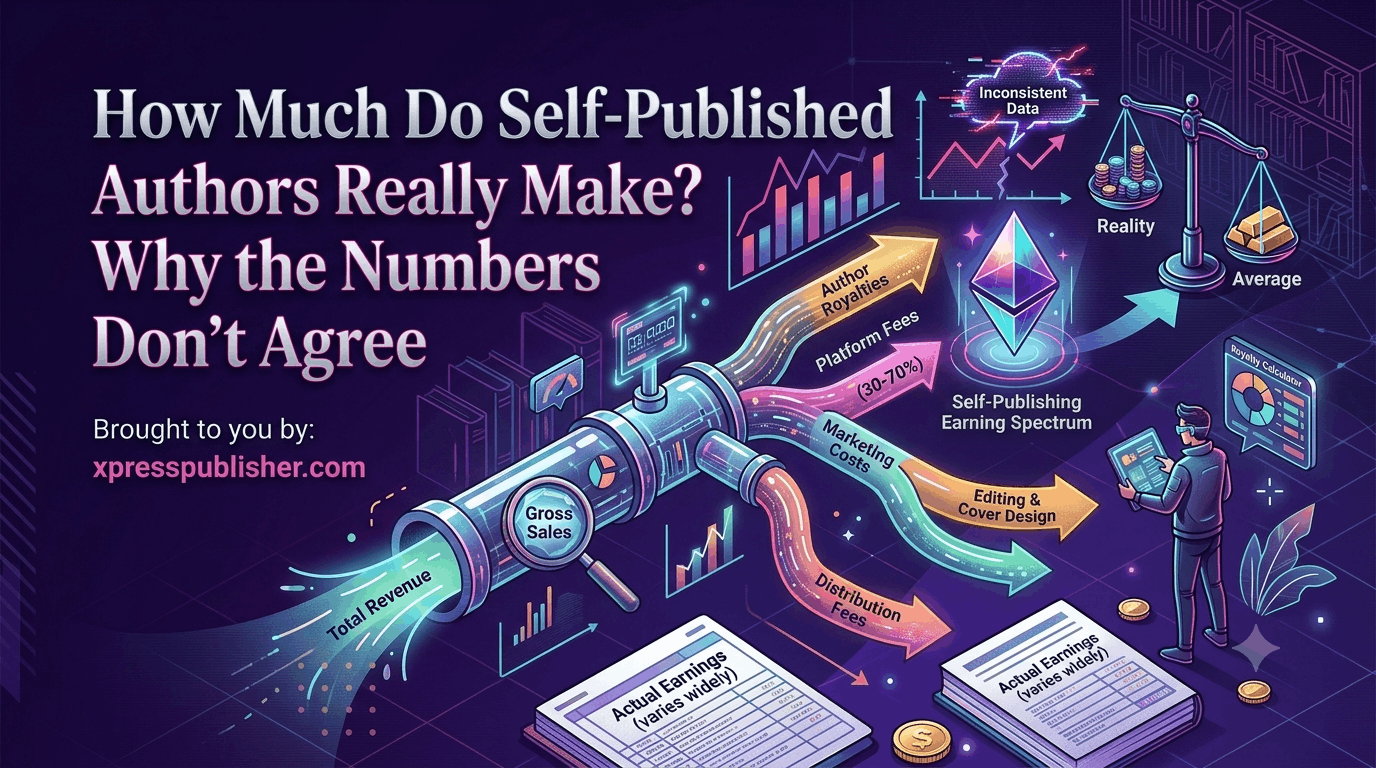
Search “how much do self-published authors make” and you’ll find a number within thirty seconds. The problem is finding the *same* number twice.
One site says the average is $57,272 a year. Another says $68,548. A third, citing an actual survey of indie authors rather than scraped job-listing data, says the median is $13,500. A fourth, citing a different but equally real survey, puts the median closer to $5,000 once you include every author who ever published anything, not just the ones actively marketing.
These aren’t rounding differences. They’re describing different planets. So before adding one more number to the pile, it’s worth answering the question nobody else seems to: when people ask how much do self-published authors make, why do the figures disagree this badly, and which one, if any, applies to you?
How Much Do Self-Published Authors Make? The Numbers, Side by Side
| Source | Figure | What it’s actually measuring |
|---|---|---|
| ZipRecruiter | $57,272/year average | Self-reported job listings tagged “self published author,” largely unrelated to actual book royalty income |
| Generic 2026 income round-up | $68,548/year average | Blended estimate across experience levels, methodology not disclosed |
| ALLi 2025 Indie Author Income Survey | $13,500/year median | Self-selected serious indie authors who passed a 50%+ time-commitment screen (n=1,520) |
| US Authors Guild Author Income Survey | ~$5,000/year median (book income) | Broad survey of all authors, including hobbyists and one-and-done publishers (n=5,699) |
| Written Word Media 2025 Survey | 44% earn $100/month or less | Mixed population of indie authors at every commitment level |
Look at that table and the contradiction stops being mysterious. These aren’t five measurements of the same thing. They’re five measurements of five different populations, and nobody bothered to put the populations next to the numbers.
Why the Gap Is So Big
Sample selection is doing almost all the work
ALLi’s $13,500 median comes from a survey that screened out anyone not spending at least half their working time on writing. That’s not “the average self-published author.” That’s the average among people who already cleared a bar of seriousness most people writing their first book haven’t reached yet.
The Authors Guild number sits lower because it includes everyone: the person who published one book in 2019 and never touched KDP again, right alongside someone publishing four books a year on a real schedule. Both numbers are honest. They’re just not answering the same question, which is exactly why how much do self-published authors make has no single correct answer.
The job-board figures are measuring almost nothing real
ZipRecruiter and similar sites scrape salary data from job postings tagged with a title, in this case “self published author.” There aren’t meaningful numbers of actual job postings for this, because self-publishing isn’t a job anyone hires for. What you’re seeing is a statistical artifact built from a thin, mismatched dataset, dressed up to look like a labor market figure. Treat any number from a general salary aggregator site as background noise on this specific question, not signal.
“Average” hides the shape of the distribution
Author income follows a power-law curve, which is a fancy way of saying a small number of people make most of the money and most people make very little. In a distribution shaped like that, the average gets dragged upward by outliers in a way the median doesn’t. A handful of authors earning $500,000 a year can pull a population average up to a number that describes almost nobody’s actual experience, including most of the people earning solidly comfortable, real, sustainable incomes from their writing.
This is exactly why two of the figures above sit four to five times higher than the others. They’re not wrong, exactly. They’re just answering “what’s the mean,” when the honest answer to “what should I expect” is closer to the median, and the median in every credible survey is dramatically lower than any of the headline averages floating around.
So How Much Do Self-Published Authors Make, Realistically?
The most defensible single number available, from a real survey of real indie authors who treat this as a business, is the ALLi figure: a median around $13,500 a year for committed, actively-publishing authors. That’s not nothing, and it’s also not “quit your job” money for most people in year one.
The factor that moves you up or down that scale more than any other single thing is catalog size. The Written Word Media data is consistent on this point: authors with 25 or more books report a median around $3,000 a month, while the large majority of authors with one to three books earn under $100 a month. That’s not a small gap. It’s the difference between a side project and a second income, and the deciding factor isn’t talent or luck, it’s whether you have a backlist deep enough for readers to fall into.
If you’re one book in and the number you’re seeing right now feels discouraging, that’s because you’re being compared (by these surveys, not by anyone personally) to people several books further along a curve that takes time to climb. The first book is rarely the one that pays the bills. It’s the one that makes the second, third, and tenth book possible.
What Actually Predicts Higher Income, Ranked
Pulling from the more methodologically honest surveys, the factors that move the needle, roughly in order of impact:
Catalog size. More books means more entry points for new readers and more backlist sales reactivated every time you release something new. This is consistently the single strongest predictor across every credible dataset.
Genre. Romance, thriller, and fantasy readers buy in volume and stay loyal to authors across long series. A romance author with a five-book series earns from a completely different baseline than a literary fiction author with one standalone, regardless of either book’s quality.
Publishing consistency. Authors releasing every two to four months consistently out-earn authors releasing annually, partly because algorithms reward recent activity and partly because infrequent releases let readers forget you exist between books.
Cover and listing quality. This is the one lever available to a brand-new author with no backlist yet. A professional, genre-appropriate cover and a well-written book description are the highest-return investment available before you’ve built any of the other advantages.
Platform and pricing strategy. Royalty structures differ meaningfully between KDP’s 35% and 70% tiers, Kindle Unlimited page-read income, and wide distribution. None of this replaces having good books and a backlist, but getting the platform mechanics wrong leaves real money on the table even when everything else is working.
The Honest Answer to How Much Self-Published Authors Make
If someone tells you “the average self-published author makes $60,000 a year,” they’re citing a number that doesn’t describe a real population of working authors. If someone tells you “self-publishing barely pays anything,” they’re usually citing a median that includes a huge number of people who published once and stopped trying. Both extremes get repeated constantly, and both are technically sourced from something, which is exactly how a contradiction this large survives in plain sight for years.
The realistic range for a committed author actively building a catalog sits somewhere between the Authors Guild’s broad median and ALLi’s screened-survey median, with catalog size doing more to determine where you land than almost anything else. If you’re early in that process, our guide on how self-publishing royalties actually work breaks down the platform mechanics in detail, and our piece on whether self-publishing is still worth it in 2026 covers the broader decision honestly.
If you want help thinking through pricing, distribution, and positioning for your specific book, our team at XpressPublisher is happy to talk it through with you.
Frequently Asked Questions About How Much Self-Published Authors Make
What is the real average income for self-published authors?
There isn’t one universally correct number, because surveys measure different populations. The Alliance of Independent Authors’ 2025 survey found a median of $13,500 among committed indie authors who spend significant time on writing. The US Authors Guild’s broader survey, which includes occasional and one-time publishers, found a much lower median closer to $5,000. Generic salary-aggregator figures citing $50,000 to $70,000 are not derived from actual author royalty data and shouldn’t be treated as reliable.
Why do different sources report such different author income figures?
The main reasons are sample selection and the use of average versus median. Surveys that screen for serious, actively-publishing authors report much higher figures than surveys including everyone who has ever self-published. Author income also follows a power-law distribution, meaning a small number of high earners pull the average far above what a typical author actually makes, while the median better reflects a typical experience.
What’s the single biggest factor in self-published author income?
Catalog size. Multiple independent surveys agree that authors with significantly more published books, generally 25 or more, earn dramatically more than authors with one to three books, largely because each new release reactivates interest in the author’s backlist and creates more discovery opportunities.
Can a first-time author expect to make a living from one book?
Rarely, according to every credible income survey. Most authors don’t reach sustainable income from a single title. Income typically builds as an author publishes more books, since backlist sales and reader loyalty compound over a catalog rather than concentrating in any one release.
Are job-site salary estimates for “self-published author” accurate?
No. Sites like ZipRecruiter aggregate job-posting data tagged with a title, but there is no real labor market of employers hiring “self-published authors,” so the resulting figures don’t reflect actual book royalty income. These numbers should be treated as unreliable for this specific question.