
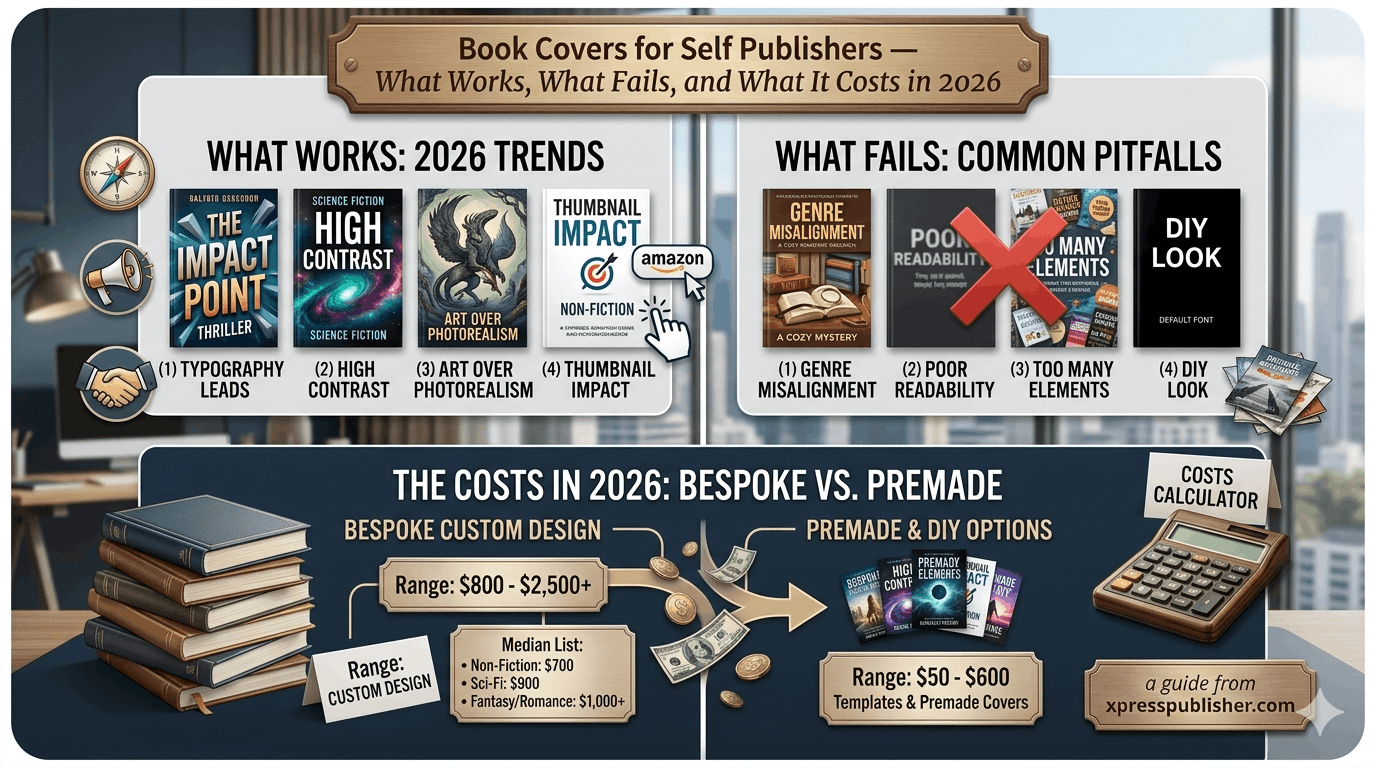
Book covers for self publishers must work harder than covers produced for traditionally published books. A traditional publisher has a design team, a genre specialist, and a sales team who all weigh in on cover performance. As a self-publisher, you make those decisions yourself — or you hire someone to help. Getting it right is not optional. Your cover is the single most visible marketing asset your book has. Readers judge it in under two seconds before deciding whether to click or scroll past.
Why Book Covers for Self Publishers Face a Different Challenge
Traditionally published books benefit from physical shelf placement, publisher credibility signals, and review coverage. Self-published books typically reach readers through Amazon search results, Kindle Unlimited browse pages, BookBub promotions, and social media. In every one of these environments, your cover appears as a small thumbnail — often 80 to 120 pixels wide. It competes directly against dozens of other titles for attention.
Furthermore, self-published books carry no built-in publisher credibility signal. The cover does all the work of establishing genre, quality, and reader expectation on its own. Consequently, a cover that looks slightly amateurish does not just underperform — it actively signals that the content inside may be equally unprofessional. That perception problem affects sales far more than most self-publishers realise.
Book Covers for Self Publishers — The 3 Non-Negotiables
1. Genre Signalling
The most important job your cover does is tell readers instantly what genre they are looking at. Before a reader reads your title, before they read your name, they assess your cover against the visual language of their favourite genre. Romance readers recognise a romance cover at a glance. Thriller readers recognise a thriller. Cozy mystery readers know what to look for.
Study the top 20 bestsellers in your exact Amazon subcategory. Notice the colour palettes, typography styles, image treatments, and compositional conventions. Your cover does not need to be identical — but it must speak the same visual language. A cover that looks like it belongs in a different genre confuses readers and kills conversions, even when the design is technically excellent.
2. Thumbnail Legibility
Most readers first encounter your cover at the size of a postage stamp. Your title must be legible at that size. Your key image must read clearly. Decorative elements that look elegant at full size often become visual noise at thumbnail size. They reduce the impact of your cover rather than enhancing it.
Test your cover by reducing it to 80 pixels wide. Look at it alongside comparable bestsellers in your genre. If your title disappears, if the image muddies, or if the overall impression is weaker than competitors, the cover needs revision before publication. Above all, the thumbnail test is the most important quality check any self-publisher can do before approving a cover design.
3. Typography That Matches Genre Expectations
Font choice communicates genre as powerfully as imagery. Serif fonts suggest literary fiction, historical fiction, or non-fiction authority. Script fonts suggest romance or women’s fiction. Bold sans-serif fonts suggest thriller, action, or business. Distressed fonts suggest horror or dark fantasy. Moreover, font weight and hierarchy — how much visual emphasis your title gets versus your name — follows genre conventions that readers read subconsciously. Match those conventions precisely.
The Most Common Book Cover Mistakes Self Publishers Make
Using Stock Photos Without Customisation
Stock photos are not inherently wrong — most professionally designed covers use licensed stock imagery. The problem is using a stock photo without significant colour grading, compositing, or visual treatment. A recognisable stock image that readers have seen on dozens of other covers destroys the sense of a distinct, professionally produced book. Your designer should transform the source material, not simply place it.
DIY Design Without Genre Knowledge
Design tools like Canva have made it technically easy to produce a cover. However, technical execution is only one component of a cover that sells. Genre knowledge is the other. Most DIY covers fail not because of poor execution but because the designer did not understand what signals the genre requires. Similarly, KDP cover templates almost always produce generic results that signal low investment to readers.
Prioritising Personal Taste Over Reader Expectations
Authors often hold strong opinions about how their book should look. Those opinions frequently conflict with what their target readers respond to. The cover is not for you — it is a sales tool designed to attract the readers who will love your book. Trust genre conventions and reader feedback over personal aesthetic preferences, especially for your first book in a new genre or series.
How Much Do Book Covers Cost for Self Publishers?
Cover design costs vary widely depending on experience level and production complexity. Pre-made covers — professionally designed templates you purchase and customise with your title — typically cost $50 to $200. Custom cover design from an experienced genre specialist costs $300 to $800 for most fiction categories. Illustrated or painted covers for epic fantasy, children’s books, or highly customised non-fiction cost $800 to $2,000 or more.
Indeed, investing in a professionally designed cover from a designer who understands your genre is one of the highest-return investments a self-publisher can make. A strong cover can double or triple click-through rates from Amazon browse pages and paid promotions. For a full breakdown of all self-publishing production costs, read our guide on how much it costs to self-publish in 2026.
Where to Find Cover Designers for Self Publishers
The best cover designers for self-publishers typically specialise in specific genres. Finding a designer with successful covers in your exact genre matters more than finding the best designer in general. Reedsy’s marketplace, The Book Cover Designer, and 99designs all feature genre-specialist designers with portfolios you can review. Additionally, author communities on Facebook and Reddit (r/selfpublishing) regularly share designer recommendations with real sales data behind them.
XpressPublisher’s cover design service produces genre-appropriate book covers for self-published authors in the USA and UK. Get a free cover design consultation here.
Before briefing your designer, read our guide on what makes a book cover actually sell. Also make sure you understand your distribution options by reading our comparison of IngramSpark vs KDP.
Frequently Asked Questions — Book Covers for Self Publishers
How much does a book cover cost for self-publishers?
Pre-made covers cost $50–$200. Custom covers from genre-specialist designers typically cost $300–$800 for most fiction. Illustrated or painted covers for epic fantasy, children’s books, or complex non-fiction cost $800–$2,000 or more. Investing in a professional genre-specialist designer produces one of the highest returns on investment in self-publishing.
Can self-published authors use Canva for book covers?
Technically yes, but most Canva-produced covers underperform commercially because they lack genre-specific visual conventions. The problem is not Canva’s tools — it is that most authors do not have the genre knowledge to signal correctly to readers. If you use Canva, study your genre’s top 20 Amazon bestsellers first and replicate their colour palette, typography conventions, and compositional approach precisely.
What makes a self-published book cover look professional?
Three things make a self-published cover look professional: correct genre signalling (it looks like the bestsellers in your exact category), thumbnail legibility (the title is readable at 80 pixels wide), and typography that matches genre expectations. Covers fail when they prioritise the author’s personal taste over what readers in that genre actually respond to.
Where can self-published authors find book cover designers?
The best sources for finding genre-specialist book cover designers are Reedsy’s marketplace (reedsy.com), The Book Cover Designer (thebookcoverdesigner.com), 99designs, and recommendations in author communities on Facebook and Reddit’s r/selfpublishing. Always look for a designer who has produced successful covers specifically in your genre — genre expertise matters more than general design skill.
What is the thumbnail test for book covers?
The thumbnail test involves reducing your cover image to approximately 80 pixels wide — the size it appears in Amazon search results and Kindle browse pages — and checking whether the title is still legible, the key image still reads clearly, and the overall impression competes with comparable bestsellers. Any cover that fails the thumbnail test will underperform on Amazon regardless of how good it looks at full size.