
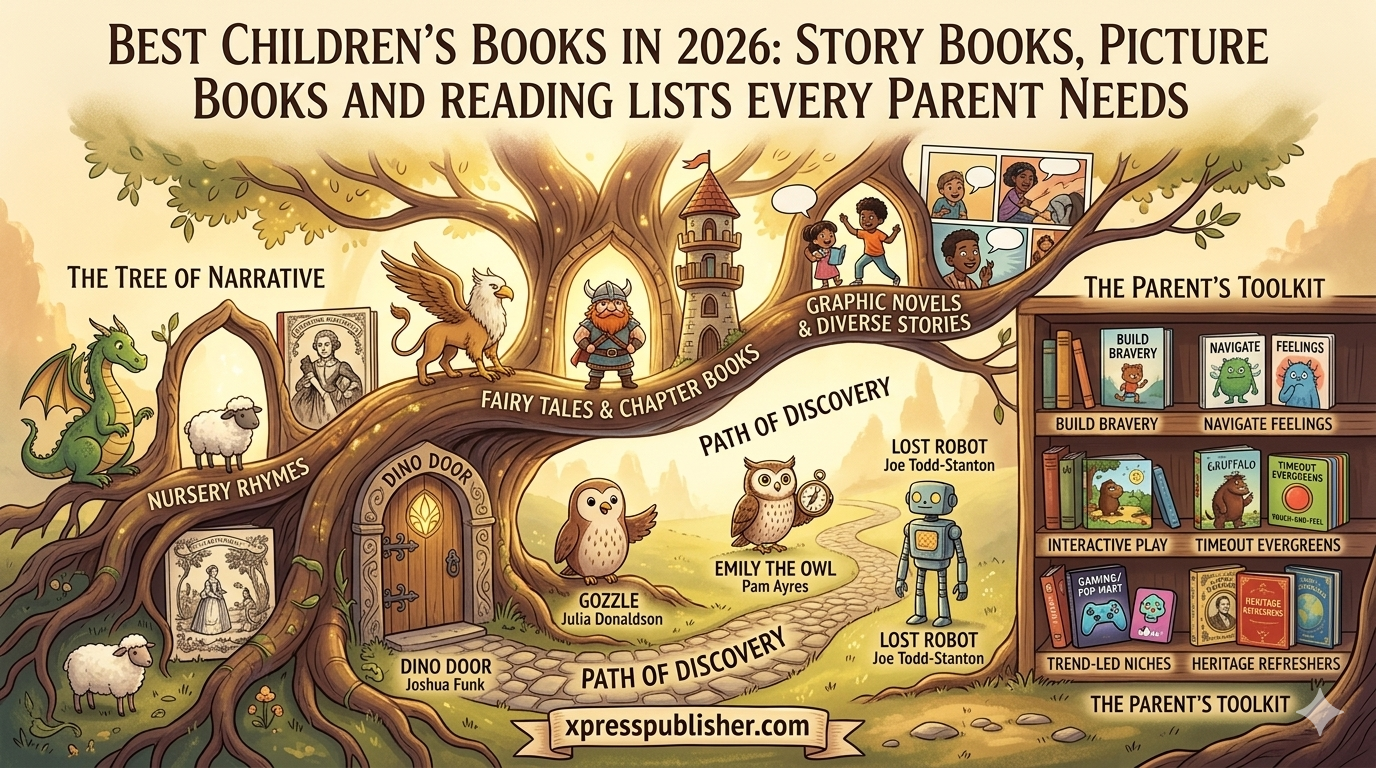
Every parent wants the same thing when they search for children’s books. They want something their child will actually read, not just something that looks good on a shelf. The problem is the sheer volume of options. Walk into any book store or open Amazon on your phone and you are immediately hit with thousands of titles across every age range, theme, and format. Narrowing that down takes time most parents simply do not have.
This guide cuts through that noise. Whether you are looking for story books for kids just starting out, picture books for toddlers, classic children’s books that have stood the test of time, or popular titles other kids are reading right now in 2026, you will find clear recommendations on every category below.
Table of contents
- Why children’s books matter more than ever in 2026
- Best picture books for kids ages 2 to 6
- Best toddler books for early readers
- Best story books for kids ages 6 to 10
- Classic children’s books every child should read
- Most popular children’s books right now
- How to get your child reading every day
- How to publish a children’s book of your own
- Frequently asked questions
Why children’s books matter more than ever in 2026
Screen time for children aged two to twelve has increased significantly over the past five years. Most parents are doing everything they can in genuinely difficult circumstances, so this is not a judgment. However, the research on what reading does for a child’s development is consistent and hard to argue with.
Kids who read regularly develop stronger vocabularies, better comprehension, longer attention spans, and higher levels of empathy. In fact, these differences show up not just on tests but in how children communicate, handle frustration, and relate to other people. A child who reads even twenty minutes a day is building skills that no app or video content replicates at the same depth.
Reading together also remains one of the most effective ways for parents to connect with their children. Sitting down with a story book, turning pages together, and talking about what happens next — both children and parents tend to remember these moments for a long time. No screen, no subscription, and no Wi-Fi required. Just a good book and a few minutes of being present.
Best picture books for kids ages 2 to 6
Picture books are the entry point for most children. Illustration and text working together teaches young readers that stories have structure, that images carry meaning, and that books are enjoyable rather than obligatory. Getting the right picture books for kids at this stage matters because habits formed between ages two and six tend to stick.
The best picture books in this age range share a few qualities. For example, the language is rhythmic and satisfying to read aloud. Illustrations tell part of the story independently, so children who cannot yet read can still engage visually. Themes are simple but not simplistic. Crucially, these books hold up to re-reading, because young children will ask for the same book many times before moving on.
Picture books parents and children both love
Where the Wild Things Are by Maurice Sendak. Fifty years old and still one of the most honest children’s books ever written. It takes a child’s experience of anger and imagination seriously without wrapping it in false comfort. Children recognise themselves in Max, while parents recognise the ending.
The Very Hungry Caterpillar by Eric Carle. Numbers, days of the week, food, transformation. This book teaches without announcing that it is teaching. In addition, the die-cut pages are part of why children love it physically as well as for the story.
Goodnight Moon by Margaret Wise Brown. The repetition and dimming rhythm genuinely help children wind down. It has been a bedtime standard for good reason. The illustrations also reward close looking at every age.
The Snowy Day by Ezra Jack Keats. One of the first picture books to centre a Black child in an everyday story of joy and wonder. The collage illustrations remain distinctive and warm more than sixty years after publication.
Dragons Love Tacos by Adam Rubin. A newer entry that earns its place because children find it genuinely funny and parents do not find it tedious to read repeatedly. The absurd premise is executed with real comedic timing, which is harder to achieve in a picture book than most people realise.
Best toddler books for early readers
Toddler books serve a different purpose from picture books for older children. At this stage, kids are developing object awareness, beginning to understand cause and effect, and learning how to hold a physical book. As a result, durable formats matter. Board books, cloth books, and books with simple tactile elements are all a good fit for children under two.
For children between eighteen months and three years, the best toddler books have short, repetitive text that children can begin to predict, bold clear illustrations, and themes from everyday life like getting dressed, eating, and playing. Familiarity is not a limitation at this age. It is, in fact, exactly what children need.
Toddler books worth having on the shelf
Brown Bear, Brown Bear, What Do You See? by Bill Martin Jr and Eric Carle. The repetitive structure teaches children how to predict and take part in a story. After a few readings, most toddlers can fill in the next animal before the page turns.
Pat the Bunny by Dorothy Kunhardt. The original tactile book. Children under two engage with books through touching as much as looking, and this one was designed specifically around that reality.
Moo Baa La La La by Sandra Boynton. Boynton understands toddlers in a way that makes her books a genuine pleasure for adults to read aloud. The humour is wry without going over young heads, and the animal sounds keep toddlers actively involved.
Chicka Chicka Boom Boom by Bill Martin Jr and John Archambault. The alphabet delivered through a story with real momentum and a satisfying ending. Kids who hear this book regularly often show early letter awareness as a natural result of the repetition.
Best story books for kids ages 6 to 10
This is the age range where reading habits either solidify or start to slip. Children at six have usually cracked the basic mechanics of reading. The real question is whether they find it rewarding enough to keep going on their own. The right story books for kids in this window make reading feel like an adventure rather than a school activity.
Above all else, story is what works here. Plot that moves. Characters children care about. Chapters that end in a way that makes it hard to stop. The best children’s books for ages six to ten do not need to carry moral weight. Instead, they need to be genuinely compelling, because a child who finishes one book and immediately wants another has developed the most important reading habit there is.
Story books kids actually finish
The Magic Tree House series by Mary Pope Osborne. Consistently one of the most recommended series for this age group by teachers and librarians. Chapters are short, historical detail is accurate without being dry, and the series is long enough that a child who loves book one has years of reading ahead.
Diary of a Wimpy Kid by Jeff Kinney. The mixed format of text and cartoons makes it easy to get into for children still building reading stamina. The humour is easy to relate to without being crude. Furthermore, every child who has felt embarrassed at school sees themselves somewhere in Greg Heffley.
Charlotte’s Web by E.B. White. One of those children’s books that handles loss, friendship, and the passing of time honestly without being upsetting. Kids read it at this age and often return as adults with a completely different view of what it is actually about.
The Boxcar Children series by Gertrude Chandler Warner. Popular with young readers for decades. Four siblings living on their own and solving problems together gives children a sense of capable independence that this age group finds deeply appealing.
I Can Read series (various authors). For children at the earlier end of this range who are building reading confidence, the levelled format gives them an achievable challenge that grows with them. Finishing a book on their own at this age matters a great deal for how children see themselves as readers.
Classic children’s books every child should read
Classic children’s books hold their place for a reason. Marketing and nostalgia alone do not keep a book in print for decades. Rather, these titles earned their place by speaking to children’s actual inner lives rather than the inner lives adults imagine children to have.
Reading classic children’s books also gives kids a shared cultural reference point. Stories, characters, and phrases from these books appear throughout literature, film, music, and conversation. As a result, kids who have read them will recognise these references for the rest of their lives.
Classic children’s books that remain essential
The Lion, the Witch and the Wardrobe by C.S. Lewis. A complete fantasy world at a pace and scale children aged seven and above can fully inhabit. Lewis trusted children to handle real stakes, real courage, and real loss. That trust is part of why the book has lasted.
Matilda by Roald Dahl. Dahl understood that children face genuine unfairness at the hands of adults and that stories which acknowledge this are more satisfying than those that pretend otherwise. Matilda is a wish-fulfilment story for every child who has felt overlooked.
A Wrinkle in Time by Madeleine L’Engle. Science fiction that does not talk down to its reader. The main character is awkward, unsure of herself, and brave — a combination that was rare in children’s literature in 1962 and remains less common than it should be today.
The Secret Garden by Frances Hodgson Burnett. A slow, careful story about healing, connection, and how inner and outer worlds affect each other. Patient readers at the upper end of this age range find it deeply satisfying. It tends to be remembered with unusual clarity.
Little Women by Louisa May Alcott. A book about four sisters that covers ambition, sacrifice, love, and identity without ever feeling like a lesson. Jo March remains one of the most fully formed characters in children’s and young adult literature.
Most popular children’s books right now in 2026
Alongside the classics, some children’s books are genuinely having a moment right now. Popular titles in 2026 reflect a few clear trends: diverse main characters, stories that acknowledge big emotions, and non-fiction that treats young readers as curious and capable.
Moreover, the best-selling children’s books across major retailers this year span picture books, middle grade fiction, and illustrated non-fiction. What they share is production quality that matches the story — covers and interiors that look as good as the writing inside them.
What parents and children are reading right now
Dog Man series by Dav Pilkey. Pilkey has done something genuinely unusual — created a series that reluctant readers choose on their own. The comic-style format, silly humour, and surprisingly strong storytelling make Dog Man books the kind of thing parents discover their child has been reading under the covers with a torch.
Big Nate series by Lincoln Peirce. Similar appeal to Diary of a Wimpy Kid but with a more positive main character. Kids who finish one Nate book almost always want the next one, which is the clearest sign that a series is working.
Thornwood by Stephanie Garber. For older children at the top of the middle grade range, fantasy with strong world-building and characters who feel real is where reading interest is high right now.
National Geographic Kids series (various). Non-fiction that looks as good as it reads. The photography is wonderful, the facts are genuinely interesting, and children who say they do not like reading often make an exception because the visual experience is so different from standard chapter books.
How to get your child reading every day
Knowing which children’s books to get is only half the challenge. Getting children to actually read them every day is where most parents find themselves stuck. Kids who read the most are not always the ones who loved reading from the start. Instead, they are the ones whose households made reading a normal and expected part of daily life.
Read together out loud, even past the age when they can read alone
Kids whose parents read aloud to them past the age of independent reading develop stronger understanding and vocabulary than those left to read alone. Reading together also keeps books linked to connection rather than solitude, which matters especially for children who are naturally more social.
Let them choose their own children’s books
A child who reads books about football or horses is building reading stamina regardless of literary value. The habit of finishing books and wanting to start new ones is what matters most at this stage. Taste develops over time. However, the habit either forms now or tends not to form at all.
Make children’s books physically available and visible
Children read what is in front of them. A low bookshelf at a child’s height with covers facing outward increases the chance they will pick up a book on their own. Similarly, leaving books on the kitchen table, in the car, or wherever your child ends up with free time applies the same idea.
Visit the book store and library and let them choose
Children who make their own choices about what to read are more likely to finish what they have started. Browsing, reading the first page of a few options, and choosing for themselves produces a more committed reader than a book picked by an adult. In addition, free kids books through the public library system mean budget does not have to be a barrier.
How to publish a children’s book of your own
Many parents reading this guide have thought about writing and publishing a children’s book of their own. Perhaps there is a story you made up for your child that they want to hear again and again. Or perhaps you have an idea you cannot find in any existing book. It is also possible that you have always wanted to write, and a children’s book feels like the right place to start.
Children’s books are one of the best formats for first-time authors. They are shorter than adult novels, the market is large and active, and a well-produced children’s book has a long shelf life. However, they are also more complex to produce than they look. The relationship between text and illustration, age-appropriate language and theme, and the requirements for a full-colour printed book all need professional attention to get right.
At XpressPublisher, we have helped authors across the USA and UK publish children’s books across every category including picture books, early readers, middle grade fiction, and illustrated non-fiction. From manuscript through to cover design, formatting, printing, and distribution — you keep full rights and all royalties from every sale.
Browse the XpressPublisher portfolio to see the range of children’s titles we have produced. Our guides on self-publishing costs in 2026 and book cover design for self-published authors cover both questions in detail.
Frequently asked questions about children’s books
What are the best children’s books for kids who do not like reading?
Kids who say they do not like reading almost always mean they have not yet found the right book. For reluctant readers, start with high-interest topics in short formats. Graphic novels, illustrated non-fiction, humorous series like Dog Man or Diary of a Wimpy Kid, and books about topics they already care about are all more likely to land than literary fiction or anything resembling a school reading list.
How many children’s books should a child read per month?
There is no magic number. A child who reads one book per month and loves it is in a better position than one who reads ten under pressure and links reading with obligation. Research suggests children who read twenty minutes per day develop stronger literacy skills over time. For a child aged seven to ten, that pace works out to roughly two to four books per month.
Where can I find free children’s books online?
Most public library systems in the USA and UK now offer digital borrowing through apps like Libby, giving library card holders access to free children’s books including ebooks and audiobooks. Project Gutenberg also has a large selection of classic children’s books available at no cost. Many publishers offer free sample chapters or first books in a series to help children find new authors they enjoy.
What age should children start reading chapter books?
Most children are ready to start short chapter books between six and eight, though there is a wide range. Series like Magic Tree House, Junie B. Jones, and the I Can Read series at higher levels are designed for children making this change, giving them a challenge that builds confidence without being too difficult.
What makes a good children’s story book?
The best children’s books take their reader seriously rather than talking down to them. A character the reader can root for, a problem worth caring about, and an ending that feels earned are the key parts. In addition, language that fits the age without being too simple, and respect for the child’s emotional awareness, round out what makes these books work.
How do I publish a children’s book?
Publishing a children’s book means writing a text that fits your target age range, working with an illustrator if needed, editing the manuscript carefully, designing a professional cover and interior, and getting the book onto the right platforms. Working with a team that has specific experience with children’s books makes the process much simpler. Get a free proposal from XpressPublisher to understand what the process looks like for your project.
Are classic children’s books still relevant today?
Yes, genuinely. Classic children’s books that have stayed in print for decades connect with something in children’s experience that does not change between generations. Kids still feel overlooked by adults, still imagine other worlds, and still go through friendship, loss, and the wish for independence. The best classic titles speak to those feelings in language that holds up because the emotional reality they address is constant.
At XpressPublisher, we help authors across the USA and UK publish children’s books that reach real readers. From picture books and story books to middle grade fiction and illustrated non-fiction, our team handles writing, editing, cover design, formatting, publishing, and marketing under one roof. You keep full rights and all royalties. Get a free proposal today and find out what it takes to bring your children’s book to life.
Call 805-635-2324 (USA) or +44 784 689 5422 (UK). Email info@xpresspublisher.com. Rated 4.2 Great on Trustpilot.
I really appreciate how this post organizes children’s books by age and type—it makes finding the right book so much easier for busy parents. Breaking things down like this not only saves time but also helps ensure kids actually enjoy what they’re reading.
The struggle of sifting through thousands of titles is something every parent can relate to, and your guide to cutting through that noise is invaluable for finding stories kids will actually engage with. I particularly appreciate the focus on timeless classics alongside current popular 2026 titles, as it strikes that perfect balance for different reading levels.
You perfectly captured the overwhelming reality parents face when trying to wade through thousands of titles just to find stories that actually engage their kids. This curated list is exactly the kind of relief that parents need to skip the endless scrolling and find quality books, whether they are looking for early readers or timeless classics. It’s great to see a guide that prioritizes what children will truly read rather than just what looks good on a shelf.