
A book launch is not the day your book goes live on Amazon. By that point, the launch has either already succeeded or already failed — depending on what you built in the weeks and months before. The authors who consistently produce strong launches treat the publish date as a reporting day, not a starting day. Everything that determines whether that day generates momentum was done earlier.
This guide gives you the complete book launch strategy — a 12-week pre-launch timeline, the launch team framework, launch week daily actions, and the 30-day post-launch playbook. Whether you’re launching your first book or your fifth, the same structure applies.
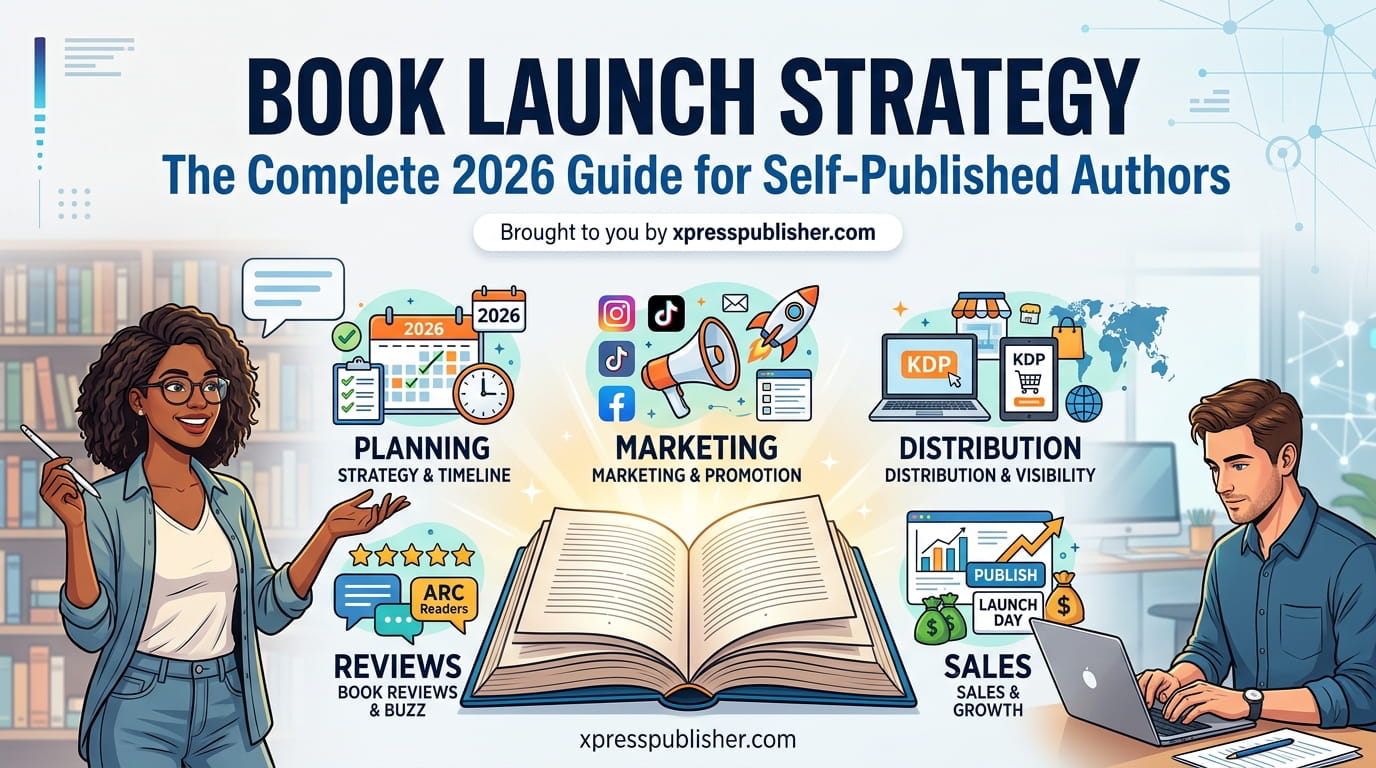
Why Launch Strategy Matters More Than You Think
Amazon’s algorithm weights sales velocity above almost everything else when deciding which new books to surface to readers. Concentrated sales in the first 7 days produce a stronger algorithmic signal than the same number of sales spread over two months. A book that sells 50 copies in its first week ranks far more prominently — and stays more visible — than a book that sells 50 copies in its first month.
Reviews compound this effect. Books that launch with 15–25 reviews convert at dramatically higher rates than books that launch with zero. The combination of early sales velocity and early reviews is what tips Amazon’s recommendation engine to start showing your book to readers who don’t already know you. Getting that combination in place requires preparation — not genius, not a large platform, not a marketing budget. Preparation.
The 12-Week Pre-Launch Timeline
Twelve weeks is the minimum viable pre-launch window for a well-organised launch. Six weeks is doable but rushed. Anything under four weeks almost always means launching cold — no ARC readers, no reviews, no pre-launch audience.
| Weeks out | Focus | Key actions |
|---|---|---|
| 12 weeks | Finalise production, set launch date | Confirm cover, editing complete, formatting done; choose exact launch date; set up pre-order on Amazon (optional but recommended) |
| 10–11 weeks | Recruit launch team and ARC readers | Email your newsletter, post in genre communities, reach out to book bloggers — target 25–50 committed readers |
| 8–9 weeks | Send ARCs; cover reveal | Distribute ARCs through BookFunnel or StoryOrigin; post cover reveal to social media and newsletter; link to pre-order if set up |
| 6–7 weeks | Build buzz; podcast and press outreach | Pitch relevant podcasts; reach out to book bloggers and newsletter curators; ask launch team for early social posts |
| 4–5 weeks | ARC follow-up; set up Amazon | Follow up with ARC readers; complete your KDP categories and keywords; finalise your book description; set up Amazon A+ Content |
| 2–3 weeks | Launch week prep | Schedule newsletter and social posts; confirm launch team members are ready to post on day one; set up Amazon Ads campaign (pending approval) |
| Launch week | Concentrated push | Email list day one; social media posts; launch team posts reviews; ads go live; community outreach |
| Post-launch | Sustain momentum | Monitor ACoS on ads; respond to early reviews; continue social content; pitch additional media |
Building Your Launch Team
A launch team is a group of readers who commit to three things: reading your book before launch day, posting an honest review on Amazon within 48 hours of launch, and sharing about the book on their social media during launch week. They receive a free advance copy in exchange. Target 25–50 members for a debut launch. Experienced authors with established reader communities often build teams of 100–200.
Where to find launch team members:
- Your existing email newsletter — your most reliable source because these readers already signed up to hear from you
- Genre-specific Facebook groups — most have an ARC or launch team section where authors can post calls
- Subreddits for your genre — r/Fantasy, r/Romance, r/ChristianBooks, etc.
- BookTok and Bookstagram — reach out to small to mid-size creators who post about your genre
- Goodreads ARC groups — several genre-specific groups exist specifically for this purpose
When recruiting, be specific about what you’re asking. Specifically, tell them: what the book is (genre, brief description), when they’ll receive their ARC, the launch date, and what you need from them (review on Amazon, share on social). Don’t ask for a positive review — ask for an honest one. That phrasing matters for Amazon’s compliance requirements and for the authenticity of the reviews you receive.
Give your launch team everything they need to share easily. Create a simple one-page document with: three pre-written social media captions they can use or adapt, the book cover as a downloadable image, your Amazon listing URL, your Goodreads link, and your author social media handles to tag. The easier you make it for them, the more of them will actually post.
The Pre-Order Decision
Setting up a pre-order before launch is optional but consistently produces stronger launches than launching cold. Pre-orders serve three functions: they generate sales before launch day (which count as day-one sales in Amazon’s reporting, boosting your launch velocity), they give you a concrete link to include in all pre-launch marketing, and they signal to Amazon’s algorithm that your book has demand before it officially publishes.
For KDP ebooks, set up the pre-order at least 3–4 weeks before your launch date. For print books, KDP Print does not support pre-orders — print goes live on the publish date. Set the pre-order price at your intended launch price. Discounting pre-orders doesn’t significantly drive volume and confuses post-launch pricing expectations.
One important KDP pre-order rule: you must upload your final manuscript at least 10 days before your launch date, or Amazon cancels the pre-order and imposes a 12-month ban on future pre-orders. Don’t set a pre-order date before your manuscript is finalised and in its final format.
The Cover Reveal: When and How
A cover reveal is a dedicated pre-launch marketing moment — you announce and share your cover for the first time, typically 4–6 weeks before launch. It gives you a reason to post, creates a shareable visual moment for your launch team, and starts driving pre-order traffic while your ARC readers are working through the book.
The cover reveal works on social media (particularly Instagram and BookTok, where visual content performs strongly), your email newsletter, and Goodreads (where you can update your listing with the final cover, which triggers notifications to readers who have shelved the book). Build a small moment around it — don’t just post the cover. Pair it with a compelling description, a link to the pre-order, and a call to share. A good cover reveal post includes: the cover image, the book title and release date, a one-line hook from the description, and a question that invites comments (“What does this cover make you expect?” or “Which character do you think this is?”).
Launch Week: The Daily Action Plan
Launch week is where your preparation pays off. The goal is concentrated, coordinated activity across the first 7 days — particularly the first 48 hours, when Amazon’s algorithm is most actively measuring your book’s momentum signal.
Day 1 (launch day): Send your newsletter announcement first thing in the morning. Post on all social channels. Confirm with your launch team that they’re posting reviews today. If you have Amazon Ads set up, verify they went live (approval takes 24–72 hours, so set them up 3 days before launch to ensure timing). Post your cover reveal again if it wasn’t recent — the launch day is worth a re-share.
Days 2–3: Follow up with launch team members who haven’t posted yet. Share early reviews on social media (screenshot or quote). Post behind-the-scenes content — what inspired the book, a scene that changed, something readers won’t learn from reading the book alone. This kind of content consistently generates higher engagement than promotional posts.
Days 4–7: Focus on community reach. Post in genre Facebook groups (where self-promotion is permitted). Reach out to any communities relevant to your book’s subject matter. If you’re a nonfiction author, your professional networks and relevant LinkedIn groups are launch week opportunities. Continue sharing reviews as they come in. Monitor your Amazon ranking and adjust ad bids if needed.
The Metrics That Actually Tell You How Your Launch Is Going
Most authors track their Amazon bestseller rank obsessively and get anxious when it moves. Sales rank is a lag indicator — it tells you what happened, not what’s about to happen. The leading indicators that actually predict continued momentum:
Review velocity: How many new reviews are appearing per day? A book accumulating 2–3 genuine reviews per week in the post-launch period is healthy. Stagnant review count after launch week signals that your reach peaked and needs a new push.
Ad ACoS trend: If you’re running Amazon Ads, is your advertising cost of sale improving week over week? A declining ACoS with stable or growing spend means your listing is converting better as more reviews accumulate — a healthy signal. A rising ACoS with declining sales suggests your launch momentum has dissipated and your listing needs attention (description, keywords, or cover).
Kindle Unlimited page reads (if enrolled): KU page reads are a leading indicator of reader engagement. Completed reads produce significantly more royalties than partial reads. If your page reads are high but completions are low, the book’s opening chapters may need attention for future editions.
The 30-Day Post-Launch Playbook
The most common author mistake after a launch is stopping. Sales decline after launch week — that’s normal — but sustainable book income comes from the compounding of post-launch activity, not from launch week alone.
Weeks 1–2 after launch: Maintain ad spend and continue monitoring ACoS. Request additional Amazon categories from KDP support (you can have up to 10; most authors only set 2 at launch). Update your Goodreads author profile with your reviews. Follow up with any podcasters or reviewers who haven’t published their feature yet.
Weeks 3–4 after launch: Evaluate your first month’s data. Which keywords are generating ad sales? Which aren’t? Move winners to manual campaigns; pause losers. Write a “lessons learned” email to your newsletter — readers love the behind-the-scenes honesty, and it re-engages subscribers who didn’t buy at launch.
Month 2 and beyond: Shift from launch mode to backlist mode. Your book is now a permanent asset. Your job is to keep feeding it visibility through ongoing ads, keyword optimisation, and occasional promotional price drops using Kindle Countdown Deals or free days. Books don’t die — they plateau. Getting them off a plateau requires either a price promotion, a new ad campaign, or a new title in the same series or genre that pulls cross-promotion traffic.
For more on running profitable Amazon Ads campaigns after launch, see our Amazon Ads guide. For building the email list that makes every future launch stronger, see our author email list guide. And if you haven’t yet set up your complete production and distribution infrastructure — the foundation that makes a launch possible — XpressPublisher’s publishing packages cover the full pipeline for authors in the US and UK.
Frequently Asked Questions About Book Launch Strategy
How far in advance should I plan my book launch?
At least 12 weeks before your launch date is the recommended minimum for a well-organised launch. This gives you time to recruit and supply your ARC reader team (who need 4–6 weeks with the book), run a cover reveal, set up pre-orders, pitch podcasts and press, and prepare your Amazon listing with optimised categories and keywords. Six weeks is achievable but leaves little margin for setbacks. Anything under four weeks typically results in launching with no ARC reviews in place, which significantly reduces your launch-day conversion rate.
What is a book launch team and how do I build one?
A launch team is a group of readers who receive a free advance copy of your book and commit to posting an honest Amazon review within 48 hours of launch, and sharing about the book on their social media during launch week. Target 25–50 members for a debut launch. Find them through your email newsletter (the most reliable source), genre-specific Facebook groups, genre subreddits, Bookstagram and BookTok communities, and Goodreads ARC groups. Give them everything they need to share easily: pre-written social captions, downloadable cover image, your Amazon and Goodreads links, and clear dates for when to post.
Should I use a pre-order for my self-published book?
Yes, pre-orders generally produce stronger launches than launching cold. Pre-order sales count as day-one sales in Amazon’s reporting, boosting your launch velocity. They also give you a live listing link to include in all pre-launch marketing. Set up your KDP ebook pre-order at least 3–4 weeks before your launch date, and upload your final manuscript at least 10 days before publication — Amazon cancels pre-orders if the final file isn’t uploaded in time, and imposes a 12-month pre-order ban as a consequence. Note that KDP Print does not support print book pre-orders.
How many reviews do I need before my launch day?
Aim for 15–25 honest reviews posted on Amazon on or within 48 hours of your launch day. This threshold represents the first meaningful social proof signal for readers who discover your book without a personal recommendation — enough reviews that the book looks established rather than brand new and untested. Books launching with fewer than 10 reviews convert at significantly lower rates than those launching with 15+. You can achieve this through an ARC team of 25–50 readers, of whom typically 30–60% follow through on posting.
What is the best day of the week to launch a self-published book?
Tuesday is widely considered the strongest launch day for self-published books. Amazon’s bestseller chart data updates throughout the week, and Tuesday launches give you full weekday momentum before the weekend. Avoid Friday and Saturday launches — weekend book browsing is high but your launch team’s ability to coordinate review posting is lower. Avoid Monday launches — they miss Sunday’s peak browsing activity. Whatever day you choose, coordinate with your launch team so reviews post within 24–48 hours of your launch, while your book is still in Amazon’s “new release” period for your categories.
What should I do if my book launch underperforms?
First, diagnose the cause. Low impressions on your Amazon listing suggest a keywords or category problem — your book isn’t appearing in relevant searches. High impressions but low clicks suggest a cover or title problem. High clicks but low purchases suggest a description or review count problem. Once you identify which metric is the bottleneck, fix that element first. A Kindle Countdown Deal or price promotion can re-inject velocity after a slow launch. Running a BookBub Featured Deal (if selected) or a Bargain Booksy promotion alongside a temporary price reduction is one of the most reliable ways to move a stalled title back into Amazon’s recommendation engine.