
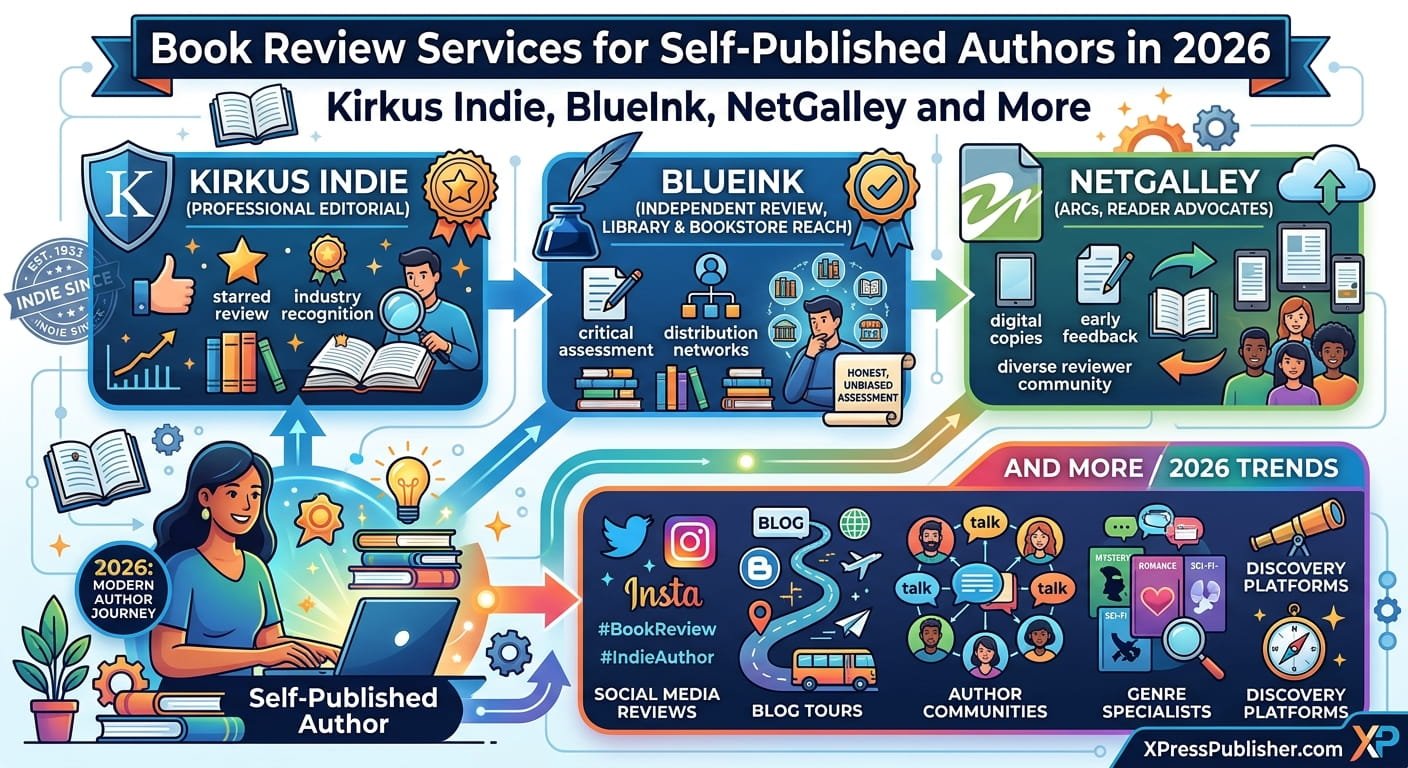
The best book review services for self-published authors can reshape how the publishing world sees your work. A review from Kirkus Indie or Foreword Reviews opens doors to bookstores, libraries, and media coverage that most self-published authors never reach. This 2026 guide breaks down every major review service, what each one costs, what you get back, and how to put those reviews to work in your marketing.
Why Book Reviews Matter More for Self-Published Authors
Traditional publishers send advance review copies to major outlets as a matter of course. Self-published authors have to make that happen themselves. Without credible third-party reviews, it is hard to get stocked in independent bookstores, win a library shelf, or earn media attention.
Many book clubs, school systems, and retail buyers rely on professional reviews when deciding what to order. Reviews also build social proof online. A starred Kirkus review or a Foreword INDIES nomination raises your book above the noise on Amazon and in bookseller databases. Even a short quote signals that an independent professional has vetted your work.
Free Book Review Options in 2026
Several services offer free reviews. Acceptance is competitive and timelines can stretch to months, but the credibility is real.
Publishers Weekly BookLife
Publishers Weekly’s self-published division, BookLife, accepts free review submissions year-round. Reviews appear on the BookLife website and feed into the Publishers Weekly network, which librarians and booksellers read regularly. Turnaround runs three to five months. Only a portion of submissions receive a full review. Those that do get a 150-to-200-word critique with a grade and a verdict. A positive grade here carries real weight with library buyers.
Foreword Reviews (Free Submission)
Foreword Reviews is one of the most respected publications covering independent and small-press books. It accepts free submissions from self-published authors. Only a fraction of those books get reviewed, but the review appears in the Foreword Reviews magazine and on its website. Library buyers follow both closely. Paid priority options (Foreword Clarion) are covered below. For the free tier, submission windows close several months in advance, so plan your timeline early.
Midwest Book Review
Midwest Book Review is a volunteer-run organisation that reviews books for library and community reading audiences. Its reviews reach librarians through several distribution channels. Authors submit for free and turnaround typically runs three to four months. This option works well for community-focused nonfiction and local interest titles.
Paid Book Review Services for Self-Published Authors
Paid services guarantee a review within a set window. The review will be honest, so a weak manuscript may still receive a critical assessment. These services are worth the investment only when your book is fully polished and professionally produced.
Kirkus Indie
Kirkus Reviews is one of the most recognised names in book publishing. Its Kirkus Indie service accepts self-published manuscripts. Standard service delivers a 250-to-350-word review in seven to nine weeks. Expedited service takes four to six weeks. In 2026, standard pricing starts at around $425 and expedited service runs around $575.
Kirkus reviews are blunt. If a book has structural problems, the review will say so. Authors receive their review before it goes live and can decide whether to publish it on the Kirkus website. Only published Kirkus reviews appear in the Kirkus database, which librarians, booksellers, and foreign rights buyers search regularly.
A starred Kirkus review is rare and genuinely valuable. Even a positive review without a star can be quoted in your marketing materials, used on your Amazon page, and submitted to literary contests.
BlueInk Review
BlueInk Review was designed specifically for self-published authors. All reviews appear on the BlueInk website and go to its network of librarians, booksellers, and publishers. Standard turnaround in 2026 is six to eight weeks at around $395. Rush service (three to four weeks) costs about $495.
BlueInk reviews include a star rating and a 300-to-350-word assessment. Authors get a private preview before the review goes live. Positive reviews are syndicated to library discovery tools, including Bowker’s Books In Print. This distribution makes BlueInk useful for authors targeting the library market.
Foreword Clarion Reviews
Foreword Clarion is Foreword Reviews’ paid service for self-published authors. A Clarion review carries the full Foreword Reviews brand credibility. It appears on the Foreword Reviews website and enters your book for consideration in the annual Foreword INDIES Book of the Year Awards. Librarians and booksellers judge the INDIES Awards, and they take them seriously in their acquisition decisions. Pricing runs around $499 in 2026 with a six-to-eight-week turnaround.
The INDIES Awards are among the few book prizes open to self-published titles. Even a Clarion review that does not win an award can go into your media kit and book club submissions.
Self-Publishing Review (SPR)
Self-Publishing Review offers a range of editorial review packages. Its standard review is thorough, honest, and uses a one-to-five-star system. Reviews appear on the SPR website and go to its subscriber network. Pricing starts around $129 for a standard review. SPR is a good entry point for authors who want professional feedback alongside a credible review quote.
NetGalley: Advance Reader Copies for Self-Published Authors
NetGalley is not a review service in the traditional sense. It is a platform where librarians, booksellers, educators, journalists, and book bloggers request and read advance digital copies (ARCs). Publishers and authors upload a digital ARC, then approve reader requests. Approved readers download the book and post reviews on NetGalley, Goodreads, and Amazon.
For self-published authors, NetGalley builds strong pre-launch buzz. These are not formal editorial reviews, but they represent authentic reader voices that matter to algorithms and to social proof. Fees for independent authors in 2026 run around $450 for a six-month listing or $150 for a one-month co-op listing through a partner service.
Use NetGalley three to four months before your release date. Set your availability window to end on launch day. This gives early readers time to post reviews at launch, when you need them most. If you are also running a BookBub promotion, running your NetGalley campaign before the BookBub deal can lift your review count before that traffic arrives.
How to Use Book Reviews in Your Marketing
Getting a review is only half the work. Using it well is the other half.
Add your best review quotes to your book’s Amazon description, your author website, and your press kit. A strong quote from Kirkus or BlueInk placed near the top of your Amazon description can lift click-through rates. Include review excerpts in every media kit you send to journalists, podcast hosts, or book clubs.
If you are approaching independent bookstores for in-store stocking or events, a professional review in your pitch packet shows buyers that your book has been vetted. Most review services allow you to quote their review text in marketing materials. Always credit the source and check the specific terms before quoting.
Choosing the Right Services for Your Goals
Your goal shapes which services to pursue.
Library sales and institutional buyers: Prioritise Kirkus Indie, BlueInk, Foreword Clarion, and Publishers Weekly BookLife. Librarians check these sources regularly when making purchasing decisions.
Pre-launch buzz and reader reviews: Use NetGalley. It reaches book bloggers and early readers who post across social media and retail platforms.
Awards and prize eligibility: Foreword Clarion reviews make your book eligible for the INDIES Awards, one of the few prizes open to self-published titles.
Budget-conscious authors: Start with the free options (Publishers Weekly BookLife, Foreword free submission, Midwest Book Review) and invest in one paid service once your book is fully polished. For guidance on producing a professional book before you seek reviews, the team at XpressPublisher’s publishing services can help you get there.
Whatever services you choose, give yourself at least three months before your release date. Most paid services take six to ten weeks and you will want time to work review quotes into your pre-launch materials.
Frequently Asked Questions About Book Review Services
Are paid book review services worth it for self-published authors?
Paid reviews are worth it when your book is fully polished and you are targeting the library market, bookstore buyers, or literary awards. Services like Kirkus Indie and BlueInk are known to librarians and booksellers. They can open distribution channels that are hard to access otherwise. They are not guaranteed marketing wins, but a strong review from a credible outlet has real commercial value for a self-published book.
Can a self-published author get a free Kirkus review?
Traditional Kirkus reviews are assigned by the Kirkus editorial team for books from established publishers. Self-published authors cannot apply for a traditional free Kirkus review. The Kirkus Indie paid service is the route available to independent authors who want a Kirkus-branded review.
What is NetGalley and how does it work for self-published authors?
NetGalley is a platform where librarians, booksellers, educators, and book bloggers request advance digital copies of upcoming books. Self-published authors pay a listing fee, upload their digital ARC, and approve reader requests. Approved readers download the book and post reviews on NetGalley, Goodreads, Amazon, and their blogs. It works best when used three to four months before your release date.
Which book review services do librarians use most?
Librarians follow Publishers Weekly, Kirkus Reviews, Foreword Reviews, and Library Journal most closely. For self-published titles, Publishers Weekly BookLife, Kirkus Indie, BlueInk Review, and Foreword Clarion are the services most likely to reach library buyers. BlueInk also syndicates reviews to Bowker’s Books In Print, which many libraries search when evaluating purchases.
How much does it cost to get a professional book review in 2026?
Professional review services for self-published authors range from free to around $500 in 2026. Free options include Publishers Weekly BookLife, Foreword Reviews (free tier), and Midwest Book Review. Paid services include Kirkus Indie (from about $425), BlueInk Review (from about $395), Foreword Clarion (around $499), and Self-Publishing Review (from $129). NetGalley costs around $450 for a six-month listing or about $150 for a one-month co-op listing.
Build a Professional Book First, Then Seek Reviews
Review services assign a professional to read your actual book. A title with formatting errors, an amateurish cover, or unedited prose will receive a critical assessment regardless of its content. Before you invest in professional reviews, make sure your book is ready.
If you are preparing to self-publish and need help with editing, cover design, and production, XpressPublisher’s publishing services cover everything from manuscript development through to final print and ebook files. A polished, professionally produced book gives every reviewer something worth reviewing.